TransUnion: Fraudsters now create larger auto-loan losses from fewer incidents
Charts courtesy of TransUnion.
By subscribing, you agree to receive communications from Auto Remarketing and our partners in accordance with our Privacy Policy. We may share your information with select partners and sponsors who may contact you about their products and services. You may unsubscribe at any time.
When the industry might have thought it made notable progress curbing fraud, new TransUnion analysis released on Thursday showed auto-loan fraud losses have more than tripled in key categories.
TransUnion explained its latest findings capture a fraud environment impacting dealerships and auto lenders where fewer events drive greater financial losses.
Experts said fraudsters have evolved to concentrate on higher-value opportunities throughout the lending lifecycle, especially as new- and used-vehicle prices reach heightened levels.
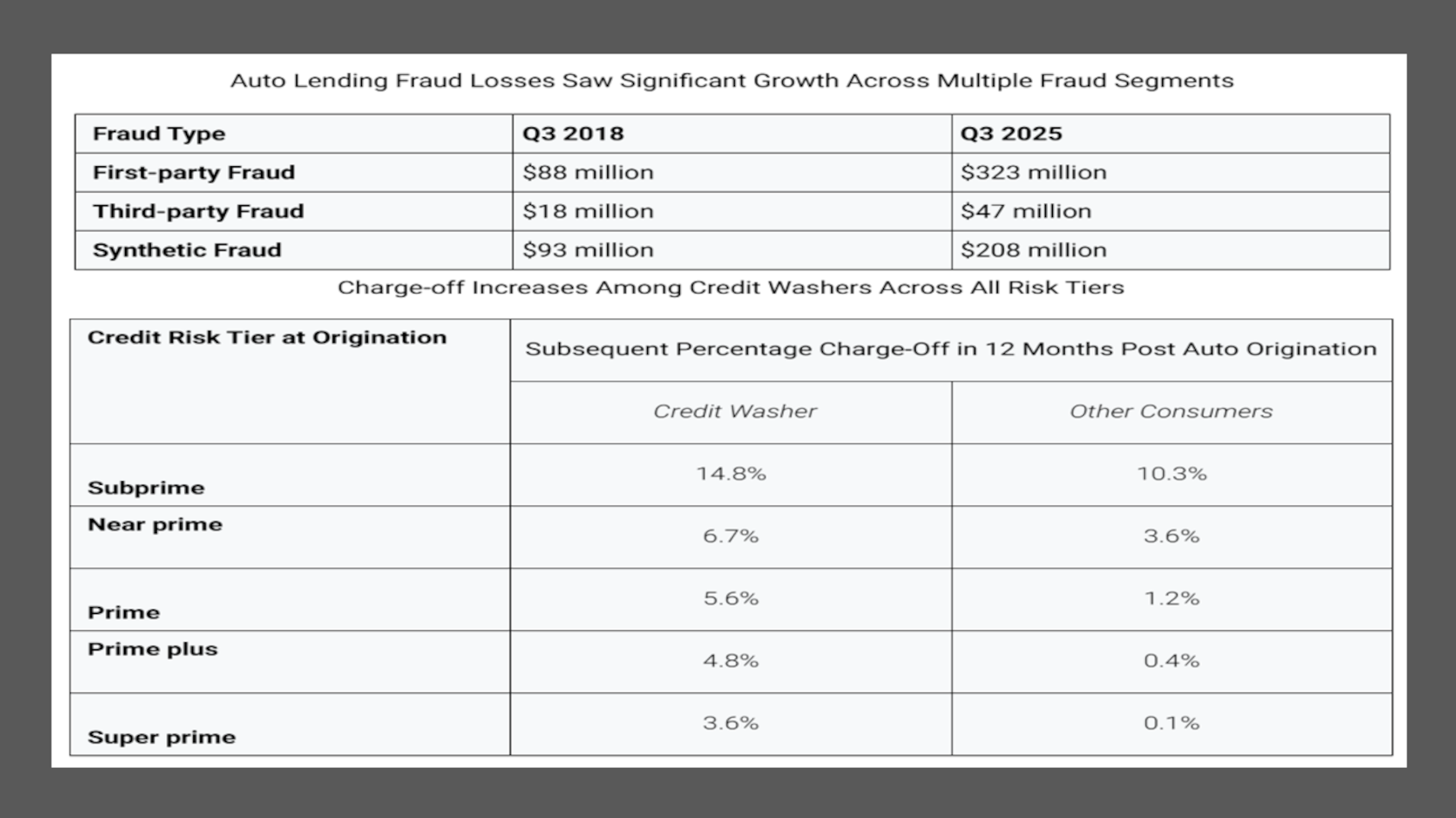
As a result, TransUnion indicated auto lenders are facing substantially higher fraud-related losses across multiple fraud categories. Between Q3 2018 and Q3 2025, losses tied to first-party, third-party and synthetic fraud increased significantly.
Experts explained first-party fraud, which occurs when an individual deliberately provides false information or misrepresents themselves to obtain goods, services or credit, generated the largest increase. They saw estimated losses rising from $88 million to $323 million — an increase of approximately 267% over that five-year period.
TransUnion pointed out that gaps in fraud detection, especially resolving identities, can create large charge-off losses by lenders and dealerships that most often are not found out until weeks or months later and are not recoverable.
Subscribe to Auto Remarketing to stay informed and stay ahead.
By subscribing, you agree to receive communications from Auto Remarketing and our partners in accordance with our Privacy Policy. We may share your information with select partners and sponsors who may contact you about their products and services. You may unsubscribe at any time.
“Fraudsters are becoming increasingly targeted and efficient,” said Satyan Merchant, senior vice president and automotive and mortgage business leader at TransUnion. “While fraud volume remains an important indicator of risk, we are seeing criminals drive significantly higher losses through fewer, more strategic attacks by targeting high-value opportunities and exploiting vulnerabilities across the lending lifecycle.
“For lenders, effectively managing fraud risk requires a comprehensive view of both frequency and financial impact — not only how often fraud occurs, but also the severity of each incident and its potential effect on the business,” Merchant continued.
Experts then explained that third-party fraud, which involves the use of another person’s identity without their knowledge or consent, is a clear example of the divergent trends of incidences and losses.
In auto lending, TransUnion recapped the incidence rate in Q3 2025 was less than half its Q3 2018 level, yet associated losses were 2.6 times higher.
Experts added that similar trends were observed for other types of fraud. They said these gaps show how fraudsters are becoming more strategic and executing fewer schemes while targeting larger loan balances and generating greater losses.
“Though less common, third-party fraud can produce substantial losses due to the high balances associated with fraudulent auto loans. Some of the largest losses occur among traditionally lower-risk, higher-credit tiers, where fraud incidence is lower, but loss severity is significantly higher,” TransUnion said.
Another threat is growing
But wait, there’s more percolating in the fraud world.
Beyond traditional fraud activity, TransUnion said lenders are also confronting emerging forms of identity and credit manipulation that can mask underlying risk.
TransUnion said that credit washing is creating new challenges by artificially enhancing the creditworthiness of some borrowers.
Experts explained credit washing conceals critical risk signals and undermines the accuracy of credit-based decisioning. Consumers with suppressed negative tradelines can exhibit risk levels similar to much lower credit tiers despite appearing prime or above prime at origination.
In some cases, TransUnion noted that these specific consumers are several times more likely to experience early charge-off in the 12 months following origination than borrowers without suppressed credit events.
“Credit washing is one of the more concerning emerging trends because it fundamentally distorts how lenders assess risk,” said Naureen Ali, U.S. head of fraud at TransUnion. “When negative credit information is removed or suppressed, consumers can appear more creditworthy than they really are, leading to a higher likelihood of early default.”
In 2025, TransUnion noticed roughly 5% of U.S. consumers have had charged-off accounts suppressed for atypical reasons, with an estimated $10 billion in debt erased from credit reports, creating disproportionate risk and decisioning blind spots.
Ali emphasized these findings reinforce the need for lenders to look beyond traditional credit attributes and incorporate deeper identity intelligence into their processes.
“The goal of fraud solutions like TransUnion’s suite of fraud solutions is to help lenders and dealers uncover and identify hidden risks,” Ali said. “Whether it is credit washing or identity-based fraud, by combining identity verification and linkage analytics, synthetic ID detection, and anomalies on the credit file, TransUnion can help lenders uncover those hidden risks earlier and allow lenders to make more informed lending decisions.”
To learn more about TransUnion’s fraud solutions and how they can help auto lenders uncover identity-related risks, detect fraud earlier and make more informed lending decisions throughout the account lifecycle, go to this website.