
VantageScore still sees ‘gradual migration’ of consumers into near-prime & subprime
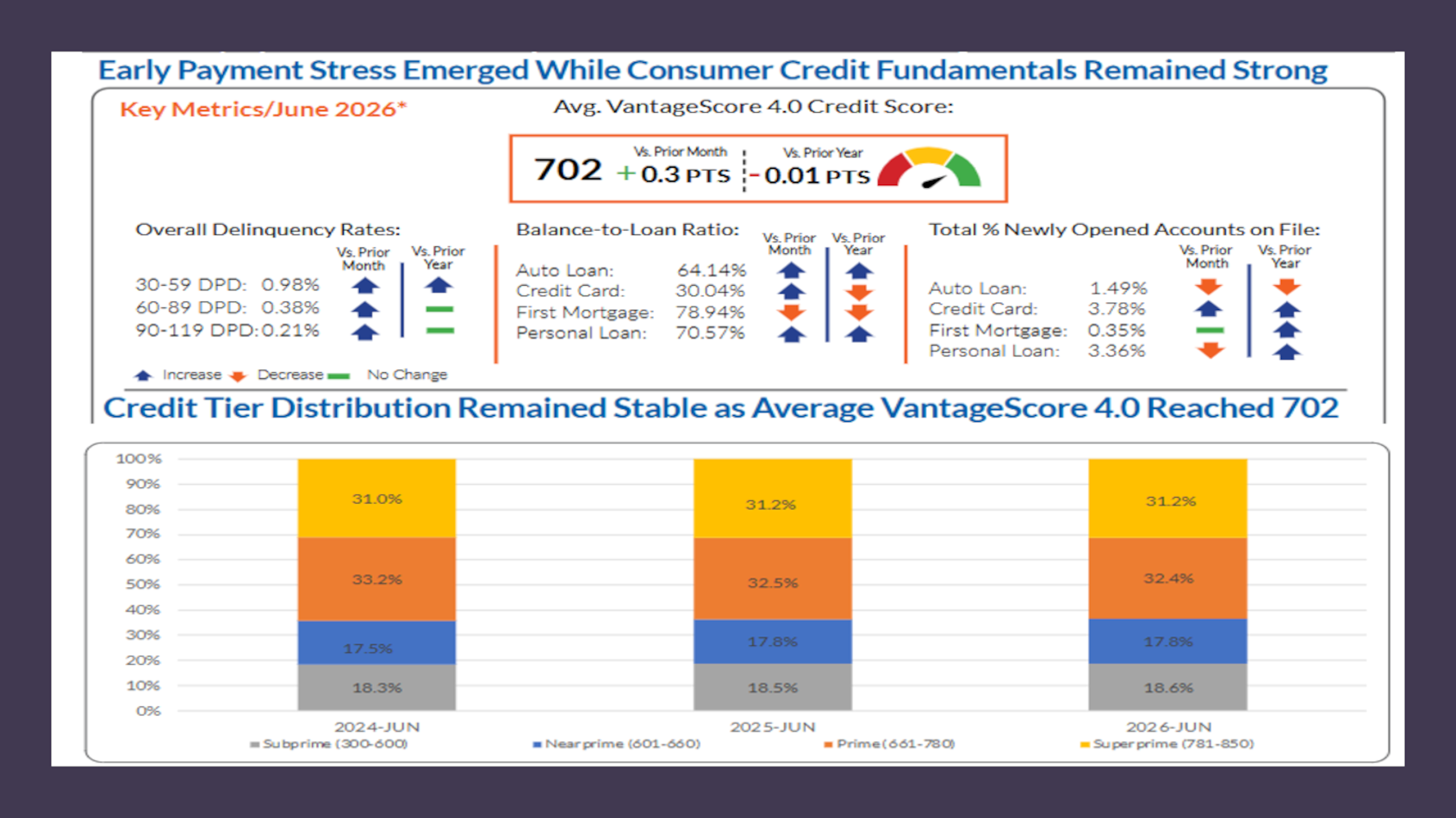
Charts courtesy of VantageScore.
By subscribing, you agree to receive communications from Auto Remarketing and our partners in accordance with our Privacy Policy. We may share your information with select partners and sponsors who may contact you about their products and services. You may unsubscribe at any time.
The average VantageScore 4.0 credit score ticked up in June, reversing the modest dip observed late last year and returning to its highest level in the past 12 months.
But analysts are also seeing the number consumers sliding into the near-prime and subprime credit tiers edging higher, too, according to the latest edition of CreditGauge released on Wednesday.
What analysts called the “gradual migration” of consumers from VantageScore Prime into the VantageScore Near-prime and VantageScore Subprime credit tiers continued in June.
While overall changes remained modest, VantageScore Prime and VantageScore Super-prime borrowers represented 63.6% of the scored population versus 63.7% a year earlier, while VantageScore Subprime increased from 18.5% to 18.6%.
“The continued shift toward lower VantageScore credit tiers suggests that some consumers are facing persistent affordability pressures, even as overall credit quality remains relatively resilient,” analysts said in their report.
Meanwhile, the average VantageScore 4.0 credit score increased one point to 702
Subscribe to Auto Remarketing to stay informed and stay ahead.
By subscribing, you agree to receive communications from Auto Remarketing and our partners in accordance with our Privacy Policy. We may share your information with select partners and sponsors who may contact you about their products and services. You may unsubscribe at any time.
“Although pockets of stress persist in certain segments, our June analysis indicates that most consumers are managing their credit responsibly and maintaining good credit health,”, VantageScore executive vice president and chief digital and insights officer Atif Mirza said in a news release.
“Between the positive employment picture and healthy household balance sheets, consumers are looking strong heading into the second half of 2026,” Mirza added.
Going back to the report for a closer look at auto finance, VantageScore found that the average auto loan balance rose to $25,200 in June, increasing modestly month-over-month ($117). It’s also 2.6% or $649 higher year-over-year.
Analysts pointed out the balance-to-loan ratio also ticked up by 0.08% to 64.14% in June 2026 and is now 0.28% above year-ago levels.
“This suggests that borrowers continued to finance a larger share of vehicle purchases amid elevated vehicle prices,” VantageScore said, adding that the balance-to-loan ratio reflects the average balance-to-loan amount on open and active installment accounts.
Month-over-month, analysts determined auto-loan originations were relatively stable across generations in June. Gen X posted a modest increase (0.06%), while Silent, Boomers and Millennials remained flat and Gen Z experienced slight declines (0.1%) compared to May.
Year-over-year, VantageScore mentioned auto-loan originations remained below June 2025 levels across every generation, with the largest declines among Gen Z (down 0.3%).
And on the back end of auto financing, VantageScore indicated the rate of auto loans between 30 and 59 days delinquent ticked up to 2.30%, joining mortgages in an upward trajectory while delinquency among credit cards eased and personal loans stayed flate.
“The divergence suggests early stage stress is building more in secured lending than in revolving/unsecured credit, even as overall levels remained low by historical standards,” analysts said.