
Record positive trade equity of certain models helping to overcome some car-business headwinds
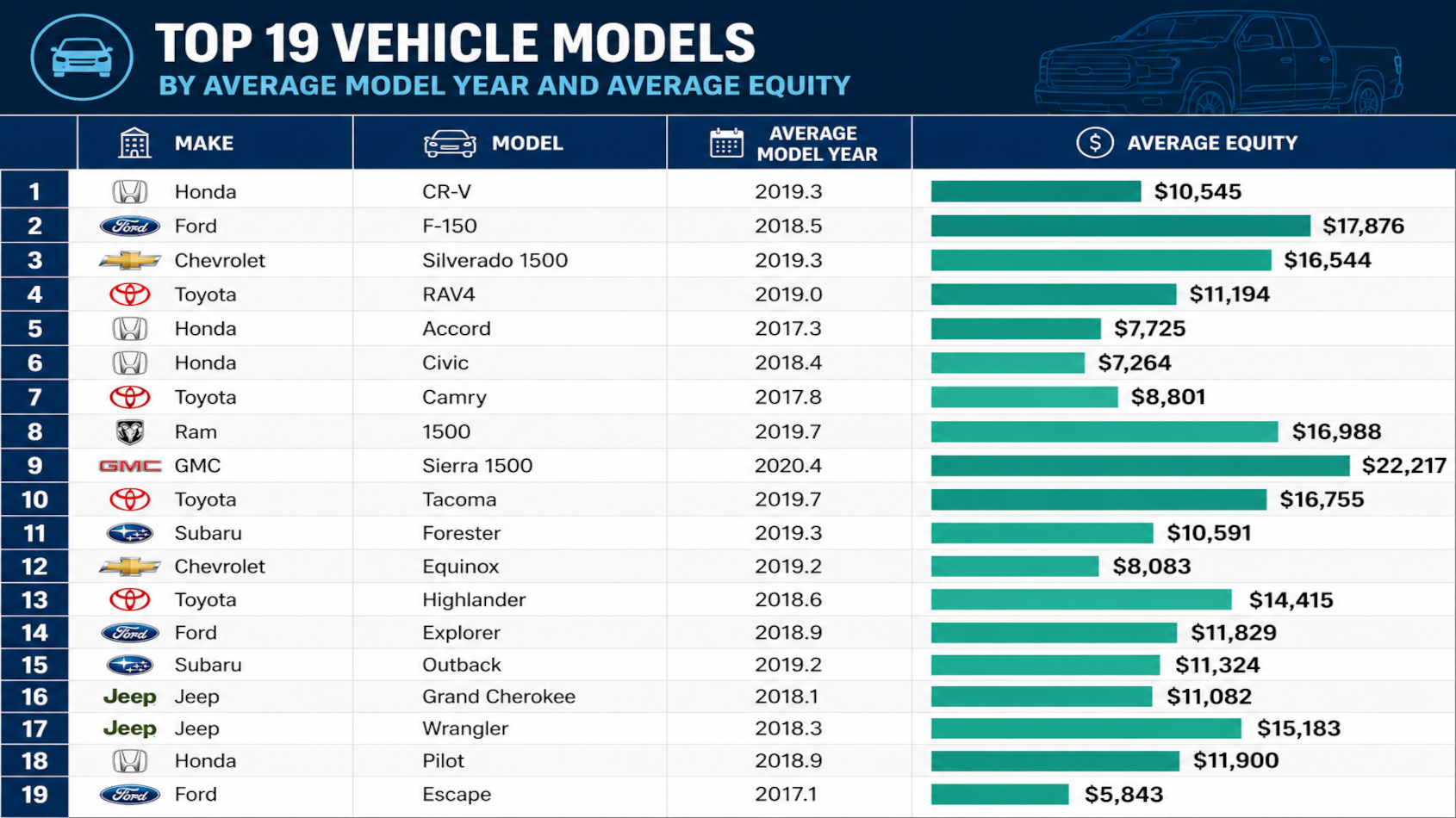
Graphic created using Edmunds data and ChatGPT.
By subscribing, you agree to receive communications from Auto Remarketing and our partners in accordance with our Privacy Policy. We may share your information with select partners and sponsors who may contact you about their products and services. You may unsubscribe at any time.
Perhaps your July auto financing and retailing activity rounded out with some deals coming together via a trade that included positive equity.
Those deals might have included some of the models that Edmunds highlighted recently that created a new record for the average amount of positive equity in trade-ins toward new-vehicle purchases during the second quarter.
The new mark topped $13,330 in Q2, propelled by full-size pickups like the Ford F-150, Chevrolet Silverado 1500, GMC Sierra 1500, and RAM 1500 as well as the Toyota Camry, Highlander, and RAV4, the Honda Accord, Civic and CR-V, and Subaru Forester.
“Trading in a car used to be pretty straightforward. You knew roughly what you’d get, somewhere in the $6,000 to $8,000 range, and you planned around it,” Edmunds’ director of insights Ivan Drury wrote in an online analysis. “Then COVID hit and the whole market turned upside down. Factories couldn’t get chips. New cars were on hold waiting to be finished. Used vehicles started fetching prices that looked like typos. They weren’t, though. There just wasn’t anything else on the lot.
“New data from Edmunds shows the average amount of positive equity in trade-ins toward new-vehicle purchases topped a new record of $13,330 in Q2 2026 — nearly double the figure prior to the pandemic — and continues to hold near record-high territory even as the market conditions that sparked the surge have normalized,” Drury continued.
“The story isn’t simply that equity went up. It’s that it has stayed up,” he added.
Subscribe to Auto Remarketing to stay informed and stay ahead.
By subscribing, you agree to receive communications from Auto Remarketing and our partners in accordance with our Privacy Policy. We may share your information with select partners and sponsors who may contact you about their products and services. You may unsubscribe at any time.
The positive equity story was certainly a positive characteristic for the car business going into the close of last month, as Cox Automotive senior economist Charlie Chesbrough noted.
“July sales are holding up despite significant economic uncertainty,” Chesbrough said in a news release distributed last week. “Stubbornly high gas prices — with no relief in sight — and historically weak consumer confidence have not discouraged new-vehicle buyers, as might be expected. The market today is being driven by more affluent buyers, so they may be less impacted by inflationary pressures and economic uncertainty. If the economy and stock market can maintain their current growing but volatile path, vehicle sales will likely follow.”
And while Chesbrough referenced the wealthy, Drury emphasized the prudent moves made by “average car buyers” that have put them in a record-setting equity positions.
“It’s easy to assume that record-breaking equity figures are driven entirely by ultra-luxury vehicles, cash buyers, or high-end models traded in after short 36-to-48-month loan terms. While those expensive, newer vehicles certainly sit on the highest individual dollar amounts, they aren’t the heart of the market,” Drury wrote.
“The true story of today’s equity surge belongs to everyday drivers in ordinary mainstream cars,” he continued. “The most frequent and consistent winners in today’s market are owners trading in ‘normal’ vehicles around 7 years old. Drivers who bought mass-market models around 2019 — and signed up for conventional 60- or 72-month financing — have largely cleared the depreciation curve. Because secondary-market values for reliable used vehicles remain historically elevated, these average owners are routinely walking onto dealer lots with about $13,000 in positive equity.
“For the average consumer who bought a solid mainstream car, paid their loan down under reasonable rates, and kept it running smoothly, the math has worked out in their favor. They might not realize it yet, but their reliable daily driver has turned out to be one of the best financial buffers they’ve had in years,” Drury went on to say.