TransUnion: Used-car loans with LTVs at 140% or higher quadruple in past five years
Charts courtesy of TransUnion.
By subscribing, you agree to receive communications from Auto Remarketing and our partners in accordance with our Privacy Policy. We may share your information with select partners and sponsors who may contact you about their products and services. You may unsubscribe at any time.
Perhaps this data point shared by TransUnion on Thursday epitomizes how much used-car financing has changed during the past five years.
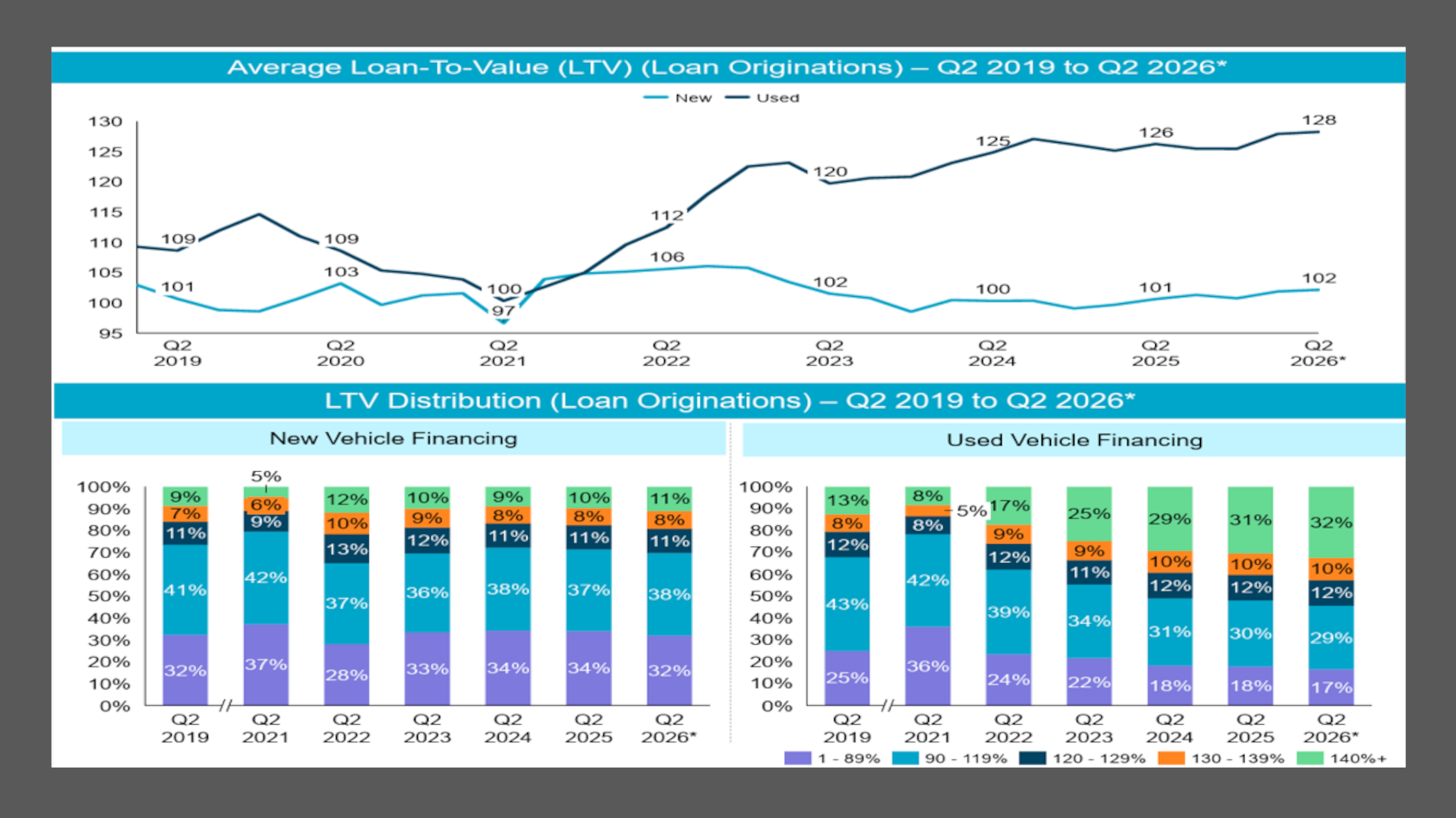
In the auto-finance segment of TransUnion’s Q2 2026 Credit Industry Insights Report (CIIR), analysts indicated that just 8% of used-car financing originations in the second quarter of 2021 were booked with a loan-to-value ratio of 140% or higher.
According to the data available from the second quarter of this year, TransUnion reported that metric quadrupled to 32%.
And, yes, LTVs in new-car financing are significantly different, too.
TransUnion indicated 5% of new-car loans originated in Q2 of 2021 had LTVs at 140% or higher. That’s more than doubled to 11% in the second quarter of this year.
Even with finance companies absorbing additional risk, TransUnion noticed that affordability continues to be an industry headwind.
Subscribe to Auto Remarketing to stay informed and stay ahead.
By subscribing, you agree to receive communications from Auto Remarketing and our partners in accordance with our Privacy Policy. We may share your information with select partners and sponsors who may contact you about their products and services. You may unsubscribe at any time.
Analysts calculated monthly payments are up 38.7% for new vehicles and 39.6% for used vehicles since 2019.
“Payment growth continues to outpace both inflation and wage gains, even as interest rates have moderated and loan terms have lengthened,” TransUnion said in a news release about some of the many topics likely to be covered during Used Car Week, which starts on Nov. 16 in San Diego.
Meanwhile, portfolio health is mixed, based on TransUnion information.
Loans in delinquency for 60 days or more remained elevated in Q2 at 1.33%. That’s 2 basis points higher year-over-year.
Independent lenders, which typically book the most subprime paper, had the highest rate of serious delinquency, with their rate sitting at 2.82% in the second quarter, according to TransUnion tracking. The rate for banks stood at 1.52%, with the readings for captives and credit unions coming at 0.81% and 0.78%, respectively.
“Serious account-level auto delinquency (is) reflecting ongoing pressure from higher vehicle ownership costs. However, the pace of deterioration has slowed, suggesting credit performance may be stabilizing,” TransUnion said.
Viewed one quarter in arrears to account for a reporting lag, TransUnion found auto originations increased 1.3% year-over-year to 6.4 million in Q1. Satyan Merchant explained the modest growth reflects the continued pullback in demand for new vehicles as more consumers are opting for used vehicles.
“Consumers are continuing to adjust to a vehicle market where affordability remains a key consideration,” said Merchant, one of this year’s Automotive Intelligence Award recipients and senior vice president and automotive and mortgage business leader for TransUnion. “Higher vehicle operation costs are increasing focus on total cost of ownership, contributing to demand for used vehicles and other budget-conscious alternatives.
“While the expiration of EV tax credits has raised purchase costs for some consumers, improving vehicle affordability and elevated fuel prices continue to support the appeal of electric vehicles,” he continued. “As market conditions evolve, lenders and dealers that can provide affordable options for consumers will be best positioned to capture demand and drive growth.”
Overall credit conditions
TransUnion said consumer credit remains widely available despite economic uncertainty, while credit usage continues to grow at a pace largely consistent with inflation.
Analysts noticed consumer access to credit continued to expand in Q2, with a little less than 262 million consumers carrying a credit balance.
TransUnion added that total outstanding balances also grew steadily, reflecting broader credit participation and borrowing patterns consistent with recent years.
“This continued expansion in credit access shows that lenders are still extending credit broadly across the market,” said Jason Laky, executive vice president and head of financial services at TransUnion. “Lenders are managing risk through the use of strategies such as smaller credit lines, which allows them to continue expanding access to credit while navigating a complex economic environment.”
TransUnion calculated that average non-mortgage minimum payments — which is the average total amount due per month for all credit accounts except mortgage — have been modest across all credit risk tiers.
The metric is up between 1 and 3 percent year-over-year for all categories except the prime tier, which climbed by 3.5%.
Analysts explained this development indicates that debt obligations have increased at a manageable pace for most consumers, and generally below the recent rate of inflation.
Together, TransUnion said these trends indicate that broader credit availability has not led to excessive consumer debt burdens.
“While affordability pressures continue to weigh on many households, consumers appear to be managing credit obligations with relative discipline, as evidenced by modest growth in non-mortgage minimum payments and generally stable balance-level delinquency rates,” said Michele Raneri, vice president and head of U.S. research and consulting at TransUnion.
“Although some consumers may be experiencing financial challenges, the broader credit picture suggests that balance growth has generally remained aligned with consumers’ ability to service their debt,” Raneri went on to say.
To learn more about the latest consumer credit trends from TransUnion, register for its quarterly webinar here.