
Edmunds on depth of ‘The Vanishing Affordable Used Car’
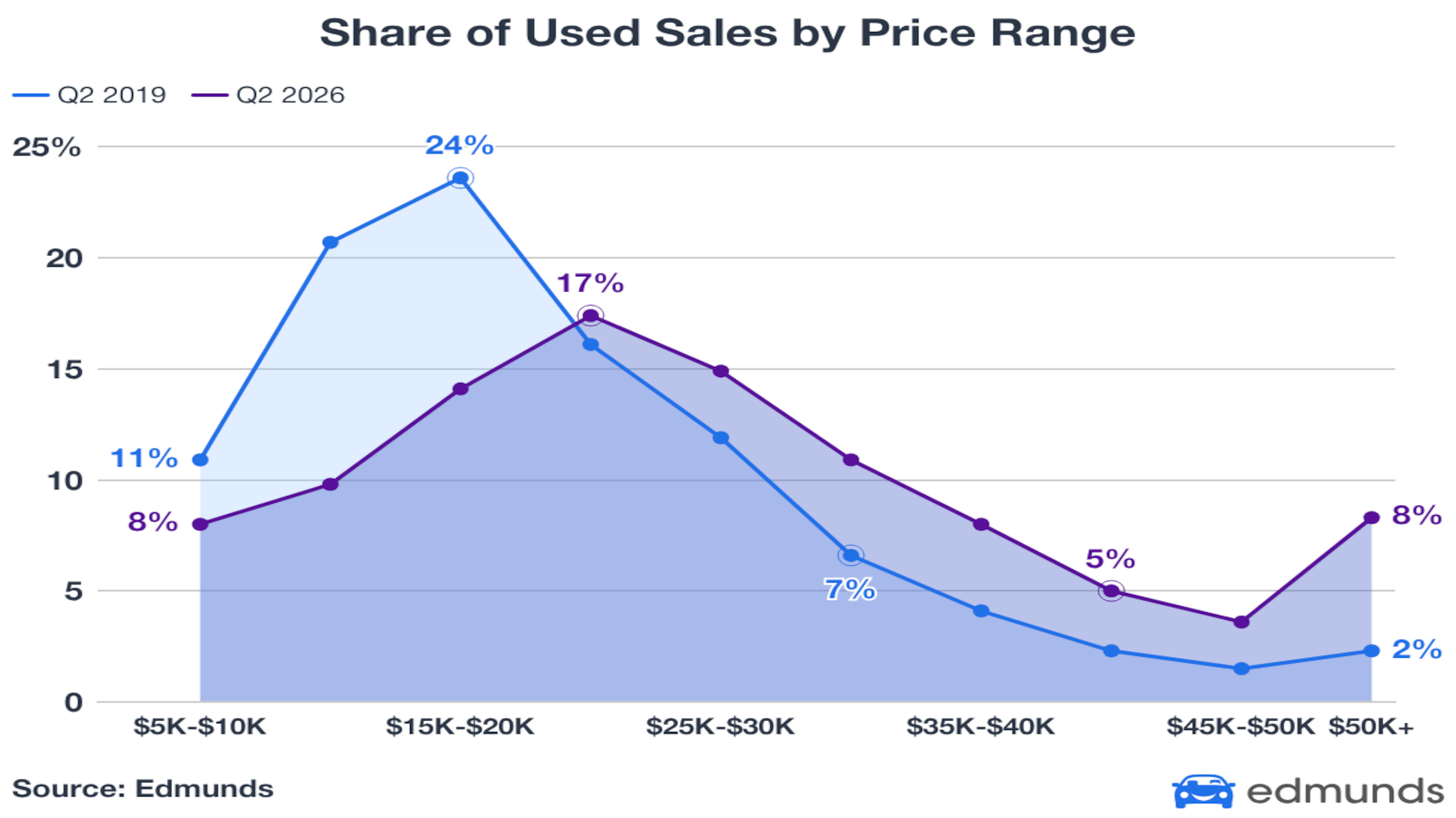
Graphic courtesy of Edmunds.
By subscribing, you agree to receive communications from Auto Remarketing and our partners in accordance with our Privacy Policy. We may share your information with select partners and sponsors who may contact you about their products and services. You may unsubscribe at any time.
Edmunds brought more interesting data to support the title of latest quarterly used-car report that highlighted how challenging it can be to get deals done with consumers who are not flush with cash or available credit.
With the appropriate title, “The Vanishing Affordable Used Car,” Edmunds highlighted that the “most striking shift in the used market” is happening below $20,000.
In the second quarter of 2019, Edmunds said vehicles that retailed for less than $20,000 accounted for 55.2% of all used sales. In Q2 of this year, analysts noticed that share fell to 31.8%.
Edmunds pointed out other comparisons over the same period tell a similar story.
The share of vehicles retailed for less than $15,000 dropped by nearly half, sliding from 31.6% to 17.8%, while the share of vehicles sold for $50,000 and higher nearly quadrupled, climbing from 2.3% to 8.3%.
“These shifts aren’t simply the result of shoppers moving upmarket,” wrote report author Ivan Drury, who is director of insights for Edmunds. “They reflect years of price appreciation stemming from a drought of used inventory that has pushed many mainstream used vehicles into higher price brackets, leaving far fewer affordable options than were available just seven years ago.”
Subscribe to Auto Remarketing to stay informed and stay ahead.
By subscribing, you agree to receive communications from Auto Remarketing and our partners in accordance with our Privacy Policy. We may share your information with select partners and sponsors who may contact you about their products and services. You may unsubscribe at any time.
OK, so let’s suppose a dealer has a vehicle with a retail price of less than $15,000 and financing is needed to complete the delivery. What are the collateral details being considered by the lender’s underwriting department?
Edmunds determined the average vehicle sold in the $10,000 to $15,000 range during the second quarter was 8.7 years old and had 98,222 miles.
In Q2 2019, Edmunds indicated that same budget bought a 4.7-year-old vehicle with 58,250 miles.
“In other words, a $10,000-15,000 budget now buys a vehicle that’s four years older and has roughly 40,000 additional miles on the odometer,” Drury wrote in the report.
Edmunds explained the trend extends across every affordable price range in the used market.
In the $15,000-$20,000 price range, the average vehicle age has climbed from 3.4 years to 6 years, while the average mileage has climbed from 41,851 to 71,192.
Even vehicles priced between $5,000 and $10,000 are getting older, with the average age rising from 8.1 years to 10.7 years and typical mileage now exceeding 120,000 miles.
And, not surprisingly, the most affordable used vehicles also continue to sell quickly.
According to Edmunds tracking, vehicles retailed for between $5,000 and $10,000 spent an average of just 25 days on dealer lots in Q2, the fastest of any price range and well ahead of the 44 days it took to sell a used vehicle priced above $50,000.
“For shoppers, that means well-priced, affordable vehicles often don’t stay on the lot for long, leaving little time to wait for a price drop or negotiate a better deal,” Drury wrote.
Quite the challenge, indeed. It’s why Used Car Week will have a panel discussion specifically about this topic, featuring another member of Edmunds’ roster of experts.
Edmunds’ consumer insights analyst Joseph Yoon, along with Laura Wehunt of Black Book and T.J. Cox of TransUnion, are scheduled to appear on a panel focused on affordability during Used Car Week, which begins on Nov. 16 in San Diego.
But until then, dealers still have customers to serve, and lenders still have contracts to book within this part of the used-car market.
After Edmunds analyzed the top 15 most frequently purchased brands in the $15,000 to $20,000 price range, Drury noted that shoppers can choose between a 3-year-old Kia with less than 50,000 miles and a 7-year-old Toyota with more than 85,000 miles.
“Neither choice is inherently better, but the trade-offs are significant,” Drury wrote. “Brands with stronger resale values, along with many luxury brands with long-tailed depreciation, command higher prices on the used market.
“As a result, lower-priced inventory from those brands tends to skew significantly older and higher in mileage than similarly priced vehicles from brands that depreciate more quickly or have lower starting prices. Shoppers willing to consider a Kia, Hyundai or Nissan may find significantly newer vehicles at the same price point, sometimes with coverage from a factory warranty still remaining,” he said.
“Conventional wisdom to ‘just buy a used Toyota’ comes with trade-offs in today’s market,” he went on to say. “For many shoppers, a newer, lower-mileage vehicle from a brand that depreciates more quickly may offer better overall value, particularly when factoring in a remaining warranty, fewer near-term repair needs, and more modern safety features.”