
FICO explains reasons for slight dip in average credit scores within auto
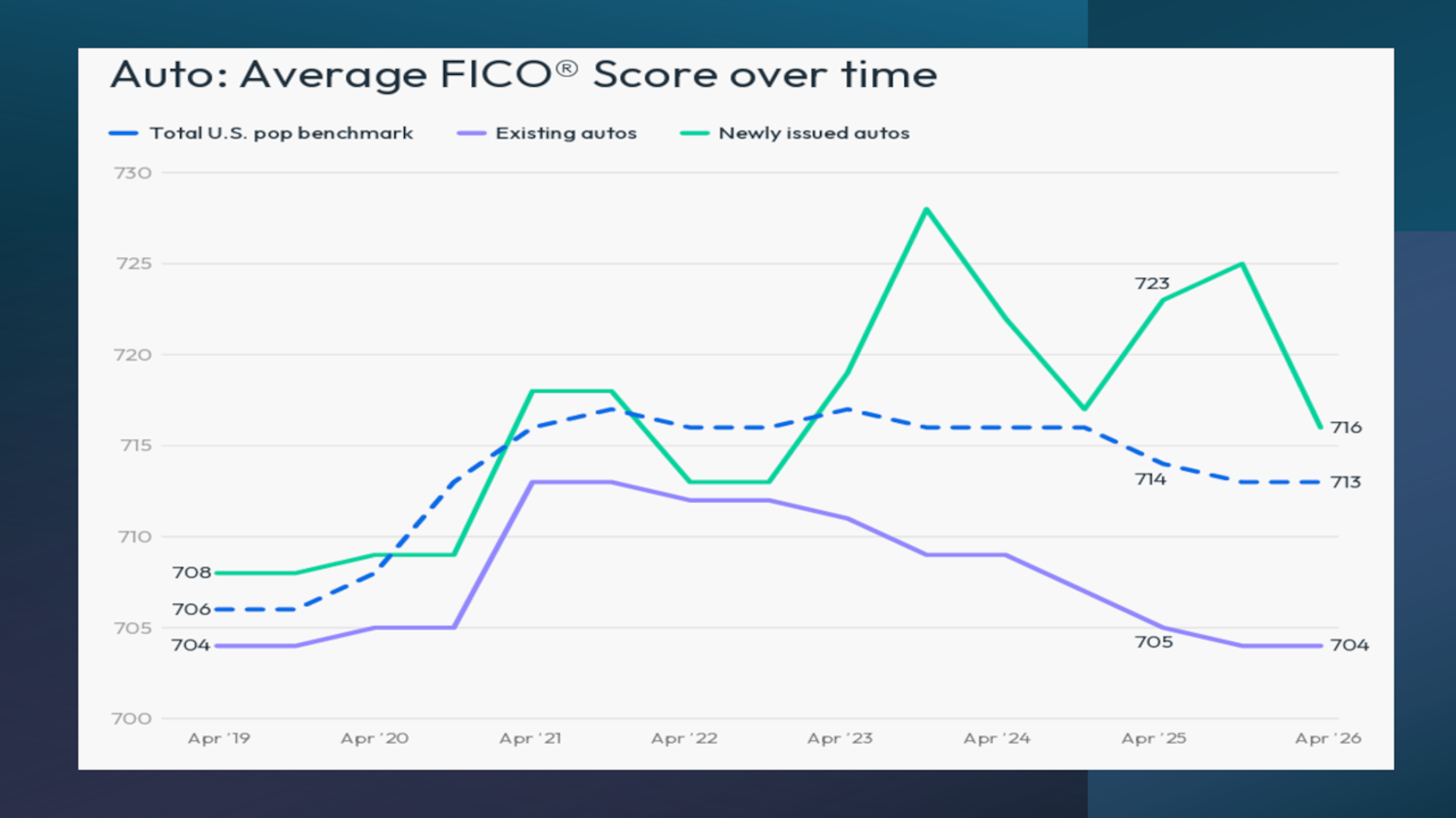
Chart courtesy of FICO.
By subscribing, you agree to receive communications from Auto Remarketing and our partners in accordance with our Privacy Policy. We may share your information with select partners and sponsors who may contact you about their products and services. You may unsubscribe at any time.
As the average U.S. FICO score has held steady, the auto-finance portion of the fall edition of the FICO Score Credit Insights report released on Tuesday revealed a slightly different situation.
Analysts indicated the average FICO core for newly issued auto finance loans slipped to 716 in April from 723 in April of last year.
“A lower average origination score is consistent with more lower-scoring applicants being approved, extending access further down the score distribution,” FICO said in the report. “This is occurring even as elevated vehicle prices and persistently high APRs continue to constrain affordability and have contributed to softer purchasing during the first four months of the year.”
Meanwhile, analysts pointed out the average FICO Score for existing auto finance loans remains at 704, down 1 point year-over-year and equal to the pre-pandemic score of 704.
FICO highlighted that broader credit availability has not translated into broad deterioration in repayment performance.
At least so far, according to information in FICO’s report, which also is available online.
Subscribe to Auto Remarketing to stay informed and stay ahead.
By subscribing, you agree to receive communications from Auto Remarketing and our partners in accordance with our Privacy Policy. We may share your information with select partners and sponsors who may contact you about their products and services. You may unsubscribe at any time.
“With the new current-month methodology, auto delinquency is more visibly seasonal, but across every bucket it has held stable for two years,” analysts said in the report, noting that the 30-day rate eased 5 basis points year-over-year to 2.6%.
FICO noted that rate remains well below the Great Recession peak of 3.5%.
However, analysts acknowledged the 60- and 90-day rates, at 0.9% and 0.4%, respectively sit marginally above that “stressed” period.
“The takeaway for lenders is a familiar one: Resolving delinquency early, before a borrower falls too far behind to recover, is what keeps this stability intact,” FICO said.
Analysts explained that underneath that steadiness in delinquency, though, the cost of financing a car has been climbing faster than prices generally.
“After a steep rise in prices from 2021 to 2022, the amount that consumers financed with auto loans grew faster than inflation. Fortunately, consumers in higher score bands have seen the rate of growth slow in recent years and close the gap,” FICO said.
“Furthermore, the average monthly payment for newly issued auto loans has grown slightly faster than overall balances and faster than inflation,” analysts continued. “The average monthly payment on new loans increased rapidly between 2021 and 2023, then flattened between 2023 and 2025 due to the major slowdown in consumers purchasing vehicles and the price reset that occurred during that period.”
Analysts reiterated that FICO Auto Score 8 is used for all analysis in this report pertaining to auto. The score for existing autos is the score calculated as of April in that year. The score for newly issued autos is the score calculated as of January in that year, so that newly issued autos can be identified from February through April of that year.
The definition of “existing” and “newly issued” is similar for the other products in this report. The auto delinquency rates above calculate the number of consumers who have a 30, 60, or 90 days past due delinquency on an auto in the current month divided by the number of consumers with an open auto. This is similar for the other products in this report.
Auto finance balances are calculated by identifying the population of consumers with an open auto finance loan in a given score range, and then taking the average of each consumer’s sum of all balances on open auto finance loans. The percentage change in auto finance balances is then the percent difference in balance between that year’s average balance and April 2019’s average balance. FICO said this is similar for the other products in the report.
How credit scores look in the overall market
As mentioned, analysts indicated that the average U.S. FICO Score held steady at 714, unchanged since October but down one point from a year ago, as student loan delinquency reporting matures and improving delinquency rates across every major loan type offset ongoing affordability pressure.
Key findings from the FICO Score Credit Insights report included:
—Average FICO score holds at 714: The national average FICOs core was flat from October to April, down 1 point year-over-year. That stability carries echoes of the K-shaped economy we reported in previous reports.
—Delinquencies stable or improving across most products: Early-stage mortgage delinquency eased from 1.42% to 1.35% year-over-year, and auto 30-day delinquency improved five basis points to 2.6%. Bankcard and personal loan delinquency were largely unchanged.
—Mortgage affordability pressures persist: the average monthly payment for a first-time homebuyer reached $2,563, a 57% increase since 2019 that has outpaced inflation since rates began climbing in 2022.
—Younger generations continue to build credit strength: Gen Z and Millennials have posted the largest FICO® Score gains since before the pandemic — up 17 and 10 points, respectively — continuing a multi-year trend of building credit history and habits.
—Pressure concentrated among lower-scoring borrowers: Mortgage balances for borrowers with FICO scores below 620 have grown 43% since April 2019, and auto loan balances for the lowest-scoring borrowers are up 36% — both outpacing the 30% inflation rate over the same period while higher-scoring borrowers tracked closer to it. That cost pressure is showing up in performance: subsequent 90-day-plus delinquency rates for both mortgage and auto rose exclusively in the lowest score bands, holding flat across every higher score range.
—Student loan borrowers show diverging paths: Approximately 3.2 million consumers with a payment due had a recent student-loan delinquency and experienced an average 38-point year-over-year decline in their FICO score, while consistent payers gained 6 points and those without recent delinquency gained 16 points.
With FICO Scores used by 90% of top U.S. lenders, the findings from the bi-annual FICO Score Credit Insights report are designed to offer critical observations insight into where consumer credit health is holding firm, where affordability pressure is concentrated, and how lenders can identify responsible growth opportunities across an increasingly segmented credit landscape.
“Affordability is the defining story in our latest edition of the FICO Score Credit Insights report,” said Ethan Dornhelm, head of scores analytics at FICO. “Costs have risen across nearly every credit product consumers use, and yet delinquency has improved or held steady across every major loan type.
“The stability of the national average FICO Score at 714 reflects the resilience many consumers continue to demonstrate. At the same time, the data shows that resilience isn’t being tested equally, with lower-scoring and thin-file borrowers facing the greatest pressure,” Dornhelm continued in a news release.
Consumers remain engaged with their credit
Another segment of the report highlighted new consumer research conducted by The Harris Poll on behalf of FICO.
Those particular findings showed Americans remain highly engaged in managing their credit, with 84% saying maintaining or enhancing their credit score is a priority for 2027 and 89% have taken at least one step in the past year to improve their financial health, most commonly checking their credit score (56%, up from 49% in 2024).
Researchers also found that 72% of Americans check their score multiple times a year or more often.
Despite the engagement, researchers also noticed knowledge gaps and credit myths persist as more than 1 in 4 (27%) believe checking your credit score lowers it, and nearly two-thirds (65%) either incorrectly believe income factors into a credit score or are unsure.
FICO pointed out that affordability challenges are also showing up in consumer credit behavior, as one in five Americans (20%) say they made less than the minimum payment or skipped a payment on a credit card or loan in the past year.
Those pressures are also driving alternative financial behaviors. The data showed that roughly 2 in 5 Americans (41%) currently use Buy Now, Pay Later (BNPL) services, with nearly a third of those users (30%) utilizing them more than a year ago. Usage is most prominent among Gen Z (ages 18-29) and Millennials (ages 30-45), as they are about twice as likely as Gen X (ages 46-61) and Baby Boomers (ages 62-80) to use BNPL services (66% and 57% vs. 32% and 16%).
Financial flexibility during tight budget periods (36%), convenience (35%), and preserving cash for other expenses (32%) are top reasons why BNPL users utilize these services. That same financial reality extends beyond credit products as more than a third of Americans (37%) say they rely on others for ongoing financial support, most commonly their parents (19%), underscoring how interconnected financial stability and credit health are for younger generations.
“Consumers are more engaged with their credit than ever, but engagement alone doesn’t guarantee understanding,” said Jenelle Dito, vice president of consumer empowerment programs and partnerships at FICO. “At FICO, we’re committed to helping consumers turn that engagement into informed action. Simple actions such as paying on time and keeping balances low are two of the most powerful things anyone can do to strengthen their FICO score.
“The data shows Americans are motivated. Pairing that motivation with the right knowledge puts consumers in better control of their financial health,” Dito went on to say.