
Experian examines subprime growth through first 6 months of year
Charts courtesy of Experian.
By subscribing, you agree to receive communications from Auto Remarketing and our partners in accordance with our Privacy Policy. We may share your information with select partners and sponsors who may contact you about their products and services. You may unsubscribe at any time.
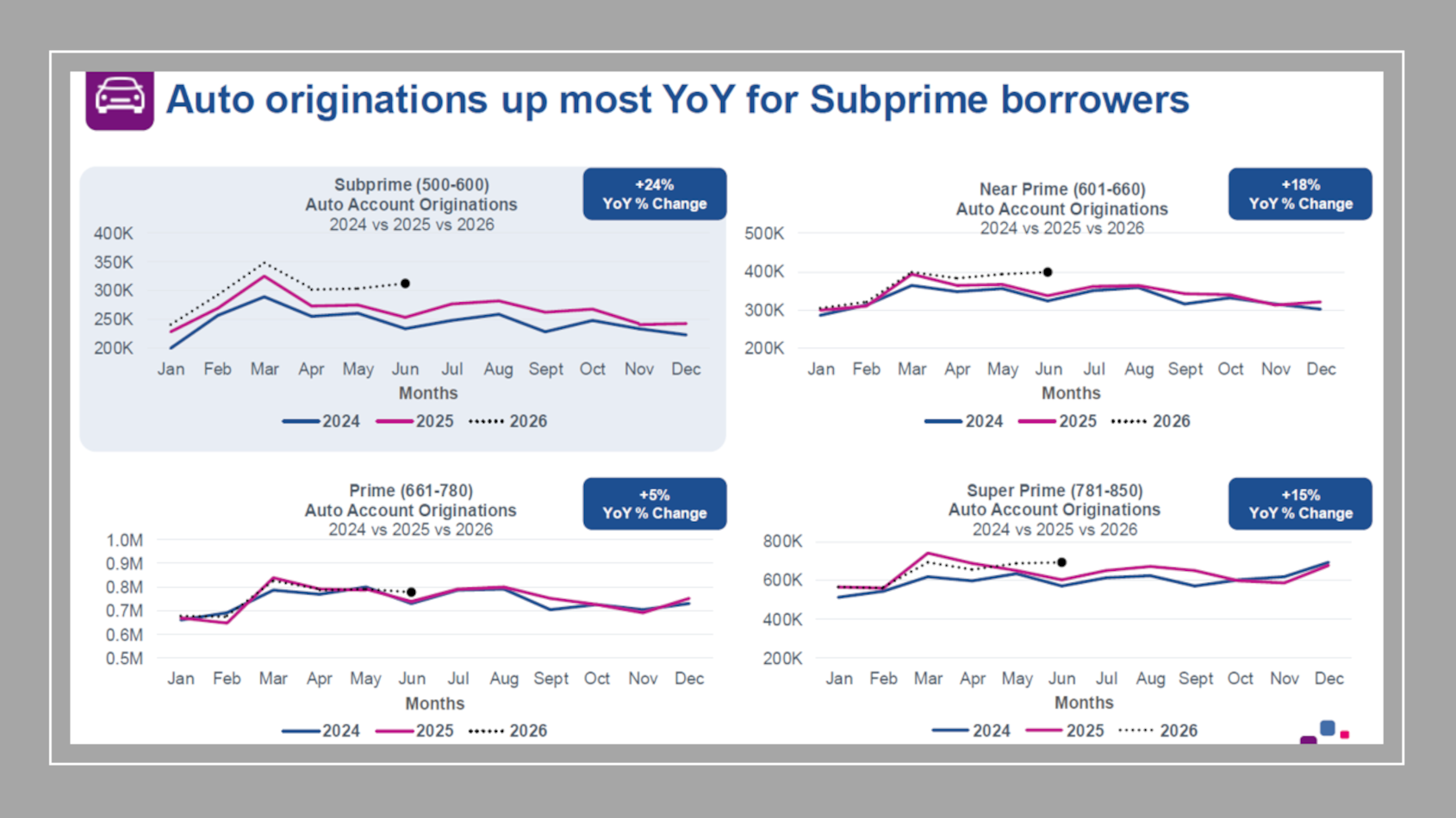
Auto lenders are absorbing more risk so far this year, based on what Experian said through its Q3 2026 Lending Conditions Chartbook released on Tuesday.
Through the first half of 2026, subprime originations are up 24% year-over-year, and near-prime originations are 18% higher, based on the same comparison.
But lenders are also booking higher-quality paper, too, since Experian found that origination volume in the super-prime category is up by 15% year-over-year.
Meanwhile, Experian pointed out in the report that origination volumes for captives and credit unions are 5% higher year-over-year, while the pace of origination for large regional banks is off by 7%.
Analysts added that contract holders are getting younger since Gen Z origination volume in auto is up 23% year-over-year.
And here’s another key point in the auto portion of the Lending Conditions Chartbook. Experian reported 60-day delinquencies dipped during each of the first six months of 2026.
Subscribe to Auto Remarketing to stay informed and stay ahead.
By subscribing, you agree to receive communications from Auto Remarketing and our partners in accordance with our Privacy Policy. We may share your information with select partners and sponsors who may contact you about their products and services. You may unsubscribe at any time.
Experian North America chief economist Joseph Mayans and senior economic analyst Josee Farmer highlighted the quarterly Lending Conditions Chartbook captures key trends important for the financial services industry.
“By bringing together Experian-only and external-market data sets on the economy, credit activity, lending standards, loan demand, originations, delinquency, and consumer sentiment, this report provides a broad view of what is happening in the credit environment,” Mayans and Farmer said in the report, which also included their discussions about the Federal Reserve, inflation, employment, and more.
Here are some of their other insights:
“Fed officials lifted their outlook for economic growth, inflation, and the path of interest rates and lowered their projection for unemployment at their latest meeting in September,” Mayans and Farmer said in the report. While the economy continues to grow at a solid pace, it faces a number of headwinds, including a higher-rate environment, ongoing geopolitical conflict in the Middle East, which continues to impact energy prices, and a heavy reliance on AI investment and related equity market gains.
“The labor market appears on solid footing, but headline figures mask some underlying stress. While the unemployment rate has declined, people are remaining unemployed longer and the white-collar, higher-educated components of the workforce are finding it more challenging to land a job,” they continued.
“Despite higher-than-expected inflationary pressures and elevated interest rates, the lending environment remains relatively stable. While lenders have become more cautious in recent months and interest rate sensitive areas like housing are still struggling, the overall market appears poised for continued growth,” Mayans and Farmer went on to say.