Affordability continues to permeate VantageScore’s monthly credit discussions
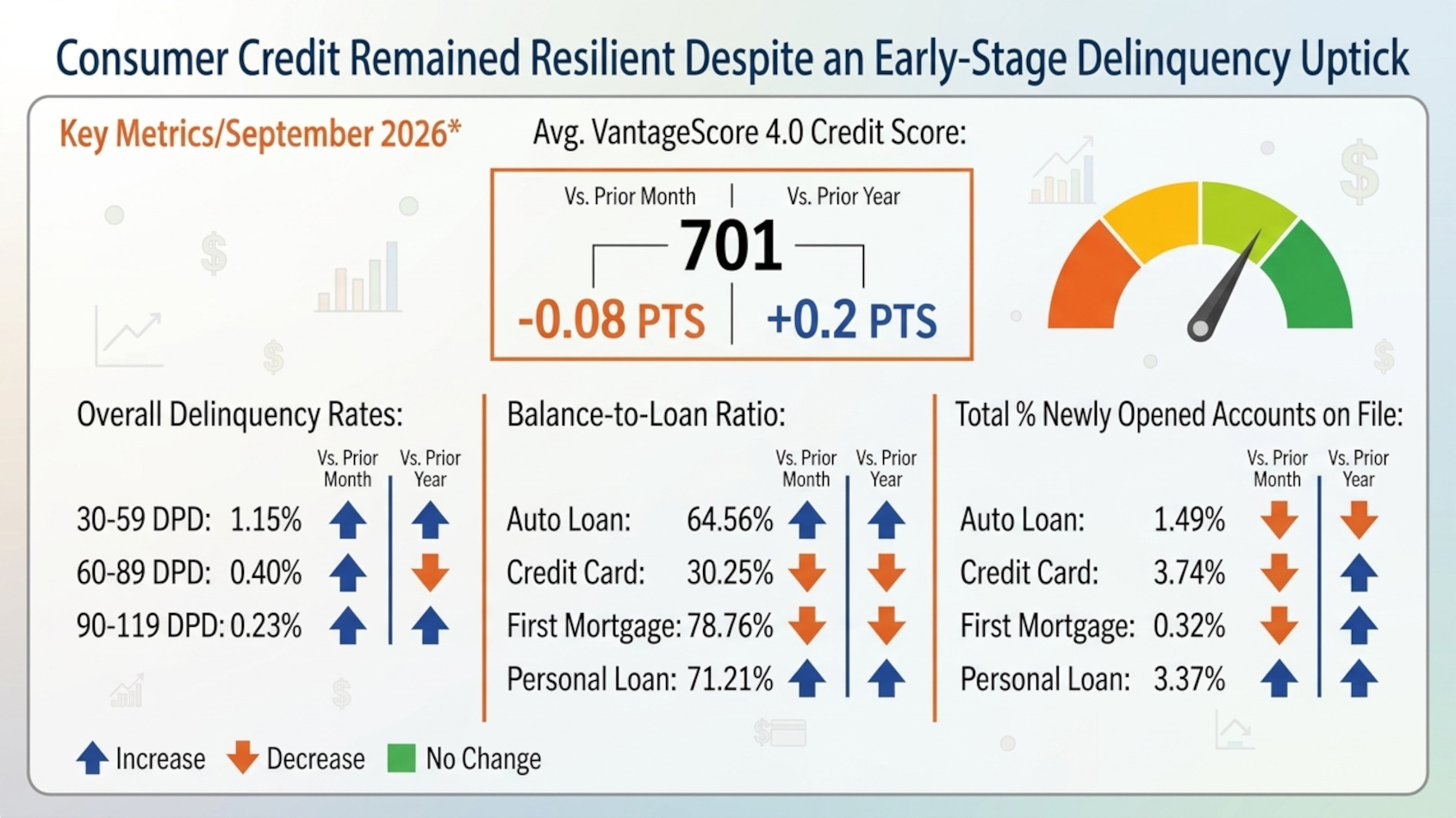
Graphic created with VantageScore data using Nano Banana 2.
By subscribing, you agree to receive communications from Auto Remarketing and our partners in accordance with our Privacy Policy. We may share your information with select partners and sponsors who may contact you about their products and services. You may unsubscribe at any time.
Whether examining only auto-finance data or delinquency connected to products throughout the credit market, VantageScore often repeated “affordability” when detailing the September information contained in the newest installment of CreditGauge.
VantageScore reported this week that average auto loan balances increased $149 month-over-month to $25,500 in September. That’s also $823 or 3.2% higher year-over-year.
Meanwhile, analysts indicated the balance-to-loan ratio (BTL) rose to 64.56%, up 0.2% from August and 0.6% from a year earlier.
“Rising balances alongside higher BTL ratios may reflect elevated vehicle prices and slower principal repayment, highlighting continued affordability pressures,” VantageScore said in the report.
Looking at all parts of credit, including auto, mortgages, credit cards, and personal loans, VantageScore found that overall subprime delinquencies climbed across early and late stages.
Year-over-year, early-stage credit delinquencies increased among VantageScore subprime consumers, rising from 12.00% to 12.39%, which is a 3.2% relative increase.
Subscribe to Auto Remarketing to stay informed and stay ahead.
By subscribing, you agree to receive communications from Auto Remarketing and our partners in accordance with our Privacy Policy. We may share your information with select partners and sponsors who may contact you about their products and services. You may unsubscribe at any time.
VantageScore said prime consumers recorded the largest relative increase of 17.0%, although delinquency rates remained low at 0.23%.
Meanwhile, VantageScore added that near-prime delinquencies improved from 2.05% to 1.98%, “suggesting that initial payment pressures remain concentrated among higher-risk borrowers.”
Looking at what analysts classify as late-stage — payments that are 90 to 119 days past due — VantageScore noticed credit delinquencies increased year-over-year among subprime and near-prime consumers, with subprime rates rising from 2.63% to 2.78%, a 5.9% relative increase, and near-prime rates increasing 4.3% to 0.27%.
VantageScore pointed out that prime credit delinquencies declined slightly, while super-prime rates remained “extremely low,” with analysts saying, “The increases among lower credit tiers suggest emerging pockets of financial stress, even as serious delinquencies remain contained among higher-scoring consumers.”
So, what did these activities do to average credit scores in September?
According to the report, the average VantageScore 4.0 credit score remained at 701, edging down just 0.08 points from August and remaining 0.02 points above September of last year.
“The minimal movement in average scores suggests that overall consumer credit quality remains resilient despite persistent affordability pressures and elevated borrowing costs,” analysts said. “Year-over-year, the distribution of consumers across credit tiers remained largely stable, although a gradual shift toward lower-scoring segments continued.”
VantageScore determined the subprime tier increased 0.1% to 18.7%, while near-prime segment rose 0.1% to 18.0%. As prime declined 0.2% to 32.5%, Super-prime remained unchanged at 30.8%, according to VantageScore.
“The modest shift from VantageScore prime toward lower VantageScore credit tiers suggests emerging pockets of credit pressure but does not indicate widespread deterioration in consumer credit quality,” analysts said.
All told, VantageScore found that the average consumer is carrying nearly $107,500 in credit debt. That figure is essentially unchanged from August and $990 above September of last year.
Analysts added the overall balance-to-loan ratio (BTL) declined from 49.60% to 49.50% month-over-month and remained 1.29% below its year-ago level of 50.79%.
“Consumers have been able to manage their debt effectively and responsibly, as evidenced in strong credit balances and lower utilization,” VantageScore executive vice president and chief digital and insights officer Atif Mirza said in a news release. “Even as early delinquencies remain an area to watch, consumers appear to be navigating this economic environment.”