COMMENTARY: Cut auto-loan servicing costs by tackling your largest preventable expense

By subscribing, you agree to receive communications from Auto Remarketing and our partners in accordance with our Privacy Policy. We may share your information with select partners and sponsors who may contact you about their products and services. You may unsubscribe at any time.
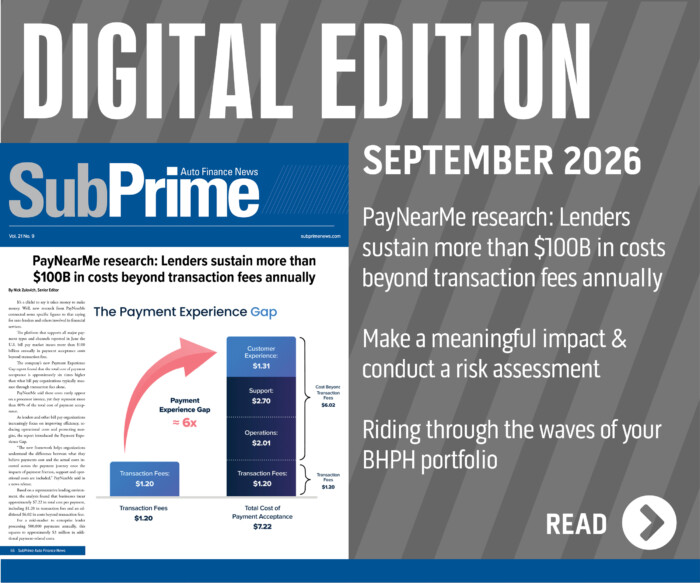
Most auto lenders know their transaction fees down to the penny. Far fewer can tell you what a failed payment actually costs. Why? Because the expenses hide behind the manual workarounds required to resolve payment-blocking issues.
Payment friction is often the culprit. Confusing portals that require logins, account numbers and multiple steps on mobile cause borrowers to abandon payments and call support. Each of these calls is a payment exception — and every exception triggers a manual workaround that can cost up to 80 times more than a self-service payment.
ACH can also be deceptively expensive. On the surface, defaulting borrowers into recurring ACH seems like the most cost-effective way to secure payment, but only if ACH is the best payment option for them. Legacy systems can’t easily flag poor ACH candidates, such as borrowers with frequent non-sufficient funds (NSFs) or those who keep funds in digital wallets instead of bank accounts.
Without automated retries and rules that redirect repeat NSF customers to payment methods more likely to succeed, each failed ACH can become a $20 or more exception. Once again, staff must manually intervene, adding to your growing total cost of acceptance.
There are many reasons payments fail or require human intervention, all of which are classified as payment exceptions, and each exception is followed by a cascade of expensive manual workarounds that add up quickly. When you examine this segment of expenses as a whole, payment exceptions represent one of the largest preventable cost centers in auto loan servicing. That’s why transaction fees alone don’t reflect your total cost of acceptance.
Measure what matters
Subscribe to Auto Remarketing to stay informed and stay ahead.
By subscribing, you agree to receive communications from Auto Remarketing and our partners in accordance with our Privacy Policy. We may share your information with select partners and sponsors who may contact you about their products and services. You may unsubscribe at any time.
To uncover your hidden payment-related expenses, start tracking exceptions by:
—Type and channel: Percent of exceptions in ACH versus cards versus wallets versus IVA
—Cause: NSF, account closed, authorization failure, fraud flags, technical errors
—Resolution path: Percent resolved automatically vs. manual intervention
—Impact: Average money cost per exception, hours of staff time, revenue delayed
—Customer segment: Exceptions among unbanked, gig workers, rural, etc
Once you understand your total cost of acceptance, the next question becomes obvious: How can you lower it?
Preventing exceptions is the real cost saver
Lowering the total cost of acceptance isn’t about promoting the cheapest rail in your payment flow. It’s about designing journeys that prevent exceptions and make repayment effortless.
That’s why auto lenders are increasingly turning to payment experience management — a combination of software and money movement services that optimizes the end-to-end payment journey. With this approach in place, you can use data and automation to orchestrate when, where and how borrowers pay. This will allow you to measure what matters: more on-time payments, higher first-attempt completion rates, fewer support calls and a lower total cost of payment acceptance.
Here are three ways you can reduce exception costs and eliminate manual workarounds:
- Optimize the payment journey with digital wallets.
Imagine a borrower adds his auto loan to Apple or Google Wallet directly from your payment screen. A digital biller card appears automatically on their phone. When the next payment is due, they receive a push notification with a personalized link that takes them directly into their payment flow. No login required. No need to look up their account number. No fumbling through your website on mobile. They simply tap, pay and move on with their day.
Research shows, borrowers want this seamless experience:
—Nearly one-third (31%) say storing bills in a digital wallet would make it easier to pay on time
—Almost half (47%) say a payment reminder notification would help them avoid late payments.
Choose an approach grounded in payment experience management that syncs billing details automatically — amount due, due date and remaining balance. With this information at their fingertips, borrowers have one less reason to miss a payment or call your support line.
- Align autopay with borrower cash flow.
Consider a borrower who gets paid every other Friday but has a single large auto payment due on the 15th of the month. With nearly 20% of new-car loans now carrying payments above $1,000 a month, rigid autopay leaves him with two choices: scramble to move money around or skip the payment and risk fees, NSFs and collection calls.
Flexible autopay gives them a third option: split their monthly obligation into smaller installments timed to their paydays, choose specific dates and decide whether to pay a fixed amount or the full statement balance.
Borrowers want this flexibility. In fact, approximately 65% say they’d be more likely to enroll in autopay if it offered more scheduling options, and 54% say splitting payments within the month would make it easier to pay on time.
Look for a platform that lets borrowers configure their own schedules directly in the payment flow. By aligning due dates with real-world cash flow, you’ll see more on-time payments, fewer NSFs, less collections work and a lower total cost of acceptance.
- Use intelligent business rules to prevent payment exceptions.
Every failed payment triggers a decision: retry, redirect or escalate. Intelligent business rules make these decisions automatically—before costly exceptions occur.
With legacy systems, a failed ACH transaction must be manually addressed by back-office staff. With intelligent automation, the platform retries the transaction based on your configured schedule, with no staff intervention required. Retrying the next day can recover 22% of failures. A second attempt brings that to 45%.
For chronic NSF borrowers, the platform automatically recognizes the pattern and stops ACH pulls after a set number of failures. The borrower receives a clear explanation and is guided toward more successful methods like debit or cash. Support agents see the same flags, allowing them to assist more efficiently.
If you haven’t audited your payment exceptions and their related costs, you’re not alone, but you’re also flying blind. Do you know:
—Your NSF rate by borrower segment?
—Your cost per agent-assisted payment?
—Your self-service abandonment rate?
Transaction fees are easy to measure. Exception costs are easy to ignore. The difference between the two is where the real savings live.
Dawn Fretwell is a seasoned professional in the auto and personal lending industry, with a career that spans frontline collections to leading large-scale operations. She began her journey as a collector and quickly rose through the ranks, gaining firsthand insight into the challenges lenders face. Today, Dawn leads a high-performing team at PayNearMe focused on the rapidly evolving world of payment technologies and their impact on auto lending. Her unique blend of operational expertise and payment strategy makes her a go-to resource for organizations looking to streamline processes, improve borrower experiences and stay ahead of industry shifts.