Trump reveals next Fed chair nominee, as Waller elaborates about need for rate cuts
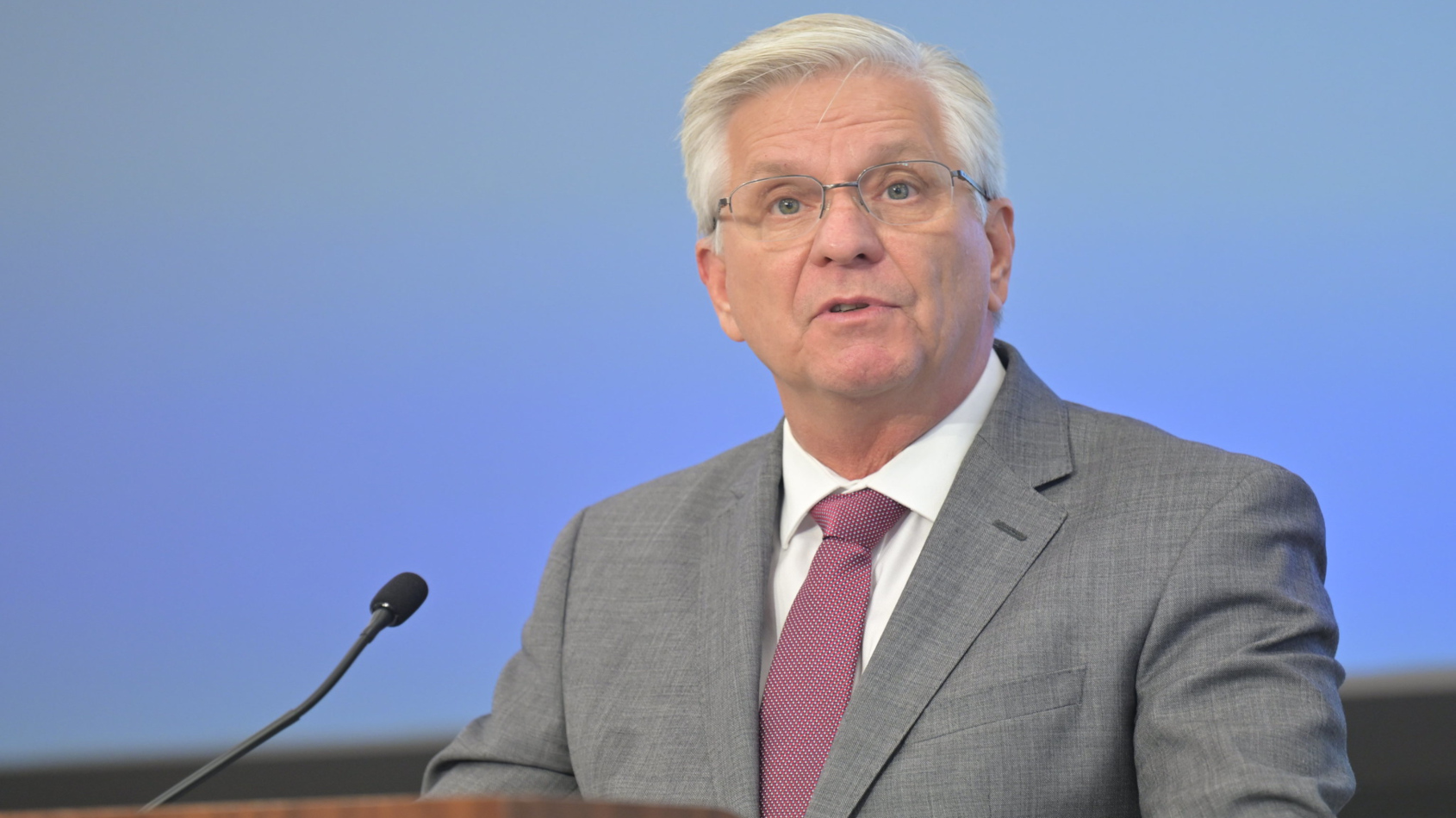
Federal Reserve governor Christopher Waller is pictured at the Payments Innovation Conference on Oct. 21 in Washington, D.C. Image courtesy of the Fed.
By subscribing, you agree to receive communications from Auto Remarketing and our partners in accordance with our Privacy Policy. We may share your information with select partners and sponsors who may contact you about their products and services. You may unsubscribe at any time.
Coinciding with President Trump on Friday announcing his nomination to be the next chair of the Federal Reserve, a vocal member of the Federal Open Market Committee (FOMC) offered more explanation why he was one of two policymakers who wanted an interest-rate cut earlier this week.
Christopher Waller went against the majority that decided to leave the federal funds rate range at 3.5% to 3.75%, potentially leaving automotive in a challenging position. Waller was looking for another trimming of 25 basis points like what the Fed did three times in 2025.
“Three cuts to the policy rate last year have moved it closer to a neutral setting but monetary policy is still restricting economic activity, and economic data make it clear to me further easing is needed,” Waller said in his statement.
Waller then went into his two primary reasons for why a cut should have been made now.
“First, in contrast to the continued solid growth in economic activity, the labor market remains weak. Despite ticking down in its most recent reading, the unemployment rate has risen since the middle of last year. Payroll gains in 2025 were very weak. Compared to the prior ten-year average of about 1.9 million jobs created per year, payrolls increased just under 600,000 for 2025. And, last year’s data will be revised downward soon to likely show that there was virtually no growth in payroll employment in 2025. Zero. Zip. Nada,” Waller said.
“Let this sink in for a moment — zero job growth versus an average of almost 2 million for the 10 years prior to 2025. This does not remotely look like a healthy labor market,” he continued. “While lower labor supply was surely a factor, it also indicates considerable weakness in labor demand. Employers are reluctant to fire workers, but also very reluctant to hire. I have heard in multiple outreach meetings of planned layoffs in 2026. This indicates to me that there is considerable doubt about future employment growth and suggests that a substantial deterioration in the labor market is a significant risk.
Subscribe to Auto Remarketing to stay informed and stay ahead.
By subscribing, you agree to receive communications from Auto Remarketing and our partners in accordance with our Privacy Policy. We may share your information with select partners and sponsors who may contact you about their products and services. You may unsubscribe at any time.
“Second, though inflation is elevated from tariff effects, appropriate monetary policy is to ‘look through’ these effects as long as inflation expectations are anchored, which they are. Inflation excluding tariff effects is running close to the FOMC’s 2 percent target and on a path to sustainably reach that goal,” Waller added.
“With total inflation excluding tariff effects close to our target at just slightly above 2 percent and a weak labor market, the policy rate should be closer to neutral, which the median FOMC participant estimates is 3 percent, and not where we are — 50 to 75 basis points above 3 percent. I favored reducing the policy rate to strengthen the labor market and guard against a deterioration that would be harder to address once it has begun,” he went on to say.
If confirmed by the U.S. Senate, Waller and his fellow policymakers will be working with a new chair in May. Trump revealed via social media that he nominated Kevin Warsh to be the next Fed chair.
Trump pointed out that Warsh served on the Fed’s Board of Governors from 2006 through 2011, joining the group as the youngest ever member at age 35. Currently, serving as the Shepard Family Distinguished Visiting Fellow in Economics at the Hoover Institution, Trump highlighted that Warsh also served as Special Assistant to the President for Economic Policy, and Executive Secretary of the White House National Economic Council from 2002 until 2006.
Warsh also has experience in the mergers and acquisitions department at Morgan Stanley & Co., in New York, according to Trump, who said in the social media post, “I have known Kevin for a long period of time, and have no doubt that he will go down as one of the GREAT Fed Chairmen, maybe the best.
“On top of everything else, he is ‘central casting,’ and he will never let you down,” Trump added.
Dean Lyulkin is a registered investment advisor and founder of The Dean’s List, who tracks the intersection of monetary policy, markets, and business stability. In a message to Cherokee Group, Lyulkin shared these perspectives about Warsh possibly leading the Fed.
“Warsh brings something markets crave right now — credibility rooted in experience. He was in the room during the financial crisis, and that kind of policy scar tissue matters. Leaders who’ve seen how fast credit stress spreads tend to communicate more clearly and move with fewer surprises. Businesses and investors can plan around that,” Lyulkin said.
“Yes, he’s a Wall Street insider with serious pedigree,” Lyulkin continued. “But strong capital markets, functioning credit, and economic stability benefit far more than just finance. When policy mistakes cascade, it hits housing, small business lending, and consumer confidence first.
“After years of aggressive tightening, experimental policy, and mixed messaging, putting someone in charge who understands both theory and how markets actually react could restore a clearer monetary direction. Stability is generally bullish for long-term investment and business planning,” Lyulkin went on to say.