
Already the top factor holding back dealership business, potential economic headwinds build
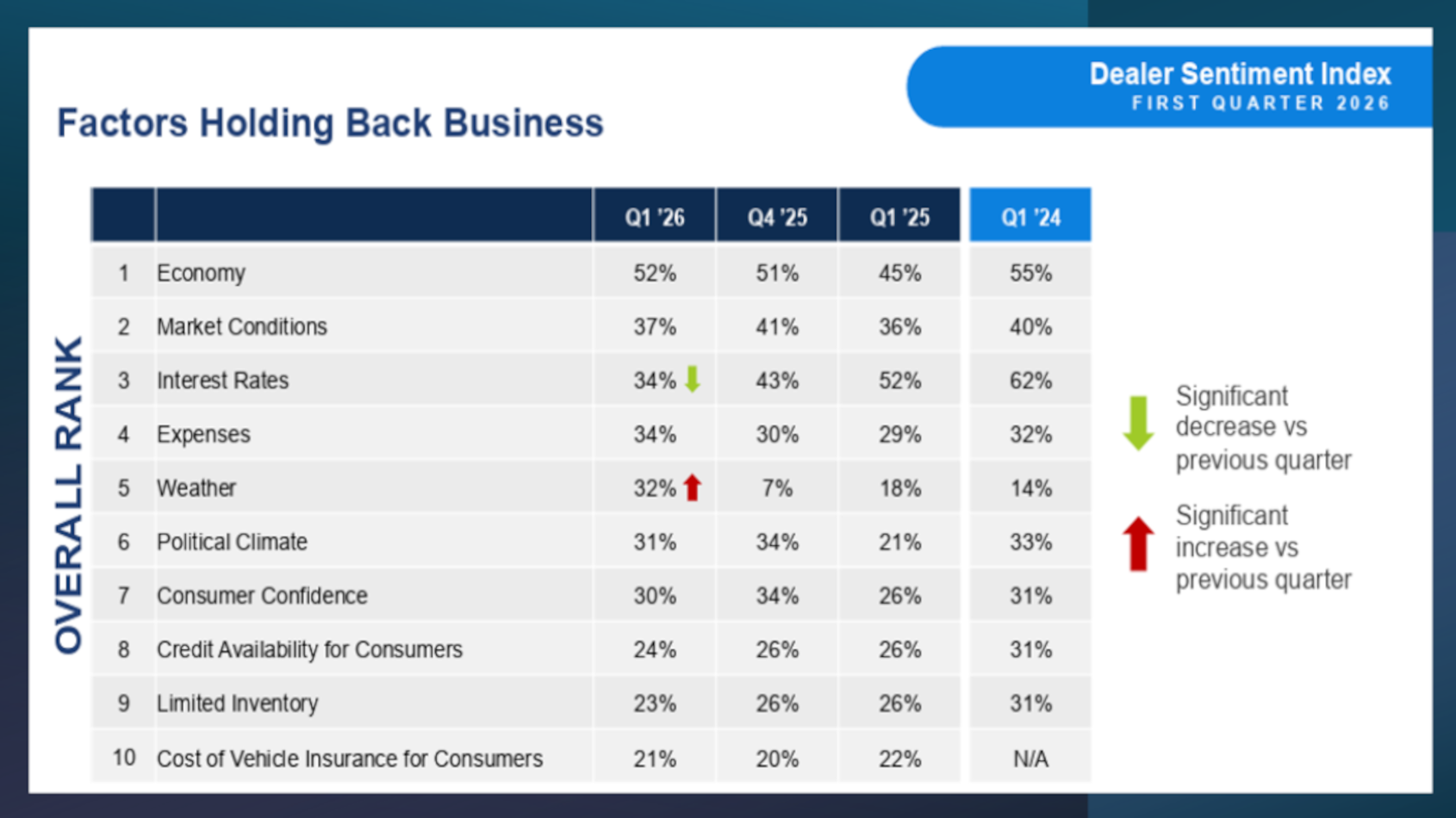
Chart courtesy of Cox Automotive.
By subscribing, you agree to receive communications from Auto Remarketing and our partners in accordance with our Privacy Policy. We may share your information with select partners and sponsors who may contact you about their products and services. You may unsubscribe at any time.
The survey generating findings for the Q1 2026 Cox Automotive Dealer Sentiment Index was conducted from Jan. 28 to Feb. 10. Responses from 1,031 participants, including 532 franchised and 499 independent dealers, showed the economy remained the top factor holding back business.
The economy was cited by 52% of dealers, up from 45% a year earlier.
By the time Cox Automotive surveys dealers again, the economy could be an even more pronounced factor holding back positive dealership activity based on trends connected with employment and energy.
Let’s examine a key component to getting a vehicle — having a job. Here’s a positive view of what’s happening.
Private sector employment increased by 63,000 jobs in February and pay was up 4.5% year-over-year according to the February ADP National Employment Report produced by ADP Research in collaboration with the Stanford Digital Economy Lab.
“We’ve seen an increase in hiring and pay gains remain solid, especially for job-stayers,” ADP chief economist Nela Richardson said in a news release. “But with hiring concentrated in only a few sectors, our data shows no widespread pay benefit from changing jobs. In fact, the pay premium for switching employers hit a record low in February.”
Subscribe to Auto Remarketing to stay informed and stay ahead.
By subscribing, you agree to receive communications from Auto Remarketing and our partners in accordance with our Privacy Policy. We may share your information with select partners and sponsors who may contact you about their products and services. You may unsubscribe at any time.
The ADP National Employment Report is an independent measure of the labor market based on the anonymized weekly payroll data of more than 26 million private-sector employees in the United States.
ADP’s Pay Insights captures over 15 million individual pay change observations each month.
“Together, the jobs report and pay insights use ADP’s fine-grained data to provide a representative and high-frequency picture of the private-sector labor market,” analysts said.
But when looking at the job market based on federal government data, the situation appears to be significantly different.
On Monday morning, Comerica Bank chief economist Bill Adams and senior economist Waran Bhahirethan recapped what the Bureau of Labor Statistics shared on Friday.
“The February jobs report was much weaker than expected, with payroll job losses, a higher unemployment rate, and big downward revisions,” Adams and Bhahirethan said. “Employers cut 92,000 payroll jobs, the second-worst month after DOGE layoffs reduced federal payrolls by 166,000 in October 2025. Accommodation and food services cut 35,000 jobs, likely partly due to severe winter weather disrupting hourly work. Healthcare fell 28,000 because of a big strike falling in the survey week. Those temporary factors don’t explain losses across many other industries, including manufacturing, construction, private education, administrative and support services, and couriers and messengers.
“The unemployment rate rose to 4.4% from 4.3% as the labor force participation rate fell to 62.0% and reached the lowest level since late 2021,” the Comerica Banks experts continued. “Most of its decline reflects workers retiring as the population ages; the participation rate for workers aged 25-54 edged down but was still near the highest since 2001.
“The February release included big revisions to the household survey in its annual benchmarking. The benchmark revised down employment in December 2025 by 1.43 million, reduced the labor force by 1.42 million, and raised unemployment a much smaller 15,000. Incorporating these revisions, employment fell 35,500 per month in the 12 months through February,” Adams and Bhahirethan went on to say.
And conflict intensifying in the Middle East is pushing costs higher at the gas pump in the U.S.
AAA reported on Thursday that the national average for a gallon of regular gasoline jumped nearly 27 cents week-over-week to $3.25. AAA also said the conflict in the Middle East has sent crude oil prices higher to the range of more than $70 per barrel.
“The recent increase puts the national average at the same price as it was in early April of 2025,” AAA said in a news release. “Springtime typically sees higher gas prices as gasoline demand rises and summer-blend gasoline production begins. The last time the national average made a similar weekly jump was back in March of 2022 during the start of the Russia/Ukraine conflict.”
Experts see trends like employment and energy prices being considered by the Federal Reserve when policymakers gather next week about making any changes to interest rates.
“The Fed began the year expecting tailwinds from interest rate cuts, tax cuts, and higher government spending,” Adams and Bhahirethan said. “The February jobs report will make them reassess that outlook but doesn’t provide enough evidence to re-write it. That makes an interest rate cut very unlikely at the Fed’s mid-March decision, especially since rising energy prices will push inflation higher near-term.”
Sounds like dealers have plenty to be concerned about.