Equifax Canada: Despite overall debt rise, consumers ‘holding off’ vehicle purchases
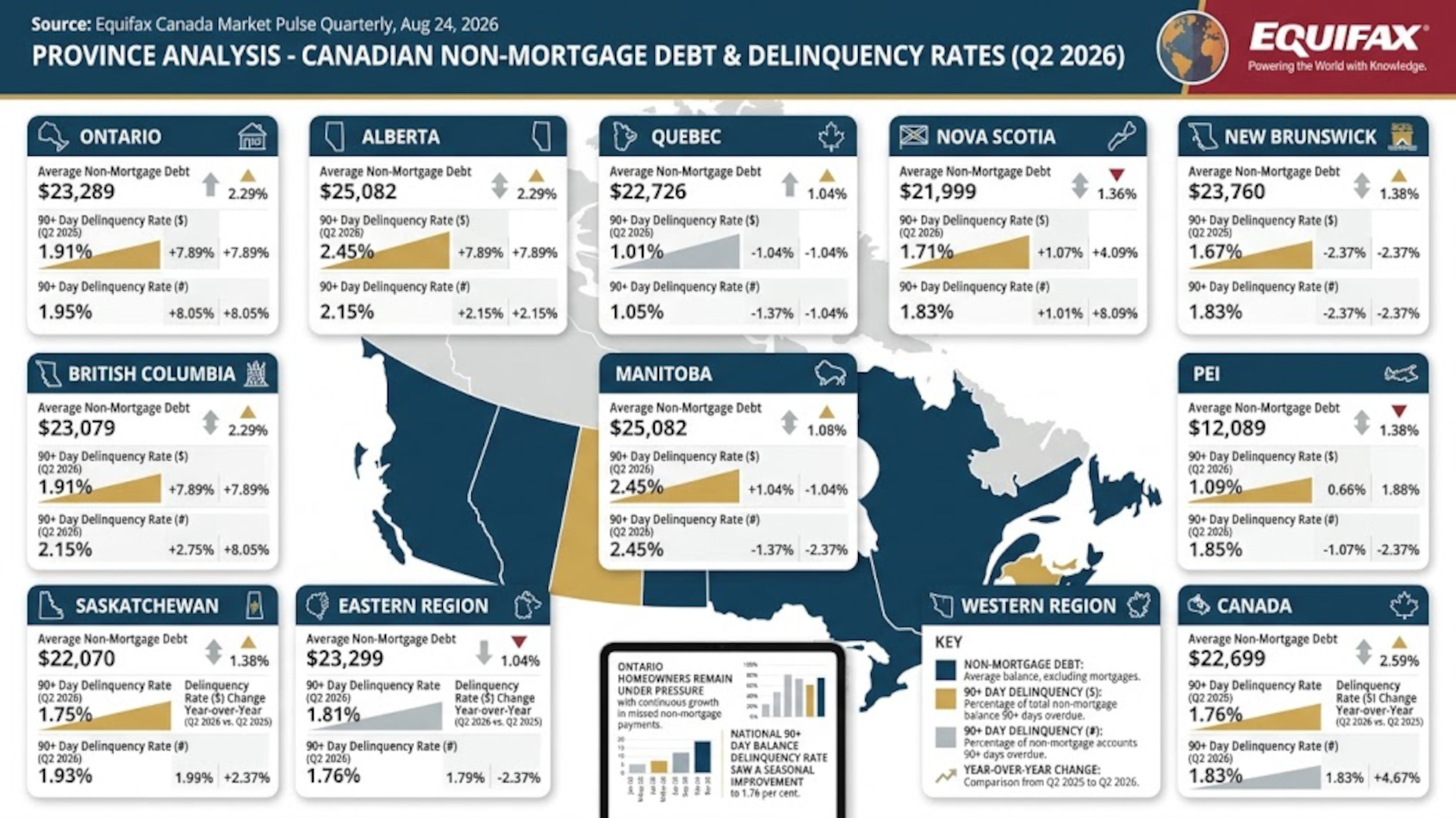
Graphic made with Equifax Canada information and Google Gemini.
By subscribing, you agree to receive communications from Auto Remarketing and our partners in accordance with our Privacy Policy. We may share your information with select partners and sponsors who may contact you about their products and services. You may unsubscribe at any time.
As total Canadian consumer debt approached $2.7 trillion after the second quarter, Equifax Canada indicated on Monday consumers remain cautious about making vehicle purchases.
However, Equifax Canada’s Q2 2026 Market Pulse Quarterly Consumer Credit Trends and Insights showed the automotive sector regained some seasonal momentum.
Analysts determined outstanding auto loan balances — representing loans from captives and banks — grew to $179.1 billion, representing a 2.2% increase from Q1 and a 4.9% rise year-over-year.
“However, this increase was below expected levels for this time of year,” Equifax Canada said, noting that the number of new auto loans opened in the second quarter was 9.2% lower than the second quarter of last year.
Analysts said they spotted a similar trend in Q1, too.
Equifax Canada indicated average new loan amounts were much higher compared to 12 months ago. On average, they jumped from $34,713 to $36,979.
Subscribe to Auto Remarketing to stay informed and stay ahead.
By subscribing, you agree to receive communications from Auto Remarketing and our partners in accordance with our Privacy Policy. We may share your information with select partners and sponsors who may contact you about their products and services. You may unsubscribe at any time.
Analysts added the higher loan amounts contributed to the rising overall balance.
“Even with financing incentives and lower used vehicle prices, many consumers appear to be holding off on big purchases like new vehicles and waiting to see what the economy will bring. Economic conditions and employment uncertainty continue to influence household decisions,” said Rebecca Oakes, vice president of advanced analytics at Equifax Canada.
On the positive front, Equifax Canada reported the overall 90-day delinquency rate for auto loans improved to 1.10%, down from 1.11%in the previous quarter.
This improvement was driven primarily by the used-vehicle market, whereas new auto loans experienced a slight uptick in severe delinquency rates, according to Equifax Canada tracking.
Looking at the overall credit scene as of the second quarter, Equifax Canada tabulated that total Canadian consumer debt rose to $2.68 trillion, a 4.18% jump year-over-year and a 1.3% uptick from the previous quarter.
Following a drop in non-mortgage debt in Q1, analysts noticed balances saw a seasonal rebound in the second quarter.
Non-mortgage debt reached $712.2 billion in Q2, marking a 4.8% jump year-over-year and a 2.09% increase from Q1.
Equifax Canada also mentioned national 90-day non-mortgage balance delinquency rates saw a seasonal improvement, dipping to 1.76% in Q2 from 1.79% in Q1, though it remained elevated compared to the 1.70% rate observed a year ago.
“Between March and June, we typically see non-mortgage debt levels rising and missed payments falling,” Oakes said. “This year has followed a similar pattern as consumers remain cautious, particularly around major purchases. And while rising delinquency levels have started to slow, pockets of growing stress are still evident in some areas.”