eLEND/700Credit survey: 93% of dealers see risk in gap between initial dealer payment quotes and final lender terms
Graphics courtesy of the companies.
By subscribing, you agree to receive communications from Auto Remarketing and our partners in accordance with our Privacy Policy. We may share your information with select partners and sponsors who may contact you about their products and services. You may unsubscribe at any time.
Two of the service providers who appeared at Used Car Week in San Diego — 700Credit and eLEND Solutions — released findings from a survey about Federal Trade Commission mandates for dealerships, lenders and allied industry professionals across the U.S.
The survey showed there is a significant potential FTC risk in the gap between initial payment terms quoted to consumers by dealers and the final fundable contract terms from lenders.
The findings also revealed that most dealers are unaware that they, not the lenders, are liable for this quote-to-payment terms gap.
“These results are a wake-up call for our industry. Even if this ticking FTC time bomb does not go off — which is a big if — this chronic mismatch between lender terms and dealer quotes is a risk to customer satisfaction and profit per vehicle sold,”, eLEND Solutions founder and CEO Pete MacInnis said about his company’s latest project titled, “Fielded the AI, Machine Learning and Vehicle Purchase Finance Terms Survey.”
According to a news release about the survey, the reduction in auto lenders providing dealers with standard rate bulletin sheets is cited by 92% of respondents as a factor in the quote-to-terms mismatch – representing potential average dealer underquotes of about $2,240 over the term of the contract.
Experts said this reduction is driven, say the majority, by black-box, AI-powered, machine-learning decisioning used by auto lenders, although credit tier pricing plays a role.
Subscribe to Auto Remarketing to stay informed and stay ahead.
By subscribing, you agree to receive communications from Auto Remarketing and our partners in accordance with our Privacy Policy. We may share your information with select partners and sponsors who may contact you about their products and services. You may unsubscribe at any time.
Without the rate bulletins, 700Credit and eLEND Solutions pointed ou that dealers lack key information required to calculate accurate initial payment quotes.
Those quotes change, following lender approval, at least 75% of the time, say the majority, which could lead to additional friction, deal re-writes, and/or the loss of the sale.
“These findings confirm that lenders’ move towards proprietary AI machine-learning loan pricing models, and away from standard rate sheets, is forcing dealers to rely on guesswork that results in them chronically changing their payment quotes after lender approval,” MacInnis said in the news release.
Respondents are generally positive about the impact of AI/machine learning on dealership intelligence if it is based on accurate, complete intelligence, with 75% acknowledging its potential value.
They also overwhelmingly support AI and machine learning as a potential solution to the quote-to-payment gap: 97% say an AI-powered solution that predicts fundable contract terms early in the sales process would be valuable to dealerships. Benefits include time-saving (46%), reduced friction with the customer, and better front and back-end profits.
Here’s a recap of the survey’s major findings from online questionnaire deployed in October among 150 self-identified auto dealers, auto lenders and allied industry professionals:
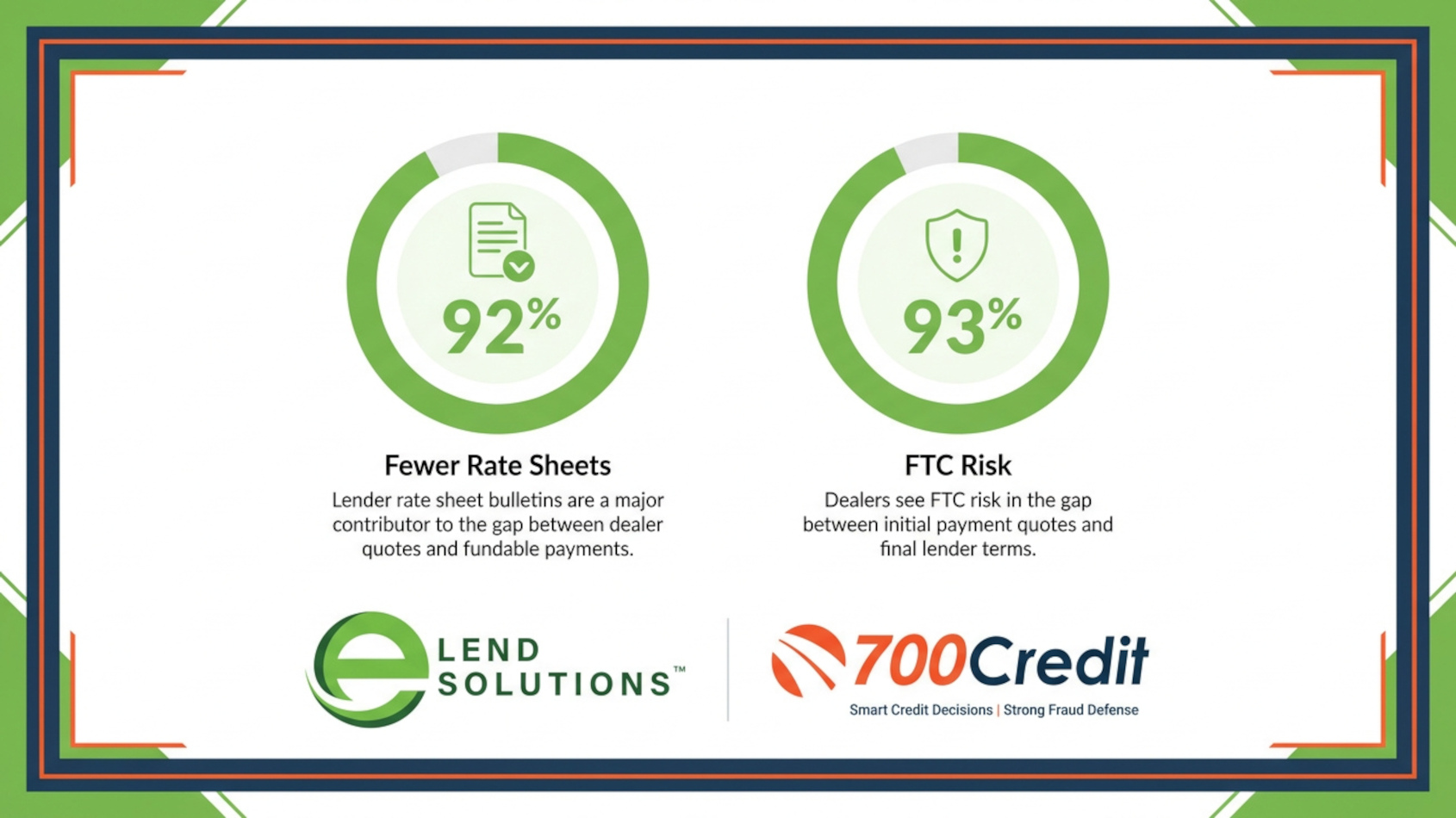
—93% of dealers, and 89% overall, say the quote-to-terms gap could become an FTC enforcement action
—While the dealer would be liable for the price-to-quote discrepancies, 56% of dealer respondents think it is the lender who holds the liability.
—92% overall say the reduction in lenders providing standard rate bulletins is a factor in the gap between initial dealer monthly payment quotes and final fundable lender terms
—70% of lenders, and 51%, overall, say lenders’ move to black box decisioning is the biggest reason rate sheets disappeared
—71% of dealers, and 56% overall, say the initial dealer’s quote — including monthly payment, down payment and loan term — changes 75% of the time after lender approval
—97% say an AI-powered solution that predicts fundable contract terms at the start of the sale would be valuable to their dealership, with 77% calling it extremely valuable.
“This survey illustrates that the industry can be bullish on AI, if it is in a solution that places machine learning intelligence, with predictive fundable contract terms guidance, at the front of the sales process,” 700Credit managing director Ken Hill said in the news release.
“With so many respondents concerned about regulatory scrutiny, a holistic solution that combines AI-powered predictive intelligence with prequalification, identity verification and compliance tools can help dealers start deals on firmer footing, while mitigating FTC risk,” Hill went on to say.