
Wolters Kluwer: eContracting adoption has grown 61% in 4 years
Graphics courtesy of Wolters Kluwer Compliance Solutions and merged using Nano Banana 2.
By subscribing, you agree to receive communications from Auto Remarketing and our partners in accordance with our Privacy Policy. We may share your information with select partners and sponsors who may contact you about their products and services. You may unsubscribe at any time.
A growth rate of 61% during a four-year stretch might be a trajectory anyone associated with auto financing would appreciate.
Well, that rate is one of the highlights of the Q3 Auto Finance Digital Transformation Index from Wolters Kluwer Compliance Solutions.
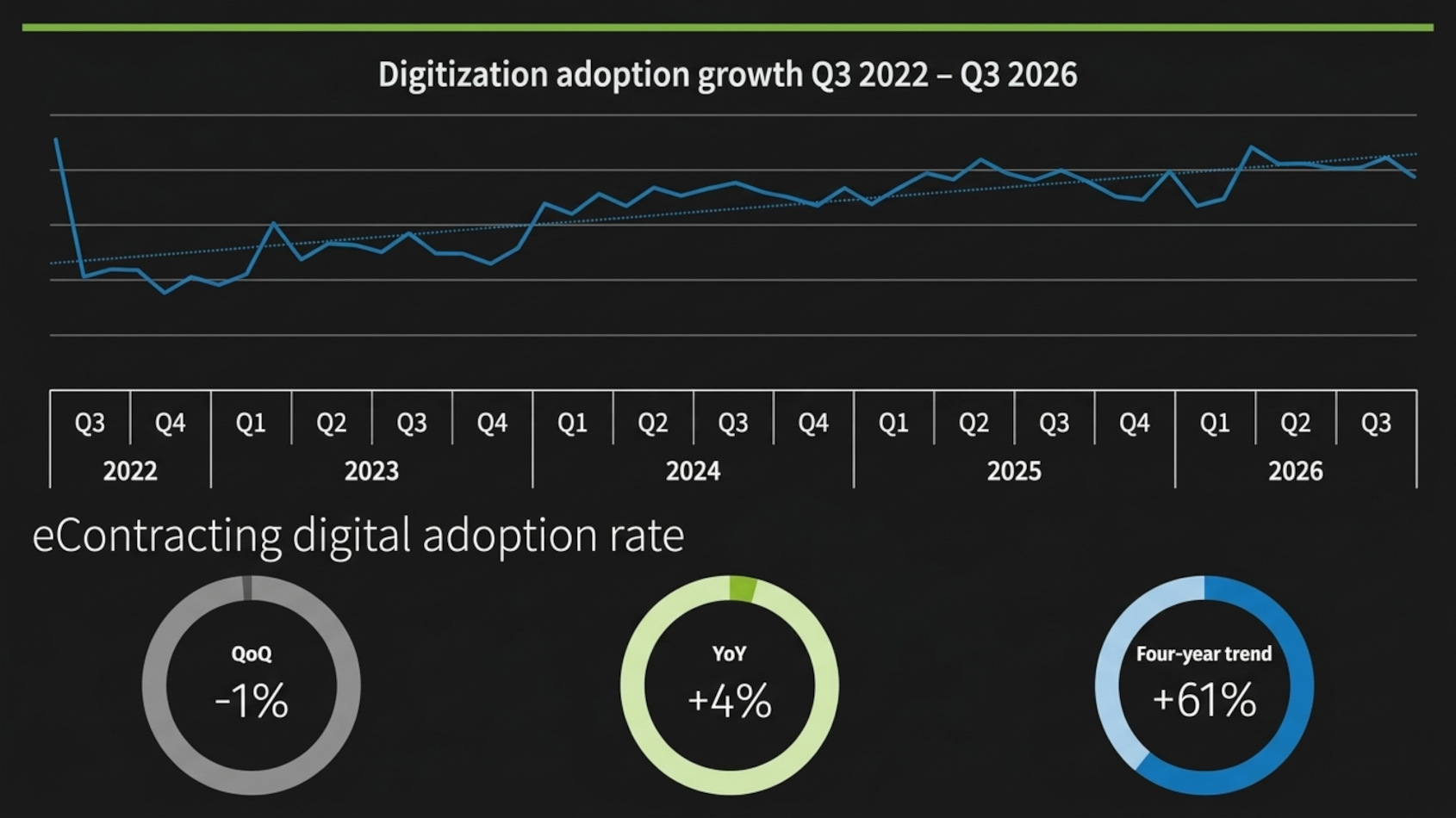
Analysts indicated the four-year trend for eContracting digital adoption is 61% since Q3 2022.
The adoption rate has also increased 3.8% year-over-year.
Other key findings associated with eContracting from the Q3 index included:
—An unchanged quarter on a higher base: Digital adoption rates decreased 0.8 percent compared with the second quarter, and increased 3.8 percent compared with Q3 25.
Subscribe to Auto Remarketing to stay informed and stay ahead.
By subscribing, you agree to receive communications from Auto Remarketing and our partners in accordance with our Privacy Policy. We may share your information with select partners and sponsors who may contact you about their products and services. You may unsubscribe at any time.
—Digital activity tracked the market: With new vehicle sales neither accelerating nor retreating, eContracting volume moved in step, with no sharp swing in either direction.
—Digital is the default, not the variable: Year-over-year growth is showing that digital contracting continues to gain adoption across the market rather than a function of sales momentum.
Wolters Kluwer also highlighted digital securitization transactions increased 15.4% from Q2 to Q3 and 46.3% year-over-year, making Q3 the strongest quarter for digital securitization activity since Q1 2025.
Through the first nine months of 2026, analysts found volume is 26.5% higher than the same period of 2025, “showing that the Q3 increase is part of a broader expansion rather than an isolated quarterly move.”
A few other notes from digital securitizations that Wolters Kluwer mentioned:
—Credit unions reach a new milestone: Credit union reissuance is now being recorded for the first time, showing growth in the category.
—Capital markets demand remains firm: Industry auto ABS issuance held near $44 billion each quarter, with Finsight reporting approximately $43.4 billion in Q1, $44.4 billion in Q2 and $44.1 billion in Q3. Digital securitization volume rose even as overall issuance stayed level, showing that funding strategy, investor demand and deal timing are shaping activity alongside vehicle sales and originations.
—From digital to verifiable: As more collateral is digital, secured parties are asking a harder question: can the data be verified? Wolters Kluwer is working with lenders and secured parties on making electronic assets verifiable, helping confirm that collateral is authentic, exists as a unique record and is not pledged elsewhere.
“Q3 tells two stories that point in the same direction,” said Matthew Babcock, who oversees digital lending product strategy for Wolters Kluwer. “In eContracting, volume held essentially unchanged against an auto market that was itself steady, which tells us digital contracting has become an increasingly established part of lender workflows.
In securitization, a credit union repeatedly bringing digitized collateral to market within the same calendar year, and across consecutive years, shows that electronic assets are now a larger part of the funding strategy,” Babcock continued in a news release.
“Furthermore, funding partners will increasingly expect proof that digitized collateral is authentic, unique, and not pledged elsewhere, and lenders who can show that stand to fund with more confidence and less friction. That is where we expect the conversation to go over the coming quarters,” he went on to say.
For more information about Wolters Kluwer, visit www.wolterskluwer.com.