Counter argument for dealers who are considering cuts in advertising & training expenditures
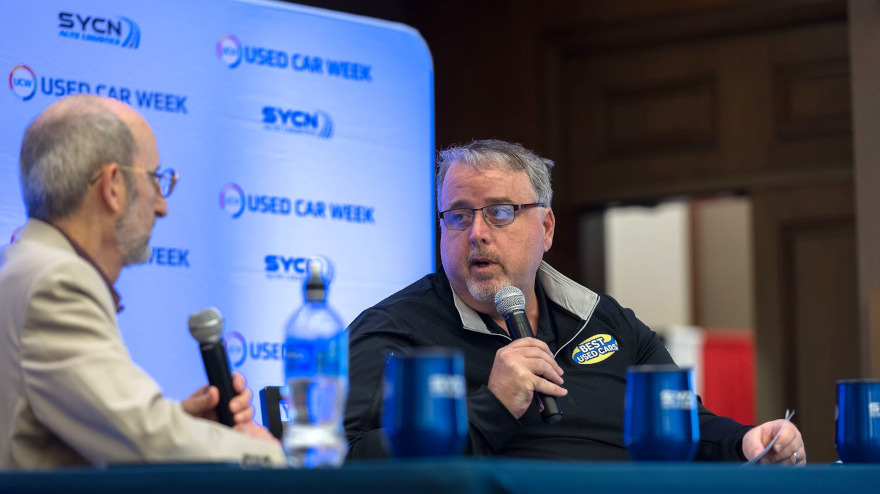
Cherokee Media Group’s Andrew Friedlander shares a conversation with Terry MacCauley, who is founder and CEO of Big Time Advertising & Marketing, during Used Car Week 2024 in Scottsdale, Ariz. Photo by Jonathan Fredin.
By subscribing, you agree to receive communications from Auto Remarketing and our partners in accordance with our Privacy Policy. We may share your information with select partners and sponsors who may contact you about their products and services. You may unsubscribe at any time.
Big Time Advertising founder and CEO Terry MacCauley recently acknowledged some independent and buy-here, pay-here dealers might not be in the best financial position, so operators are having to trim expenditures.
MacCauley strongly urged dealerships to be wary of making their advertising and training endeavors some of the first things to cut.
“When dealers pause marketing and training to save money, they often produce a larger, slower, more expensive recovery,” MacCauley said in an industry message. “Momentum is an economic asset. Treat it like one.”
MacCauley then went into some hypothetical figures to reinforce his economic asset reasoning.
“A typical dealer that spends $10,000 per month on advertising converts that spend into roughly $40,000 in monthly gross profit,” he said. “If that dealer pauses advertising for three months and then returns to market, a conservative estimate of the restart cost can exceed $20,000 for a single month of restored volume, while the dealer will have forgone roughly $120,000 in gross profit during the pause.
“When the pause, the restart cost, and the lost profit are combined, the strategic result is a large negative present value,” MacCauley continued. “In plain language, the money saved by waiting is small compared with the cost of returning to where the business already was.”
Subscribe to Auto Remarketing to stay informed and stay ahead.
By subscribing, you agree to receive communications from Auto Remarketing and our partners in accordance with our Privacy Policy. We may share your information with select partners and sponsors who may contact you about their products and services. You may unsubscribe at any time.
After sharing those figures, McCauley explained how momentum works, “in plain economics,” He said momentum is an economic asset comprised of three measurable components.
- Algorithmic momentum. Advertising platforms reward continuity. Accounts with steady creative and steady spend receive better delivery and lower cost per acquisition over time.
- Audience momentum. Retargeting pools, brand recall, and repeat exposure are inventory items. They shrink when campaigns stop. Rebuilding them costs more than maintaining them.
- Human momentum. Sales skills, response speed, and operational processes atrophy when unused. Retraining and ramp time are real costs.
“These three elements interact. A pause reduces algorithmic delivery, shrinks audiences, and begins the slow loss of human capital. Restarting requires higher spend, heavier creative production, and time. That is the restart penalty,” MacCauley said.
What if a dealership is so stretched financially that some expenditures must go? MacCauley offered five suggestions in that scenario, including:
- Reduce wasteful prospecting CPM bids and pause low-quality broad prospecting.
- Pause expensive, low-probability experiments. Keep micro-tests.
- Preserve baseline retention and awareness spend at 10 to 30 percent.
- Do not cut training or retargeting. Those are the core of momentum.
- If the emergency remains, reduce creative production cadence but keep at least a lean creative lab.
“This hierarchy preserves the asset while acknowledging short-term cash stress,” he said.
For more ideas to keep your store in the black and other dealership strategies, visit Big Time Advertising online at https://www.gowithbigtime.com.