Cox Automotive: Subprime share decreases again in July, as loan terms stay at all-time high
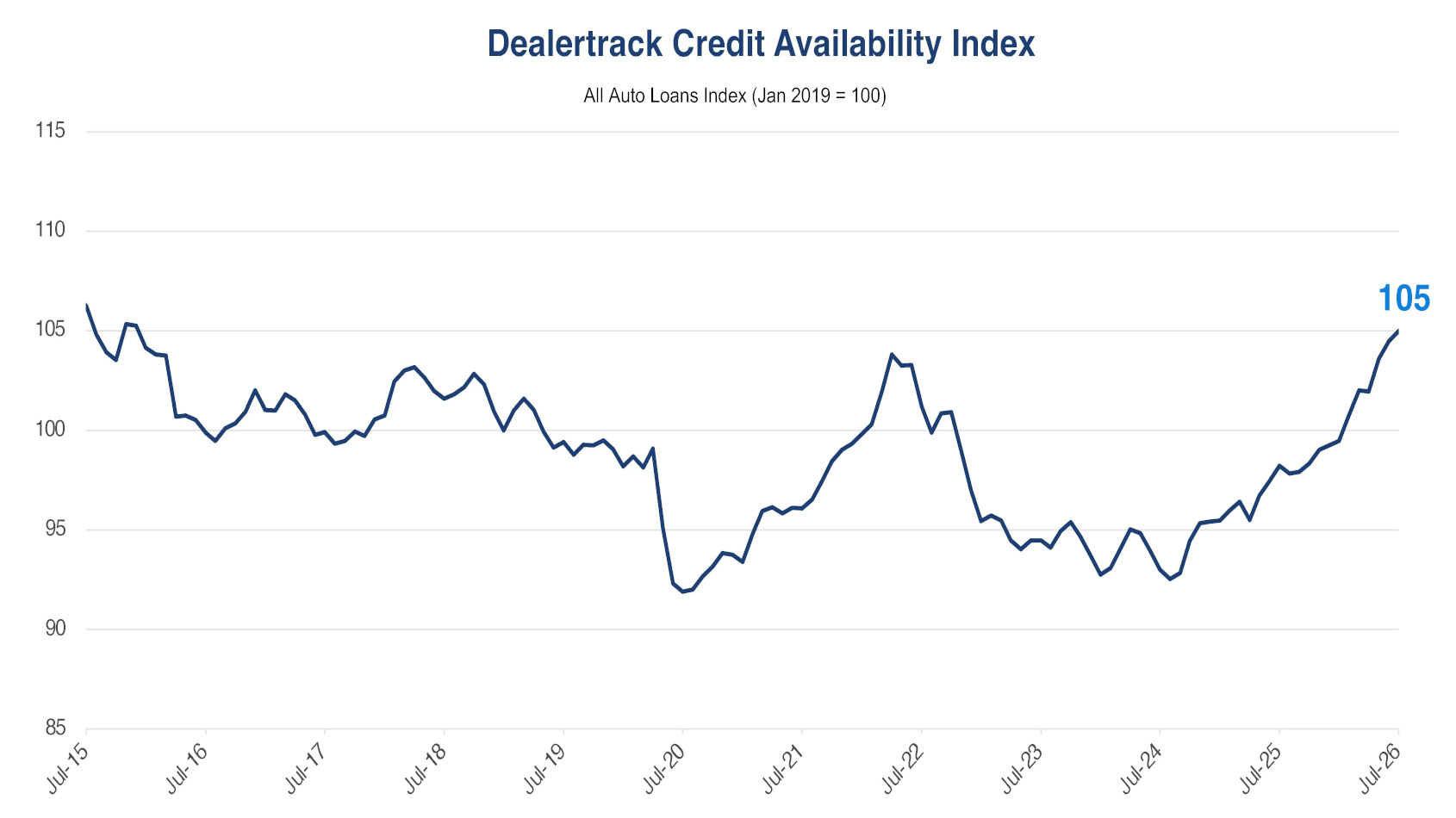
Chart courtesy of Cox Automotive.
By subscribing, you agree to receive communications from Auto Remarketing and our partners in accordance with our Privacy Policy. We may share your information with select partners and sponsors who may contact you about their products and services. You may unsubscribe at any time.
The Dealertrack Credit Availability Index keeps climbing, but the subprime share keeps sagging.
Cox Automotive’s latest index update might be reflecting what’s happening at your finance company, ticking up 7% year-over-year to 105, which is the highest level since November 2015.
But the share of loans to subprime applicants declined 21 basis points month-over-month to 16.4%. Jonathan Gregory, who is a senior director on Cox Automotive’s economic and industry insights team, indicated that’s the fourth consecutive monthly decrease following March’s surge to 19.5%.
Despite four months of pullback, Gregory said the subprime share remains up 267 basis points year-over-year “reflecting conditions that are still more positive for higher-risk borrowers than a year ago.
“The continued decline was the primary drag on July’s index,” he added in his analysis that accompanied July’s update.
Gregory pointed out overall approvals are going counter to what’s happening in subprime. Cox Automotive noticed the overall loan approval rate in July jumped 37 basis points from June to 74%, extending the streak of increases to four straight months.
Subscribe to Auto Remarketing to stay informed and stay ahead.
By subscribing, you agree to receive communications from Auto Remarketing and our partners in accordance with our Privacy Policy. We may share your information with select partners and sponsors who may contact you about their products and services. You may unsubscribe at any time.
Gregory explained that the yield spread is also fueling the index’s upward trajectory.
In July, Gregory indicated the yield spread declined 20 basis points from 6.77% to 6.57% to its narrowest reading since January. The July mark is also 59 basis points below the average spread of 7.2% Cox Automotive has seen since the start of 2023.
Cox Automotive added the average contract rate fell 8 basis points to 10.90% while the 5-year Treasury yield rose 12 basis points to 4.33%, “narrowing the spread from both directions,” Gregory said.
Year-over-year, Gregory pointed out the spread is 32 basis points lower as it was 6.89% last July. “The narrowing was the single largest contributor to July’s index gain,” he said.
The index update also highlighted the three other trends that Cox Automotive tracks each month, including:
—Term length: The share of contracts booked in July with terms greater than 72 months stayed at the all-time high in the dataset at 31.1%, “as lenders and consumers continue to stretch loan length to make deals work,” Gregory said.
The metric is also 484 basis points higher than a year ago.
—Negative equity share: Cox Automotive reported the share of loans with negative equity declined 23 basis points to 56.8%. It’s the fourth consecutive monthly decline following March’s record high of 59.2%.
Despite four months of easing, Gregory pointed out that negative equity share is 269 basis points higher year-over-year. It’s also than any monthly reading recorded between 2015 and 2019.
—Down payment percentage: Cox Automotive said down payments declined 22 basis points to 13%, the second consecutive monthly decline and the lowest level since October 2022.
After holding steady near 13.5% since July of last year, Gregory acknowledged the share has moved lower in each of the past two months, leaving it 51 basis points below that year-ago level.
What should lenders take away from the latest Cox Automotive information?
“Approvals are only back to year-ago levels, so the willingness to lend is holding rather than expanding, and the subprime share of booked loans fell for a fourth straight month, shifting the mix toward better credit even as subprime application volume rose,” Gregory said.
“Both cost lenders yield, one on the spread and one on the mix. What runs the other way is duration and the share of value financed, with a record share of the book extending past 72 months and a smaller share of price covered by cash at signing,” he continued. “Longer loans, thinner equity at origination, and an elevated share of loans written above the value of the collateral remain the watchpoints, compounding duration and collateral risk across the book even as credit quality holds.”
And when looking through the consumer prism, Gregory added these observations.
“Conditions for financing a vehicle were more favorable in July, though the improvement was not evenly distributed,” Gregory said.
“The terms doing much of that work, though, push cost outward,” he continued. “A record share of loans ran past 72 months, down payments fell to their lowest share since October 2022, and a majority of loans were written for more than the vehicle was worth. Each of those makes a purchase manageable month to month while raising total loan cost and risk exposure over the life of the loan, extending the period during which a borrower owes more than the vehicle is worth.”