Economic roundup: Recession outlook & explaining Supreme Court decision about tariffs via automotive
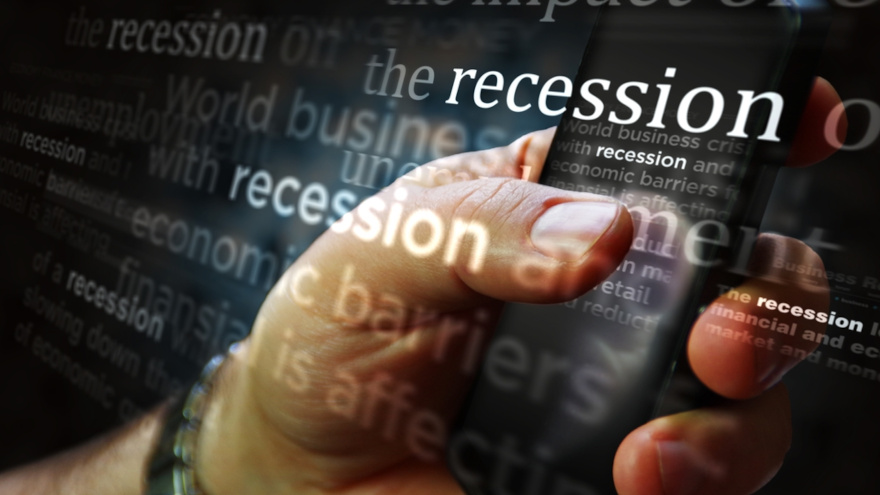
Image by Skorzewiak / Shutterstock.com.
By subscribing, you agree to receive communications from Auto Remarketing and our partners in accordance with our Privacy Policy. We may share your information with select partners and sponsors who may contact you about their products and services. You may unsubscribe at any time.
Experts from Comerica Bank, Edmunds and S&P Global Ratings tackled a variety of economic topics with connections to automotive, including the chance of a recession in the next 12 months, the Supreme Court’s decision about President Trump’s tariffs, and gross domestic product data.
Let’s begin with S&P Global Ratings.
The company says resilient growth momentum in the U.S., capital investment commitments related to artificial intelligence and positive fiscal impulse prompted analysts to lower their expectation of recession risk for 2026.
“We now judge probability of a recession starting within the next 12 months in the U.S. at 20%-25%, down from 30% in September,” S&P Global Ratings experts said in a news release highlighting availability of their new report titled, U.S. Business Cycle Barometer: Recession Risk Falls Amid Resilient Growth.
S&P Global Ratings continued, “The share of principal leading indicators giving positive signals of near-term growth increased in the last three months. Coincident indicators indicate slow growth but stable economic conditions.
“Despite rising vulnerabilities, we believe the U.S. economy looks capable of absorbing a potential equity market pullback driven by investors reassessing stretched tech and AI related valuations, as long as any correction reflects a normalization of pricing rather than a fundamental rethink of AI’s long-term growth story,” experts added.
Subscribe to Auto Remarketing to stay informed and stay ahead.
By subscribing, you agree to receive communications from Auto Remarketing and our partners in accordance with our Privacy Policy. We may share your information with select partners and sponsors who may contact you about their products and services. You may unsubscribe at any time.
Speaking of growth, Comerica Bank chief economist Bill Adams and senior economist Waran Bhahirethan on Monday recapped federal data that showed real GDP slowed to a 1.4% annualized increase in the fourth quarter, down from 4.4% annualized in the third quarter and falling below the 2.8% consensus forecast.
Adams and Bhahirethan pointed out that a drop in federal spending docked 1.15 percentage points from annualized growth.
While acknowledging the federal government shutdown was “a big headwind,” Adams and Bhahirethan said, “adjusted for that, the trend looked fine: Real final sales to private domestic purchasers grew a respectable 2.4% annualized—this measure of core GDP strips out swings in federal spending, inventory fluctuations, and the trade balance to track the trend.
“For 2025 as a whole, real GDP grew 2.2%, the slowest year since the 2020 recession,” the Comerica Bank experts continued. “The slowdown is because the federal government tightened fiscal policy by cutting nondefense discretionary spending and raising taxes on imports (tariffs). This shrank the fiscal deficit to 5.8% of GDP — good! — but came at the cost of weaker growth — bad. Even so, 2.2% is fast enough real GDP growth for the U.S. The bigger issue is that job growth didn’t keep up with GDP, since employers added just 15,000 jobs per month last year.
“From the Fed’s perspective, the economy’s growth momentum looks fine, but inflation is still too high,” Adams and Bhahirethan went on to say. “The Fed can be expected to hold short-term rates steady until Chair Powell’s term ends in May. Economic growth will ride tailwinds in 2026 from lower taxes, more government spending, the Fed’s rate cuts last year, an improving housing market, the continuing AI boom, and refunds of the reciprocal tariffs that the Supreme Court invalidated (on Friday). The biggest downside risk to growth is from labor supply bottlenecks.”
And speaking of that Supreme Court decision, Edmunds head of insights Jessica Caldwell addressed that development, explaining how the ruling might not be a significant headwind or tailwind to the automotive retailing and financing sectors.
“While today’s Supreme Court ruling has renewed attention around tariffs, it does not appear to affect existing tariffs on vehicles, auto parts, or key materials like steel and aluminum. As a result, the core cost structure facing the auto industry hasn’t fundamentally changed overnight,” Caldwell said Friday.
“So far, automakers appear to be absorbing much of that pressure. Edmunds data shows that average transaction prices for new vehicles remain historically high but have stayed relatively stable in recent months, even as tariffs remain in place,” she continued.
“That stability, however, reflects a delicate balancing act,” Caldwell added. “The industry is already operating in a challenging affordability environment, with elevated vehicle prices and persistently elevated interest rates making financing more expensive for consumers. If cost pressures continue to build, automakers may have less room to shield shoppers from higher prices — but for now, the broader market impact is still playing out.
“One bright spot for shoppers may be the used market,” she said. “After a shortage of lease returns in 2025, Edmunds expects off-lease volumes to increase this year, bringing more near-new used vehicles back into the market. That should give consumers a broader selection and potentially more affordable options compared with what was available in 2025.”