
Equifax notices multiple subprime trends within outstanding portfolio & originations
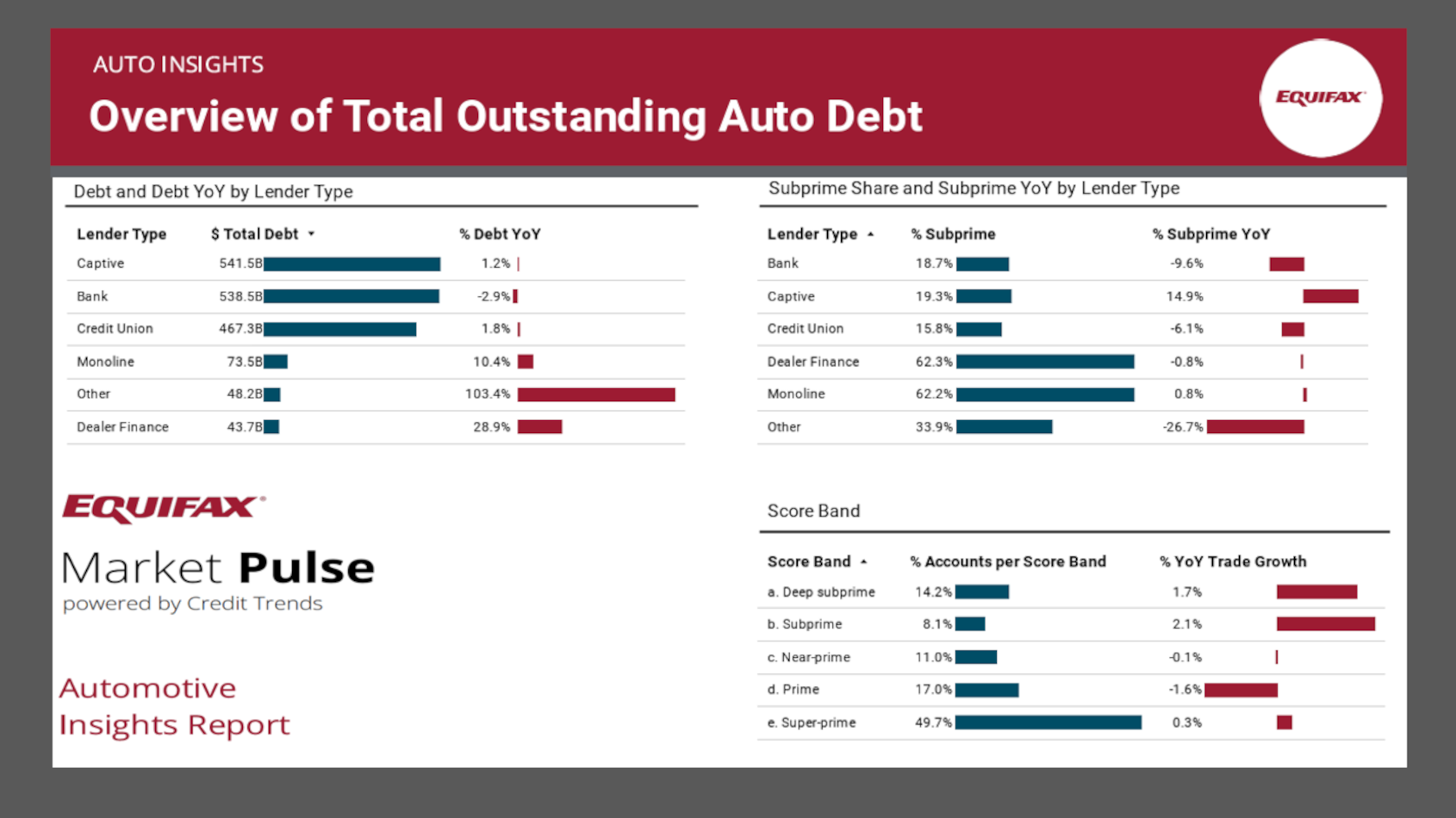
Charts courtesy of Equifax.
By subscribing, you agree to receive communications from Auto Remarketing and our partners in accordance with our Privacy Policy. We may share your information with select partners and sponsors who may contact you about their products and services. You may unsubscribe at any time.
The July installment of the Automotive Industry Market Pulse from Equifax included multiple noteworthy trends connected to subprime auto financing.
Equifax reported total outstanding auto debt reached $1.7 trillion in May, representing a 2.4% increase year-over-year. Pushing the figure higher was a 14.9% surge in the subprime share.
While total account volume grew slightly by 0.3% to 87.4 million loans, Equifax also highlighted the subprime share of debt grew by 1.3% to reach 21.5%.
“This portfolio divergence indicates that rising vehicle valuations are sustaining balance growth even as unit volume stabilizes. Lender dynamics reveal a clear shift in risk appetite,” Equifax said in the report that’s designed to provide automotive professionals with the latest auto credit information and industry insights to help them make informed decisions.
Furthermore, Equifax pointed out that deep subprime contracts now represent the second-highest category of all outstanding loans, with the segment constituting 14.2% of all accounts as of May. Only super-prime at 49.7% constitutes a higher proportion of outstanding portfolios, according to Equifax tracking.
Equifax elaborated further about the subprime segment in a blog post that accompanied its newest Automotive Industry Market Pulse, acknowledging lenders are taking different approaches to risk
Subscribe to Auto Remarketing to stay informed and stay ahead.
By subscribing, you agree to receive communications from Auto Remarketing and our partners in accordance with our Privacy Policy. We may share your information with select partners and sponsors who may contact you about their products and services. You may unsubscribe at any time.
“Captive lenders posted significant growth in outstanding auto debt, increasing their portfolios to $541.5 billion while significantly expanding subprime exposure. Banks moved in the opposite direction, reducing both outstanding balances and their subprime concentration. Credit unions continued to grow steadily while maintaining a more measured risk profile,” Equifax said.
“These differences suggest that lenders are responding to today’s market with distinct priorities. Some are pursuing growth opportunities within higher risk segments, while others are emphasizing portfolio quality and long-term stability,” Equifax continued.
“For automotive professionals, these shifts provide valuable insight into where competition may intensify and how financing options could evolve across the market,” Equifax went on to say.
Equifax also examined originations via data available through March.
During the first quarter, Equifax determined originations totaled 6.3 million; a number off by 1.0% year-over-year. But the amount financed at the time of booking climbed 4.5% year-over-year to land at $195.5 billion.
Again, subprime surfaced with Equifax indicating that the subprime share of originations rose 11.2% to 19.1%.
“These mechanics suggest that higher average loan amounts are primarily driving originated balance growth rather than a surge in new unit volume,” Equifax said.
Also of note, Equifax mentioned how risk averse credit unions were in Q1. Originations by this segment of providers softened by 0.5% to 1.6 million loans.
Sliding even more were captive originations, which fell by 8.6% to 1.8 million units, according to Equifax tracking that also revealed credit tier distribution for new loans remains heavily weighted toward the super-prime band since it accounts for 49.5% of loans and 65.7% of leases.
After sharing the data, Equifax wrapped up its observations of auto financing this way.
“Higher loan balances continue to support portfolio growth even as origination volumes level off. Lenders are pursuing markedly different risk strategies, demographic preferences continue to reshape competition, and synthetic identity fraud remains an important consideration even among high-quality borrowers,” Equifax said.
“For automotive professionals, success will depend on looking beyond headline growth numbers. Understanding how lender strategies, borrower behavior, and fraud risk intersect will be essential for making smarter lending decisions and identifying opportunities in an increasingly competitive market,” Equifax went on to say.