Fed’s Waller explains reasons for potential interest-rate uptick coming next week
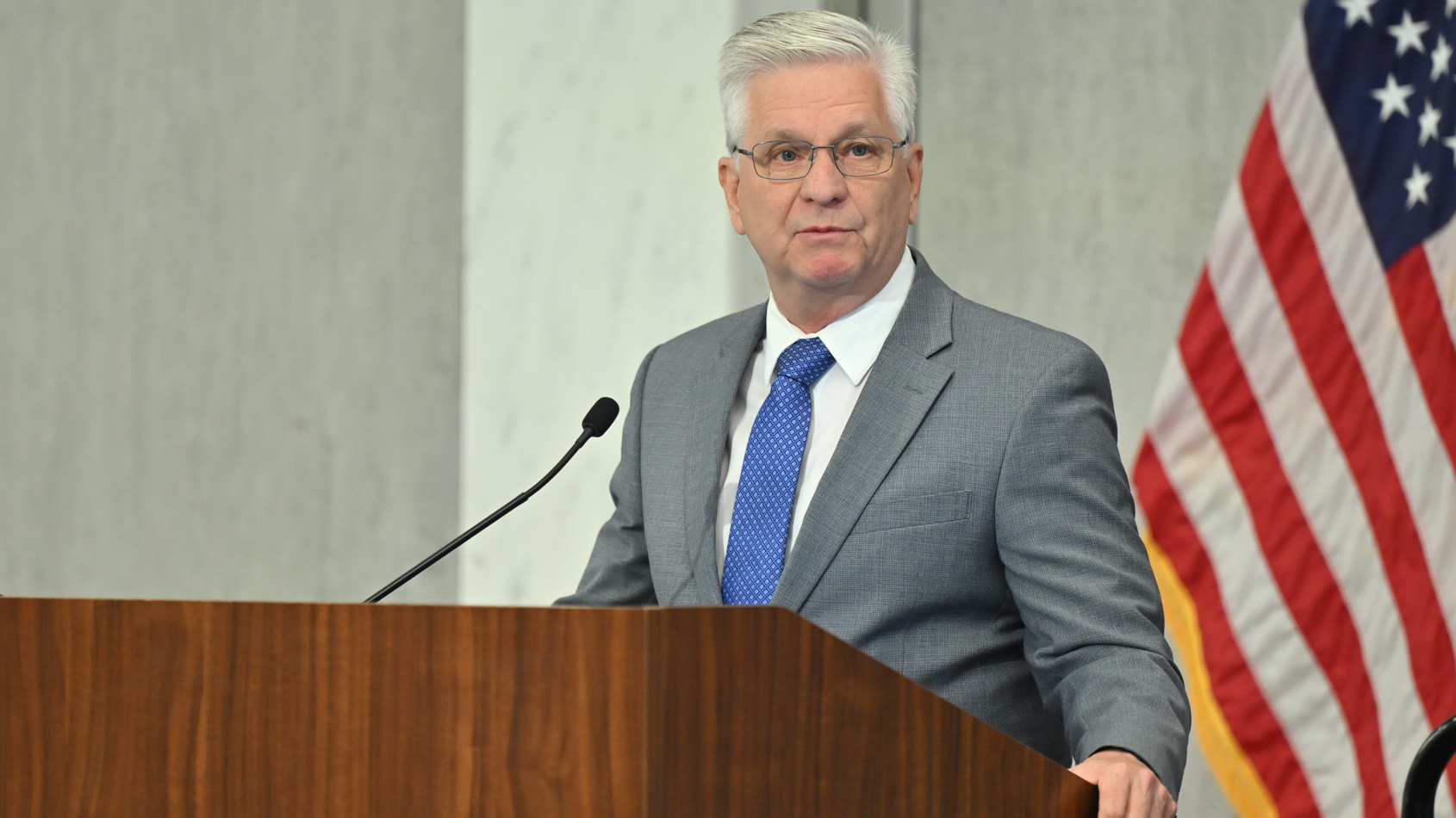
Federal Reserve Governor Christopher Waller delivered welcoming remarks at the Fifth Conference on the International Roles of the U.S. Dollar on June 22. Image courtesy of the Fed.
By subscribing, you agree to receive communications from Auto Remarketing and our partners in accordance with our Privacy Policy. We may share your information with select partners and sponsors who may contact you about their products and services. You may unsubscribe at any time.
Federal Reserve Governor Christopher Waller continued his pattern of being forthcoming about the economy and what he might do as part of the Federal Open Market Committee (FOMC) that decides interest rates, creating rippling impacts from the car business to Wall Street and beyond.
Last week in Washington, D.C., Waller explained why he might choose to push interest rates higher when the FOMC meets again next Tuesday and Wednesday and has its next opportunity to adjust the federal funds rate for the first time since December.
“As of today, the labor market is stable, with employment near its maximum sustainable level, and inflation is making slow but continued progress on reaching 2%,” Waller told the gathering just before Labor Day weekend. “We will get another employment report and inflation reading before the next FOMC meeting. I don’t expect that the employment data will deviate much from what we have been seeing. So, my decision on the appropriate stance of policy will be heavily influenced by what we learn about August inflation. If there is continued progress toward our 2% goal, then I am willing to support holding the policy rate at its current level.
“But if inflation comes in hot, I would consider a rate hike,” Waller continued. “I judge that policy is currently only slightly restricting aggregate demand, and it may not take much acceleration in inflation to nudge me into supporting tighter policy. If there is evidence that progress toward 2% inflation reversed in August, a small adjustment in our stance would help ensure that it resumes.”
Before anyone started to think Waller’s comments were outlandish, the Fed policymaker wrapped up his latest appearance by distinguishing what he called the three types of communication that matter for monetary policy and how he tries to communicate my views to the public.
“First, I try to communicate why I have taken my current policy position. If I vote to hold rates steady, I explain how current economic conditions affected my policy decision. I was comfortable supporting the FOMC’s decision in late July to hold rates steady because the data at that time led me to view the real side of the economy as solid and we finally saw hints that disinflation may be starting. So I was willing to be patient and see if the disinflation would continue,” Waller said.
Subscribe to Auto Remarketing to stay informed and stay ahead.
By subscribing, you agree to receive communications from Auto Remarketing and our partners in accordance with our Privacy Policy. We may share your information with select partners and sponsors who may contact you about their products and services. You may unsubscribe at any time.
“The second way in which I communicate is to explain how future economic data will shape my future monetary policy decisions — in short, I try to describe my ‘reaction function.’ When thinking about future data, I communicate that if the data comes in a particular way, then I will advocate for policy to be set a particular way,” he continued. “The key point here is that this it is not a commitment to a policy action—it is a conditional policy statement. A different economic outcome would lead me to advocate for a different policy action. In my remarks today, I have outlined what it would take for me to support a continued pause as well as what would cause me to support tighter policy.
“By communicating my reaction function, consumers, businesses, and investors can better understand how I will vote on policy given the range of outcomes and then factor that into their planning for the future,” he added.
Before getting into the third portion of his communication strategies, Waller offered this acknowledgement, using a baseball analogy.
“Now, is that reaction function perfect? No. But my years as a professional economist and policymaker have given me substantial knowledge on how policy should respond to shocks,” Waller said. “In this sense, I view myself as a home plate umpire in baseball. The pitcher is trying to strike out the batter, and the batter is trying to hit the ball or walk to get on base. Both want to play the ball, but they cannot do that until they know the umpire’s strike zone. The strike zone is the umpire’s reaction function. If the ball goes here, it’s a strike; if it goes there, it’s a ball. The players don’t expect the umpire to have a perfect strike zone. They just need a rough idea of its parameters and some guarantee that it won’t change much on every pitch. Perfection is not needed for them to play well.
“So, when it comes to my reaction function, I do not let perfection become the enemy of the good,” he went on to say.
Waller closed with his third communication path, which is one investment observers often latch on to when publicly traded companies report their quarterly financial results. It’s forward guidance that Waller said specifies a path for the policy rate that is essentially independent of incoming data.
“This type of communication is most warranted when the policy rate is at the effective lower bound and additional communication is needed to guide market expectations,” he said. For example, by September 2021 it was clear to me that we needed to raise the policy rate to deal with accelerating inflation. But as this would only happen after asset purchases had stopped, I supported forward guidance that strongly signaled the end of those purchases, setting the stage for rate increases in 2022. By communicating to markets that rate hikes were coming and coming soon, market interest rates began to climb. By March 2022, the two-year Treasury note had increased 200 basis points, and we hadn’t moved the policy rate off the effective lower bound yet.
“In this example, forward guidance helped tighten economic conditions long before we actually raised the policy rate. But it is important to remember that those actions were taken when the policy rate was near zero. I agree with Chairman (Kevin) Warsh that forward guidance isn’t appropriate now or in many other situations. But when it is truly needed, I believe it should be used,” Waller added.