
Fed’s Waller recaps impact of labor market’s ‘head-snapping volatility’ on policymakers’ next rate decision
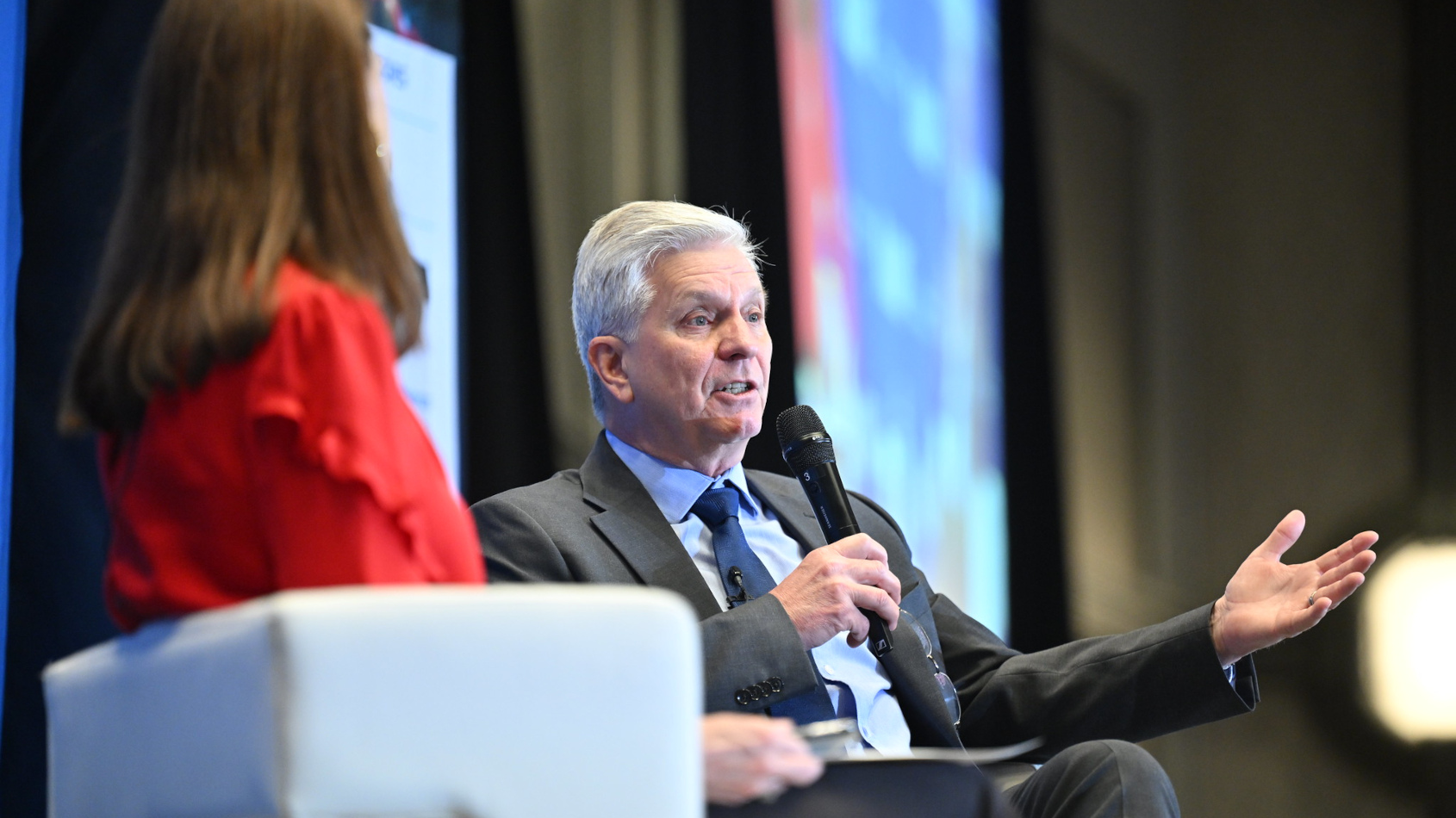
Federal Reserve Governor Christopher Waller is pictured at the 42nd annual NABE Economic Policy Conference hosted by the National Association for Business Economics in Washington, D.C., on Feb. 23. Image courtesy of the Fed.
By subscribing, you agree to receive communications from Auto Remarketing and our partners in accordance with our Privacy Policy. We may share your information with select partners and sponsors who may contact you about their products and services. You may unsubscribe at any time.
Federal Reserve Governor Christopher Waller made another public appearance on Friday. This time, Waller was back in Alabama, where he previously served as a professor at Auburn University.
Ahead of next week’s Federal Open Market Committee (FOMC) meeting when policymakers will consider a change to interest rates, Waller described how difficult the labor market is making the task.
Waller recapped how federal readings of payroll gains and losses for the past 10 months have swung back and forth more than a Southeastern Conference football game on the Auburn campus. He pointed out the job market shed 17,000 positions in December, grew by 160,000 in January — what Waller said was the largest increase in more than a year — tumbled by 133,000 in February and rebounded to climb by 178,000 in March.
“This head-snapping volatility has only made it harder to assess the state of the labor market and where things stand relative to the FOMC’s maximum-employment goa,” Waller told the assembled gathering in Auburn, Ala.
“I am going to have to get used to payroll numbers that are lower than I am accustomed to seeing in a growing economy as well as the possibility that even several months of negative payrolls may not be the warning sign of a recession that it often has been in the past,” he continued.
Next, Waller recapped the Job Openings and Labor Turnover Survey data, noting that information “is consistent with what business contacts have been telling me,” as well as what has been collected in the Federal Reserve’s Beige Book survey of business conditions.
Subscribe to Auto Remarketing to stay informed and stay ahead.
By subscribing, you agree to receive communications from Auto Remarketing and our partners in accordance with our Privacy Policy. We may share your information with select partners and sponsors who may contact you about their products and services. You may unsubscribe at any time.
“On the one hand, employers are hesitant to shed workers, even in the face of softening demand, perhaps because of the difficulties they faced in finding workers in the tight labor market after the pandemic,” Waller said. “On the other hand, employers are very hesitant to hire workers because of the considerable uncertainty over the outlook.
“My sense is that employers are walking a tightrope between their earlier challenges in finding qualified workers and where they think the economy is going, leaving them vulnerable to some economic shock that could tip them over and lead to significant job reductions,” he continued. “While the unemployment rate is fairly steady and close to FOMC participants’ views of its longer-term, or natural, rate, data on job finding, availability, and openings are continuing to edge lower.
“The low job-finding rate means that workers are unemployed for longer, and behind the fairly stable count of unemployed people, a growing share are out of work for an extended time,” Waller went on to say.
Then, Waller uttered what was likely percolating in attendees’ minds — perhaps as much as how long Auburn’s newest football coach will remain in place.
So, what happens next?
“Let me stipulate that I believe economic forecasting is hard even in normal circumstances,” Waller said. “I am tempted to say it is a bit like batting averages in baseball, where an excellent result is failing two-thirds of the time, but that wouldn’t be fair to baseball. We forecasters have an even lower rate of success.
“Anyway, add a military conflict in the Middle East to the task of predicting the course of the economy, and things get very complicated,” he continued. “The first thing to do is establish a good baseline, which I hope I have done in the foregoing discussion of the outlook on the eve of the conflict’s outbreak. Beyond that, when presented with a new development that could produce a range of economic outcomes, I have found it helpful to use stylized scenarios.”
While Waller didn’t completely divulge what he might do back in Washington, D.C., where the Fed assembles next Tuesday, he again explained how he intends to approach an interest-rate decision.
“But the longer energy prices remain elevated and the Strait of Hormuz is constrained, the greater the chances that higher inflation gets embedded across a wide variety of goods and services, various supply chain effects start to emerge, and real activity and employment start to slow,” Waller said. “I will be particularly attentive to indications that this latest price shock, on top of the effects from tariffs, has moved up inflation expectations.
“A slower economy would restrain demand for goods and services, and perhaps soften the increase in prices, but I expect higher inflation than in the first scenario and that it would be elevated for some time,” he continued. “In this case, I also believe we would have a weaker labor market. High inflation and a weak labor market would be very complicated for a policymaker.
“If I face this situation, I’ll have to balance the risks to the two sides of the Fed’s dual mandate to determine the appropriate path of policy, and that may mean maintaining the policy rate at the current target range if the risks to inflation outweigh those to the labor market,” Waller went on to say.