July VantageScore report notes stability in auto delinquency & overall scores
Charts courtesy of VantageScore.
By subscribing, you agree to receive communications from Auto Remarketing and our partners in accordance with our Privacy Policy. We may share your information with select partners and sponsors who may contact you about their products and services. You may unsubscribe at any time.
The latest edition of CreditGauge from VantageScore contained multiple metrics executives and managers could see as positives, including delinquency in auto finance.
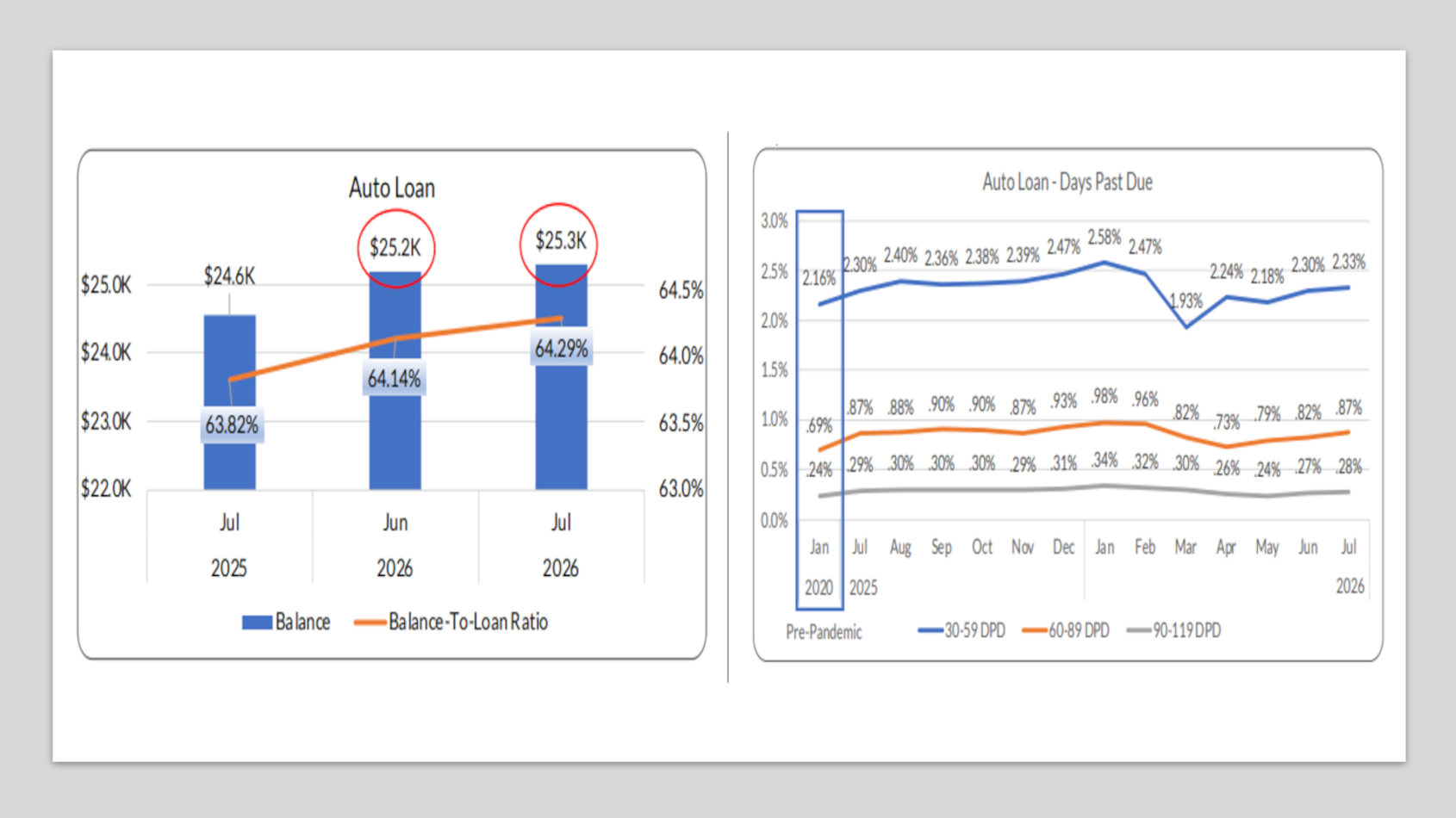
VantageScore reported for its July installment that each of its three segments of auto delinquency remained stable compared to the previous month and year. Here’s the breakdown:
30-59 days past due: 2.33% in July, compared to 2.30% in June and 2.30% last July
60-89 days past due: 0.87% in July, compared to 0.82% in June and 0.87% last July
90-119 days past due: 0.28% in July, compared to 0.27% in June and 0.29% last July
Readings like those prompted VantageScore to claim that consumers continued to largely maintain their credit health in July, characterized by easing delinquencies in other parts of financial services and low credit card utilization.
Subscribe to Auto Remarketing to stay informed and stay ahead.
By subscribing, you agree to receive communications from Auto Remarketing and our partners in accordance with our Privacy Policy. We may share your information with select partners and sponsors who may contact you about their products and services. You may unsubscribe at any time.
Analysts explained the balance-to-loan (BTL) ratio declined to its lowest level of the year, while credit card utilization was below July 2025 levels despite modest growth in average balances.
They added the average VantageScore credit score decreased slightly to 701 but remained within the narrow 700 to 702 range seen over the past year.
“Consumers have continued to enjoy strong momentum in credit health this summer, keeping up with their payments and refraining from using all of their available credit,” said Atif Mirza, executive vice president and chief digital and insights officer at VantageScore.
“At the same time, personal loans may be an area to keep an eye on as consumers try to stay afloat amid the current high-cost environment,” Mirza said in a news release.
Personal loans were the only major product to show year-over-year increases across all delinquency stages, according to VantageScore.
In July, VantageScore indicated the average personal loan balance remained stable at $17,000 compared to June but below the $17,300 average recorded in July of last year. Meanwhile, the balance-to-loan ratio increased to 70.79%, up from 70.57% in June and 70.45% a year ago
Getting back to auto finance, analysts indicated the average auto loan balance in July rose to $25,300. That’s up modestly ($99) from June. It’s 2.6% or $743 higher versus a year earlier.
VantageScore also mentioned the balance-to-loan ratio in auto increased to 64.29%, its highest level in the past year.
Higher average balances may reflect persistently elevated vehicle prices and borrowing costs, which continued to pressure auto affordability,” analysts said in the report, which is available online.
And revisiting overall credit scores, the average VantageScore 4.0 credit score of 701 followed June’s modest increase, returning to levels observed for much of the past year.
“The slight decline may partly reflect recent changes in student loan reporting and higher charge-off activity,” analysts said in the report. “Despite monthly fluctuations within a narrow 700–702 range, average credit scores have remained broadly stable, indicating resilient overall consumer credit quality amid ongoing affordability and borrowing-cost pressures.”
Analysts closed by noting the distribution of consumers across VantageScore credit tiers remained broadly stable in July.
Year-over-year, VantageScore prime declined modestly from 32.5% to 32.3%, while VantageScore near-prime edged up from 17.7% to 17.8% and VantageScore subprime from 18.7% to 18.8%. VantageScore super-prime remained unchanged at 31.1%.
“The modest shift toward lower credit tiers is consistent with some ongoing affordability pressure, but the overall distribution continued to signal resilient consumer credit quality,” VantageScore said.