LendingTree spots states with most and least consumers carrying $1,000 car payments
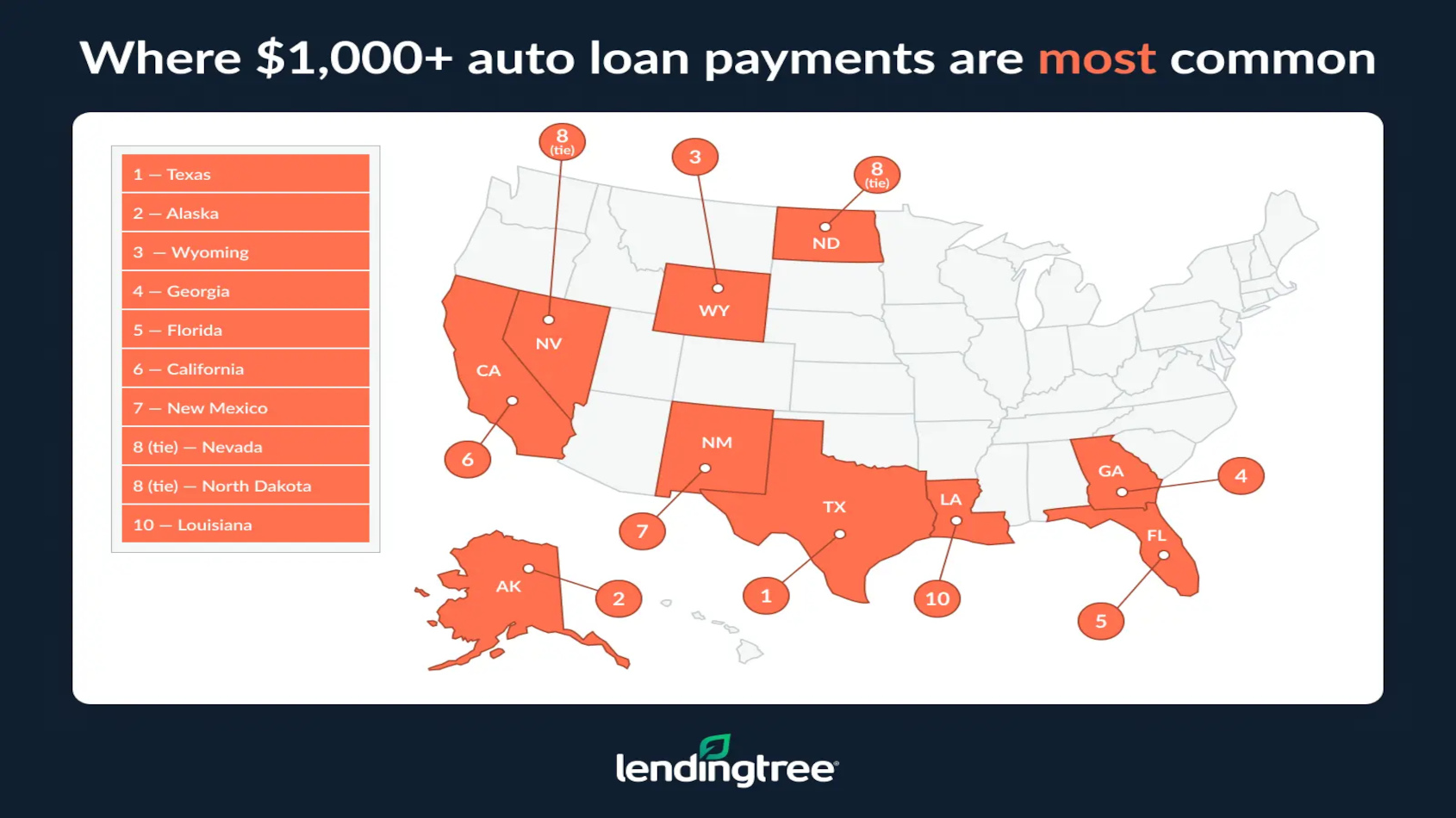
Graphic courtesy of LendingTree.
By subscribing, you agree to receive communications from Auto Remarketing and our partners in accordance with our Privacy Policy. We may share your information with select partners and sponsors who may contact you about their products and services. You may unsubscribe at any time.
It may now seem farfetched, but there really was a time when some consumers only used $1,000 a month to cover rent, car payment and other expenses.
New LendingTree research showed that $1,000 now is enough only for some vehicle-loan commitments in states like Texas.
Analysts recently found that nearly one in 10 Americans with an active auto loan now pays at least $1,000 a month for their vehicle. Here are more top findings courtesy of a LendingTree news release:
—9.6% of Americans with active auto loans had at least one monthly payment of $1,000 or more. That’s up from 8.6% last year and equivalent to 14.0% of the median household monthly income of $7,147 a month.
—High car payments are most common in Texas, as 14.9% of borrowers with active auto loans in the Lone Star State have at least one monthly payment that’s at least $1,000. Overall, 16 states have shares of at least 10.0%.
—Four-figure car payments are least common in the Northeast and Midwest. Rhode Island has the lowest share of $1,000 monthly payments at 4.4%, followed by Maine at 5.7% and Pennsylvania at 6.0%.
Subscribe to Auto Remarketing to stay informed and stay ahead.
By subscribing, you agree to receive communications from Auto Remarketing and our partners in accordance with our Privacy Policy. We may share your information with select partners and sponsors who may contact you about their products and services. You may unsubscribe at any time.
—Gen Xers are most likely to have a $1,000 car payment, as LendingTree found that 12.0% of Gen Xers with an auto loan have at least one monthly payment at that level. That compares with 9.3% of baby boomers, 9.0% of millennials and 3.8% of Gen Z consumers.
—Higher credit scores are linked to larger monthly auto payments. Borrowers with credit scores of 720 or higher are the most likely to have a $1,000-plus monthly payment, at 11.4%.
“A $1,000 car payment is really, really high, but many Americans are clearly willing to take them on,” LendingTree chief consumer finance analyst Matt Schulz said in the news release.
“In much of this country, you can’t get by without a vehicle. This isn’t just about what people need. It’s also about what they want, and Americans love their vehicles. That passion for cars, trucks and SUVs drives a whole lot of spending, too,” Schulz continued.
In the LendingTree report, Schulz called these figures “troubling,” especially since they don’t even factor in other car ownership costs like insurance, maintenance or fuel.
“If you’re putting that much of your income into a car payment, it means you’re likely not putting enough of your income toward building an emergency fund, investing for retirement, saving for a mortgage down payment or other long-term financial goals,” Schulz said. “It shrinks your financial margin for error in a major way, and that’s the last thing people need today.”
Researchers analyzed a sample of about 180,000 anonymized credit reports of LendingTree users from the fourth quarter of last year.
The analysis focused on users with active auto loan debts, including both individual and joint accounts. Analysts calculated the percentage of consumers with at least one monthly auto loan payment of $1,000 or more.
The analysis was conducted nationally and by state, generation and credit score. LendingTree defined generations based on the following age groups:
Generation Z: 18 to 28
Millennial: 29 to 44
Generation X: 45 to 60
Baby boomer: 61 to 79
And analysts defined credit score groups based on the following ranges:
Deep subprime: Below 580
Subprime: 580 to 619
Near-prime: 620 to 659
Prime: 660 to 719
Super-prime: 720 or above
LendingTree researchers used the U.S. Census Bureau 2024 American Community Survey with one-year estimates for household income by state. Those income figures were then projected to 2026 using Bureau of Economic Analysis (BEA) personal income data accessed through Federal Reserve Economic Data (FRED).
Analysts added that projected annual median household income was divided by 12 to estimate monthly median household income in each state. Researchers then calculated what share of that monthly income a $1,000 car payment would represent and ranked states based on that percentage.
LendingTree went on to say that U.S. figures were calculated separately and shown as a national comparison.