TransUnion: Subprime auto originations climb for fifth consecutive quarter
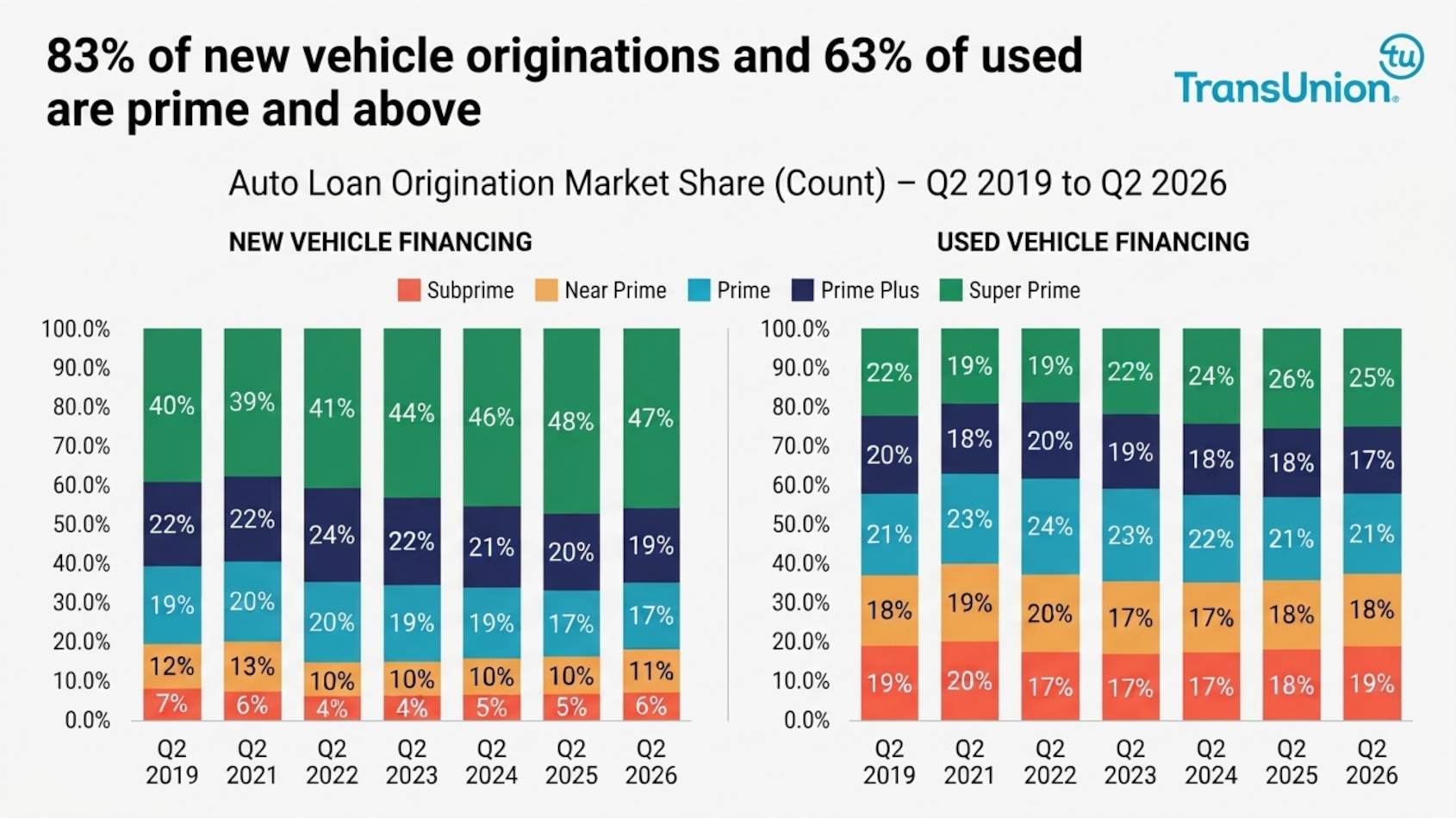
Graphic created from data in TransUnion’s Q3 2026 Credit Industry Insights Report (CIIR) using Nano Banana 2.
By subscribing, you agree to receive communications from Auto Remarketing and our partners in accordance with our Privacy Policy. We may share your information with select partners and sponsors who may contact you about their products and services. You may unsubscribe at any time.
TransUnion’s Q3 2026 Credit Industry Insights Report (CIIR) contain details about auto originations that are one quarter in arrears to account for reporting lag.
But that probably won’t take away from the significance of what’s happening in subprime that analysts reported on Thursday. Auto loan originations totaled 6.8 million in the second quarter, That’s 2.3% higher year-over-year.
TransUnion highlighted growth was concentrated in below-prime segments, led by subprime originations at 9.8%.
Subprime originations now have increased for five consecutive quarters, according to TransUnion tracking.
What could be viewed as of the third quarter was outstanding auto loan balances, which reached $1.65 trillion in Q3. TransUnion said that’s 2.1% higher year-over-year, adding that average new account balances increased 4.1%.
Analysts explained rising vehicle costs continued to push financing amounts higher year-over-year, with average balances financed increasing 3.5% for new vehicles and 3.9% for used vehicles.
Subscribe to Auto Remarketing to stay informed and stay ahead.
By subscribing, you agree to receive communications from Auto Remarketing and our partners in accordance with our Privacy Policy. We may share your information with select partners and sponsors who may contact you about their products and services. You may unsubscribe at any time.
What might delight finance companies most is TransUnion said payment performance remained generally stable.
Analysts indicated the delinquency rate for accounts 60 days or more past due dipped 2 basis points year-over year to settle at 1.43% as of Q3.
TransUnion pointed out that Q4 2025 new account vintages show similar delinquency levels in their first year as pre-pandemic originations, particularly among prime and lower credit risk tiers.
Analysts also mentioned used-vehicle vintages showed modest improvement, while new-vehicle vintages showed some deterioration.
Satyan Merchant is senior vice president and automotive and mortgage business leader at TransUnion.
“The auto finance market remains resilient, with originations growing year-over-year even as balances and monthly payments rise,” Merchant said in a news release. “Lending continues to grow, particularly among below-prime consumers, while higher vehicle and ownership costs continue to influence purchasing decisions.
“Overall delinquency remains relatively stable, suggesting consumers are managing their obligations. Looking ahead, affordability, shifting vehicle preferences and performance across consumer segments will remain important factors shaping the market,” Merchant continued.
Looking at personal loans
TransUnion determined the unsecured personal loan market reached new highs in Q3, with originations climbing 22.7% year-over-year to a record 8.41 million loans and outstanding balances rising 9.0% to $293.4 billion.
Analysts added that the number of consumers carrying an active unsecured personal loan balance also increased 8.3% to 28.0 million.
TransUnion noticed fintechs remained the primary growth engine, originating 49.4% of all unsecured personal loan and contributing the majority of year-over-year origination growth.
“While finance companies and credit unions posted modest gains and bank volumes were flat, these traditional lender groups continued to hold significant balances and maintain consistent credit performance,” analysts said in the news release.
TransUnion also noted credit trends were mixed as borrower-level delinquency increased while balance-level performance remained stable.
Analysts said the share of borrowers 60 days or more past due rose to 4.12%, but balance-level 60-day delinquency held steady at 1.95% and new charge-off balances declined, limiting growth in overall dollar exposure.
Josh Turnbull is senior vice president and consumer lending business leader at TransUnion.
“The unsecured personal loan market continues to expand as lenders meet strong consumer demand, driving record originations, balances and borrower counts. Notably, growth is being fueled by a larger number of smaller loans, particularly among subprime consumers, helping broaden access without a proportional increase in overall exposure,” Turnbull said.
“While borrower-level delinquency has risen, stable balance-level performance and declining charge-offs suggest risk remains manageable. Looking ahead, lenders will remain focused on balancing growth opportunities with disciplined underwriting as market participation continues to widen,” he continued.
Overall credit observations
Following a period of rapid growth, TransUnion said the credit market has settled into a more consistent expansion pattern.
Analysts tabulated total outstanding balances grew by roughly 3% year-over-year in Q3 as the number of credit-active consumers reached 263 million.
TransUnion also mentioned the K-shaped distribution that emerged in recent years, with growth concentrated among both super prime and below prime consumers, has largely stabilized.
Jason Laky is executive vice president and head of financial services at TransUnion.
“Lenders have limited exposure and improved portfolio performance through the use of strategies such as lower credit lines, smaller loan amounts and interest rate adjustments for consumers in below prime risk tiers. As a result, balance-level delinquencies have declined even as a greater share of lending has gone to higher-risk borrowers,” Laky said.
Charlie Wise is head of global research and consulting at TransUnion.
“The most effective lending strategies recognize that financial success is shared between borrowers and lenders,” Wise said. “As lenders continue balancing growth with prudent risk management, consumers are increasingly focused on managing budgets and meeting obligations.
“When both sides make thoughtful, data-informed decisions, credit can remain accessible, sustainable, and beneficial for consumers seeking financial opportunities and lenders safeguarding long-term portfolio performance,” Wise went on to say.
To learn more about the latest consumer credit trends, register for the Q3 2026 Quarterly Credit Industry Insights Report webinar via this website.