Metrics that formed April’s Dealertrack Credit Availability Index ‘masked a more complex picture’
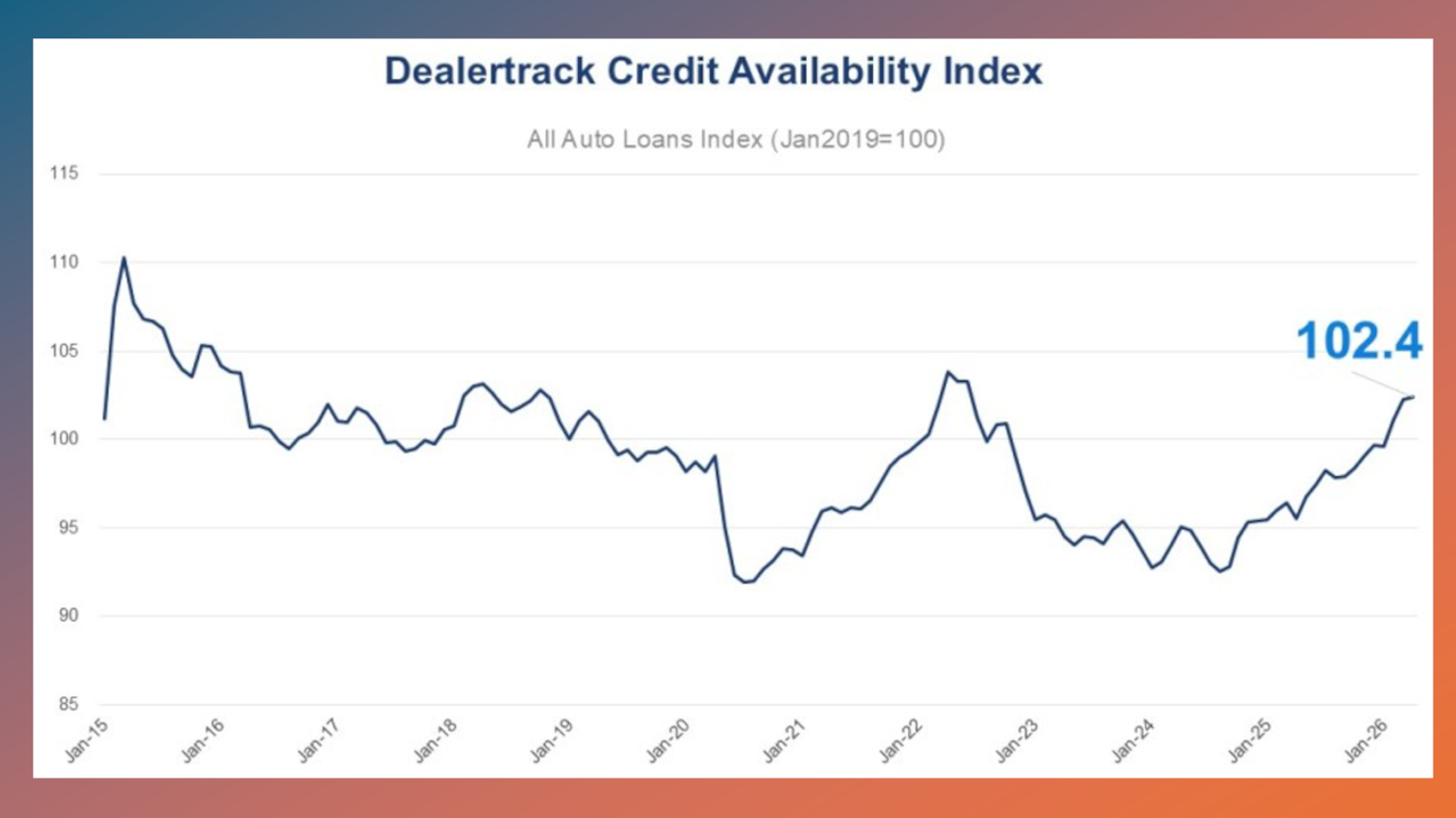
Chart courtesy of Cox Automotive.
By subscribing, you agree to receive communications from Auto Remarketing and our partners in accordance with our Privacy Policy. We may share your information with select partners and sponsors who may contact you about their products and services. You may unsubscribe at any time.
Few gauges of the car business are as clear as newly installed windshield. And the newest reading of the Dealertrack Credit Availability Index reinforces that point.
Cox Automotive reported Monday that the April index climbed to 102.4, its highest level since June 2022. But Jonathan Gregory, who is a senior director on Cox Automotive’s economic and industry insights team, explained that the reading was essentially unchanged from March’s revised-lower 102.3 and “masked a more complex picture beneath, as gains in some key metrics offset losses in others.”
The index also is approximately 7.2% higher than a year ago, according to Gregory’s online commentary that accompanied the update.
As you might recall, the Dealertrack Credit Availability Index tracks six factors that affect auto credit access, including:
—Approval rates
—Subprime share
—Yield spreads
—Term length
—Negative equity
—Down payments
Reported monthly, the index indicates whether access to auto credit is improving or declining. This typically means that it is cheaper and easier for consumers to obtain a loan or more expensive and harder.
Subscribe to Auto Remarketing to stay informed and stay ahead.
By subscribing, you agree to receive communications from Auto Remarketing and our partners in accordance with our Privacy Policy. We may share your information with select partners and sponsors who may contact you about their products and services. You may unsubscribe at any time.
“The month’s most significant movement was a sharp pullback in subprime lending, which was the largest drag on the index,” Gregory said in his analysis. “Narrowing yield spreads, longer loan terms, and a recovery in approval rates collectively offset that pressure.
“However, longer loan terms reached a new all-time high in doing so, and negative equity remains deeply elevated year over year despite a slight easing from March’s record, both signals that affordability challenges and balance sheet risk across the auto finance market persist,” he continued.
Let’s delve deeper into some of those trends Gregory mentioned, starting with the subprime segment, which TruDecision’s Daniel Parry also discussed recently.
Cox Automotive found that the share of financing to subprime consumers fell sharply in April, declining 210 basis points month-over-month, from 19.5% in March to 17.4% in April.
Gregory explained the April pullback followed March’s surge to its highest reading since March 2020. Despite the decline, he said subprime share remains elevated, jumping 370 basis points year-over-year.
Cox Automotive also reported the share of contracts with terms longer than 72 months increased 90 basis points month-over-month, increasing from 28.8% to 29.7% and setting a new all-time high in its dataset and surpassing the previous record of 29.3% set in February.
Gregory said the metric is up approximately 470 basis points year-over-year.
“The continued extension of loan terms reflects persistent affordability pressures,” he said. “Even as loan rates dipped modestly in April, consumers continue to stretch repayment horizons to manage monthly payment burdens, extending the period of financial exposure.”
Meanwhile, Cox Automotive noticed the share of borrowers with negative equity in April declined 70 basis points month-over-month to 58.5%, ending a three-month streak of record highs.
Despite this “modest” improvement, Gregory pointed out that the share of contracts with negative equity increased approximately 540 basis points year-over-year, up from 53.1% in April 2025.
“The elevated level signals that a substantial share of borrowers continue to carry loan balances that exceed their vehicle’s value, a persistent source of risk for both borrowers and lenders,” Gregory said.
And the risk lenders are absorbing continues to intensify since the down payment percentage continues to soften.
Cox Automotive said the average down payment percentage decreased 50 basis points in April, declining from 13.9% to 13.4%. Gregory added that it’s also about 130 basis points lower year-over-year from around 14.7% in April 2025.
When it comes to the yield spread, Cox Automotive computed that it narrowed by 59 basis points in April, sliding from 7.84 to 7.25. That’s a direct reversal from the widening of 31 basis points in March.
Gregory determined the average contract rate declined 50 basis points to 11.2%, while the five-year Treasury yield rose 9 basis points to 3.94%.
“The narrowing spread reflects more favorable borrowing conditions for consumers in April,” he said.
Bottom line: Cox Automotive indicated the approval rate for auto finance rose to 71.0% in April, climbing 60 basis points from March’s reading, which was revised to 70.4%.
Gregory added approval rates are 120 basis points lower than April of last year, “continuing a trend of year-over-year tightening of loan approvals even as month-over-month conditions improved.”
Per usual, Gregory wrapped up his analysis by separately commenting through the prism of consumers and lenders. First, here’s what he said about the prospects for individuals looking to secure financing.
“April brought a more favorable pricing environment compared to March, with the yield spread narrowing nearly 60 basis points and the average contract rate falling 50 basis points. For consumers who financed in April, this represented a tangible improvement in borrowing cost,” Gregory said.
“However, the broader picture carries important cautions,” he continued. “Loan terms reached a new all-time high of 29.7% with terms greater than 72 months, meaning more consumers are extending repayment to 6 or more years to manage monthly payments.
“Combined with negative equity that remains nearly 540 bps above year-ago levels, consumers face compounding financial risk that can be difficult to unwind, and should carefully consider the full terms of any financing offer, particularly total loan length and overall cost,” Gregory went on to say.
What about the prospects for credit providers?
“Banks again led credit expansion in April, posting the strongest monthly gain for the second consecutive month and continuing to extend their year-over-year lead,” Gregory said. “Finance companies also improved. The pullback in captive and credit union credit access is notable and may reflect portfolio management decisions in an environment where structural risk indicators remain elevated.
“The sharp retreat in subprime lending in April is a positive development from a risk management standpoint; however, the subprime share remains 370 basis points above year-ago levels, and the new all-time high in loans exceeding 72-month terms signals that portfolio risk remains a key watchpoint,” he continued. “Balancing volume growth with disciplined underwriting will continue to be important as these longer-term indicators build.”