
TransUnion’s April Credit Industry Snapshot shows positives for auto finance
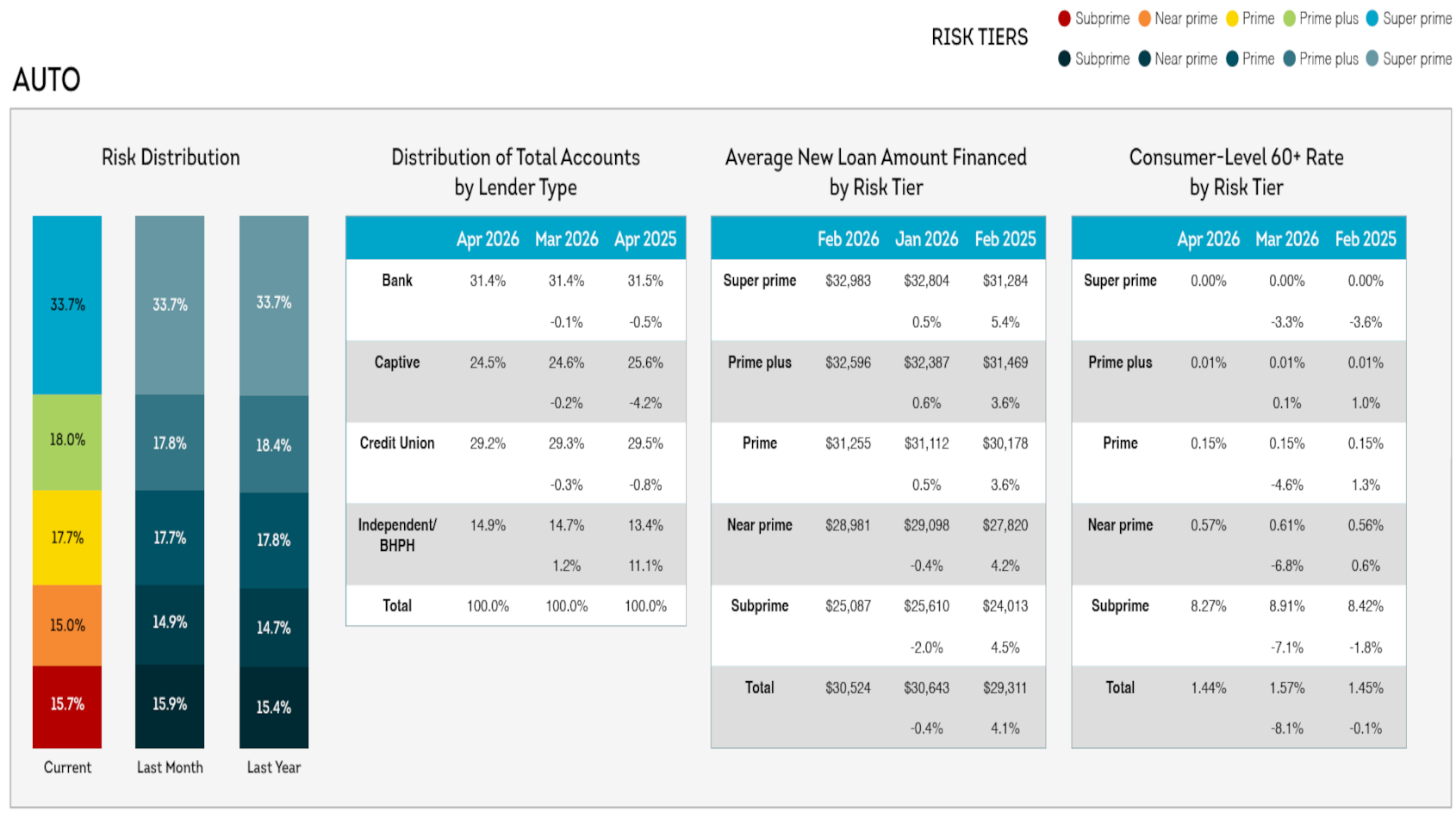
Chart courtesy of TransUnion.
By subscribing, you agree to receive communications from Auto Remarketing and our partners in accordance with our Privacy Policy. We may share your information with select partners and sponsors who may contact you about their products and services. You may unsubscribe at any time.
Let’s begin the week with a little positive news for the auto-finance space, courtesy of TransUnion’s April Credit Industry Snapshot.
While TransUnion reported the 30-day delinquency rate for auto rose 16 basis points sequentially to 3.97%, analysts also noticed the 60-day delinquency rate on the same comparison slid 13 basis points lower to 1.44%.
Furthermore, to use industry vernacular, the amount of “money on the street” decreased in April, as the average amount financed for new contracts booked in April dipped $119 month-over-month from $30,643 to $30,524.
“Economic growth remained positive in the first quarter, with GDP expanding at a 2% annualized rate,” TransUnion wrote in its analysis. “Although this came in slightly below expectations, the expansion continues to be supported by steady consumer spending and solid private domestic demand.
“The labor market continued to show improvement in April, with employers adding 115,000 jobs, surpassing expectations and marking a second consecutive month of positive growth. The unemployment rate remained steady at 4.3%, reflecting stable conditions even as the pace of hiring remains more moderate than in prior periods,” analysts continued.
“Inflation remains a central focus for policymakers. The Core Personal Consumption Expenditures Index, the Federal Reserve’s preferred measure of inflation, stands at 3.2%. While this measure excludes food and energy, it remains important in assessing underlying price trends,” TransUnion went on to say.
Subscribe to Auto Remarketing to stay informed and stay ahead.
By subscribing, you agree to receive communications from Auto Remarketing and our partners in accordance with our Privacy Policy. We may share your information with select partners and sponsors who may contact you about their products and services. You may unsubscribe at any time.
Analysts did acknowledge that “recent increases in energy prices have introduced additional uncertainty.” AAA reported on Monday that the average price for a gallon of gasoline in the U.S. stands at $4.51, with the average cost for diesel coming in at $5.63. Those price readings have been nearly steady for the past week, according to AAA tracking.
“Although these prices do not directly factor into core inflation, policymakers continue to monitor whether higher energy costs begin to pass through into other goods and services that rely on energy as an input,” TransUnion wrote.