
Economic roundup: ‘Subdued’ debt demand & ‘secondary risks’ no matter what Fed does
Graphics courtesy of defi SOLUTIONS.
By subscribing, you agree to receive communications from Auto Remarketing and our partners in accordance with our Privacy Policy. We may share your information with select partners and sponsors who may contact you about their products and services. You may unsubscribe at any time.
Consumer demand for taking on additional debt is already “subdued,” according to findings from a recent survey orchestrated defi SOLUTIONS.
And the cost of that debt might not be mitigating as the Federal Reserve has its penultimate meeting this week to decide on any adjustments to the federal funds rate.
Combining those factors, plus escalating costs for fuel and other goods, and Cox Automotive chief economist Jeremy Robb sees “secondary risks” no matter what policymakers choose to do.
In his Auto Market Weekly Summary posted on Monday, Robb asked, “In this environment, does the committee raise again and risk slowing the economy further, or do they remain forthright in their remit to get inflation down quickly?
“Either choice carries secondary risks that could offset their goals, and with the midterm elections now just days away, the committee may also see value in pausing to judge the effects of their earlier decisions,” Robb continued. “As we’ve noted before, the lack of forward guidance from the Fed has added uncertainty and has likely contributed to the rise in loan rates over recent months, which now may be weighing further on the economy.”
The question of carrying additional weight via debt was the crux of what defi SOLUTIONS sought to answer via a survey of 1,500 U.S. consumers ages 18 to 64 that examined borrowing attitudes, how consumers choose among lenders, and what they expect from the loan experience.
Subscribe to Auto Remarketing to stay informed and stay ahead.
By subscribing, you agree to receive communications from Auto Remarketing and our partners in accordance with our Privacy Policy. We may share your information with select partners and sponsors who may contact you about their products and services. You may unsubscribe at any time.
The research found that most respondents (roughly 53%) are open to taking out a loan in the near term, while 22% said they were considering a loan within the next six months. And 20% may take out a loan before the end of 2027.
At the same time, 55% of participants told defi SOLUTIONS that they try to avoid debt whenever possible, suggesting a market where borrowing demand remains significant but consumers are approaching debt with caution.
“Consumer loan demand has been subdued, but our research suggests the tide could be starting to shift,” said Tom Allanson, CEO at defi SOLUTIONS. “More than half of consumers are considering borrowing, and as that demand returns, lenders will be competing for borrowers whose expectations have evolved.
“Affordability will always matter, but today’s borrower is also shopping around and evaluating the entire experience, from the first interaction to the ease of the digital process to the ability to reach a person when needed. Lenders should be taking a hard look at whether they’re prepared to deliver on those expectations,” Allanson continued in a news release.
Other findings from the defi SOLUTIONS survey that’s also available online included:
—Borrowers are shopping around: Nearly half of respondents (47.3%) compare three or more lenders, and 30.5% compare two. Only 22.1% go straight to one lender.
—Price leads lender selection, but trust matters: When deciding who to borrow from, 46.5% prioritized rate and loan term, while reputation and trustworthiness ranked second at 24.6%.
—First impressions can influence whether borrowers move forward: 61.2% said their first interaction with a lender is “very important,” while another 35.7% said it is somewhat important.
—Consumers favor digital with access to human support: 44.5% prefer a mostly digital application with easy access to a person if questions arise, compared with 17.9% who want a fully digital process with no human interaction, and 24.5% who prefer working directly with someone in person or over the phone.
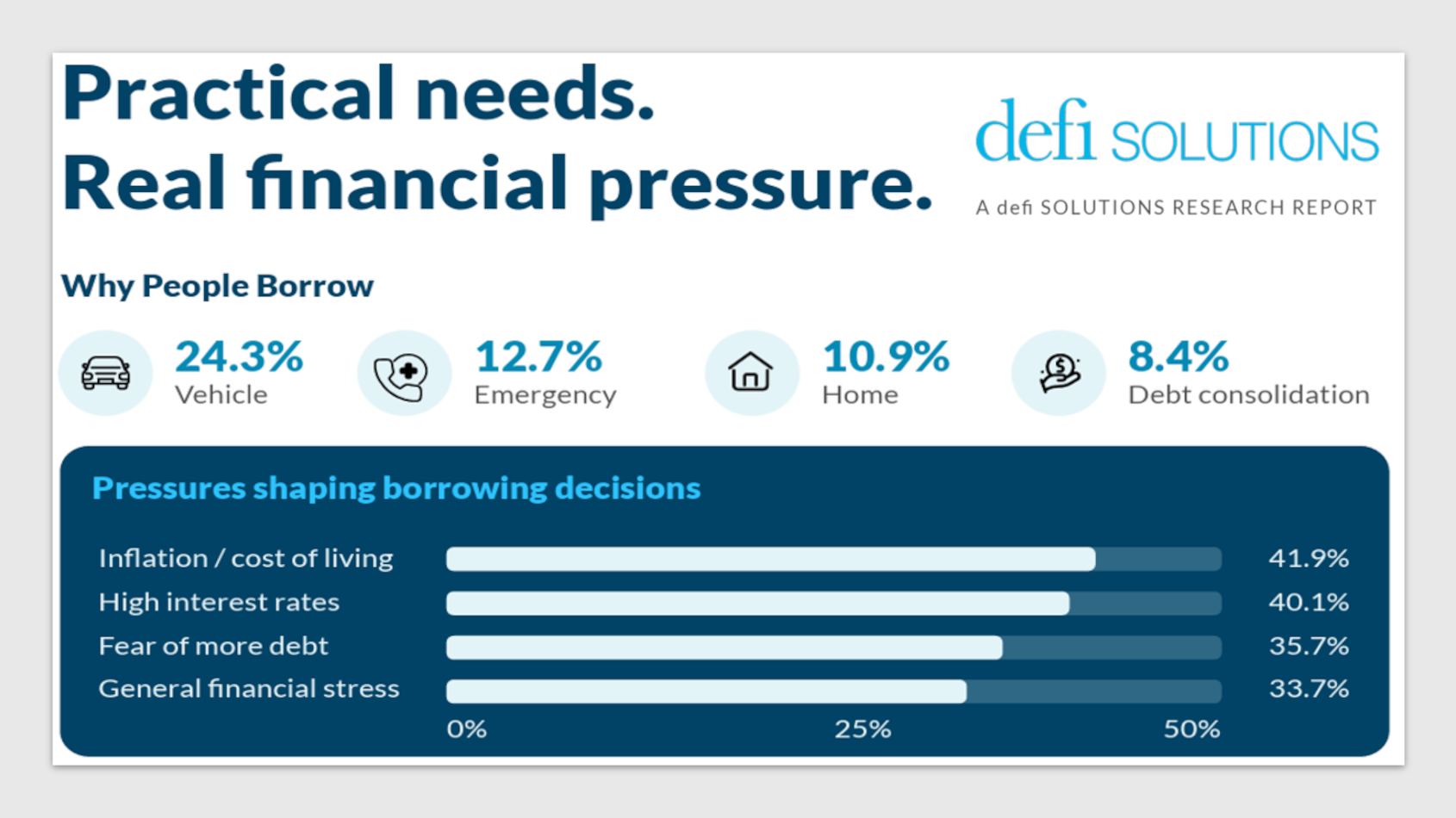
—Economic pressures are weighing on borrowing decisions: Inflation and the rising cost of living were cited by 41.9% of respondents, slightly ahead of high interest rates at 40.1%. Financial stress was cited by 33.7%, while about one in five respondents expressed concern about not getting approved.
—Vehicle purchases drive borrowing needs: Buying a vehicle was the most common reason for borrowing, cited by 24.3% of respondents, ahead of emergency expenses (12.7%), buying a home (10.9%), and consolidating debt (8.4%).
—Affordability drives loan decisions: When evaluating a loan, 47.8% said the best interest rate matters most, followed by the lowest monthly payment (affordability) at 38.6%. When asked what would most increase their willingness to move forward, 39.8% selected a lower interest rate, and 32.9% selected lower monthly payments.
Consumer behavior like what was recapped in the defi SOLUTIONS survey is among the factors being watched closely by the Fed. Vice chair Philip Jefferson reiterated the strategy when he made a public appearance at the beginning of October at the University of Virginia’s Darden School of Business in Charlottesville, Va.
“As I described, I see economic activity and labor market conditions remaining broadly solid while inflation remains above our target. The economy is being buffeted by a cascade of shocks, including rising energy prices, the surging AI buildout, and changes to trade policy. We do not have the luxury of considering each of these shocks in isolation. Rather, we must consider how this cascade might affect the entire economy when setting policy to achieve our dual-mandate objectives,” Jefferson told the gathering.
“As we look ahead, my view is that any future adjustments in policy should be determined by carefully examining trends in the data, the evolving outlook, and the balance of risks,” he continued. “Since our September meeting, yields across the term structure have increased further, a sign that investors are reassessing the evolving macroeconomic landscape. My colleagues and I will need to come to our own judgment, which may take more time. I will continue to assess whether underlying trends suggest that inflation will return to target with sufficient speed. With more data in hand, such trends may lend themselves to better discernment, as may the appropriate stance of monetary policy.
“It is the Fed’s responsibility to deliver maximum employment and stable prices. That is what Congress has instructed us to do, and those are the conditions that will result in the best outcomes for all Americans,” Jefferson added.