LegalShield Consumer Stress Legal Index highlights likelihood of escalating bankruptcies
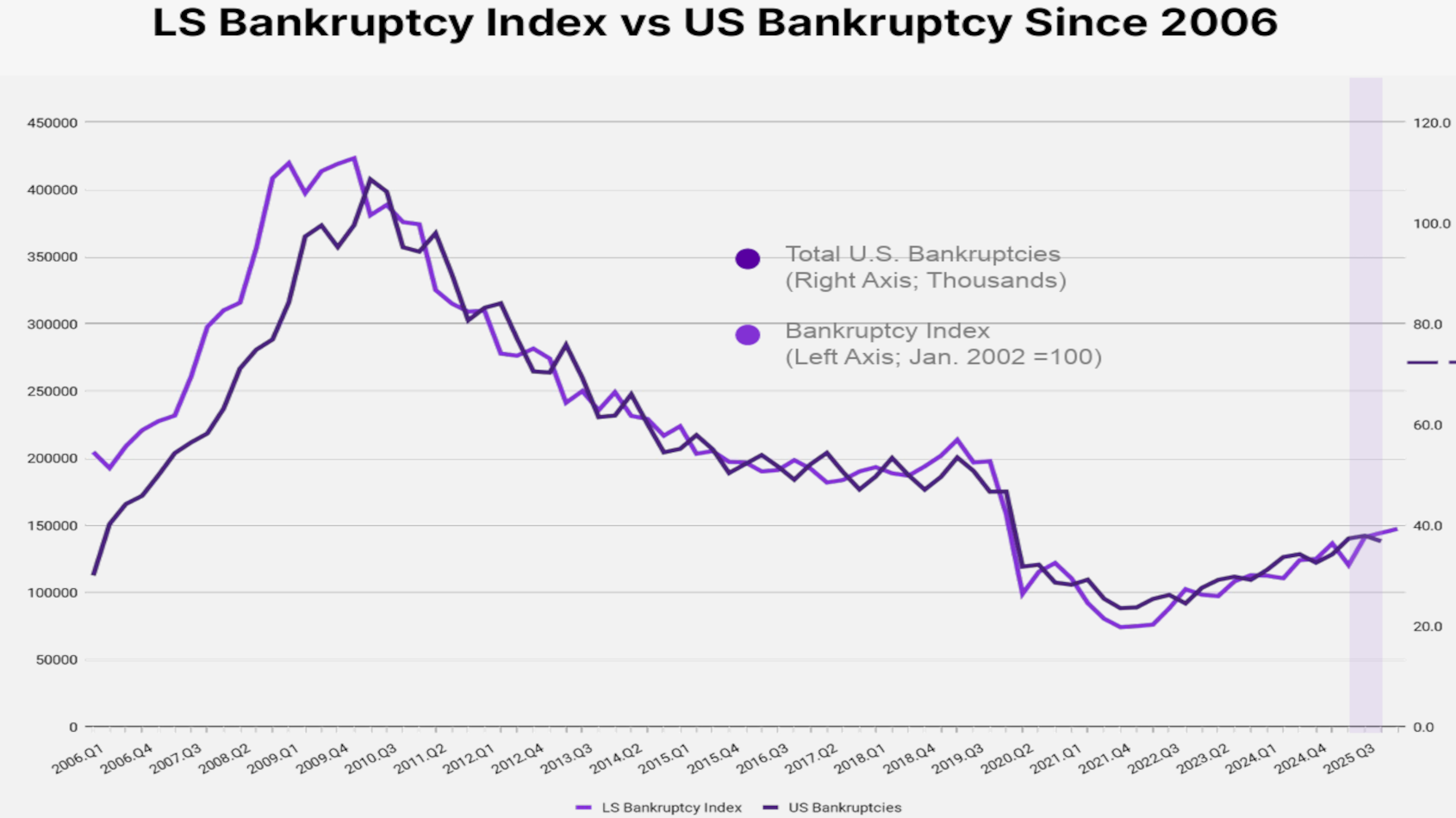
Chart courtesy of LegalShield.
By subscribing, you agree to receive communications from Auto Remarketing and our partners in accordance with our Privacy Policy. We may share your information with select partners and sponsors who may contact you about their products and services. You may unsubscribe at any time.
First-quarter data provided this week by Epiq AACER showed bankruptcy filings jumped 14% year-over-year with total cases surpassing 150,000.
Well, the Bankruptcy Index that’s part of the LegalShield Consumer Stress Legal Index (CSLI) indicated automotive and other industries ought to prepare for similar increases later this year and perhaps beyond.
LegalShield reported this week that its Bankruptcy Index rose 2.0% in the first quarter to 39.3 and is 8.0% higher than March 2025.
The company, which has provided Americans with access to legal advice, counsel, protection, and representation since 1972, said the Bankruptcy Index has now climbed steadily for four years, driven by the cumulative weight of elevated interest rates, persistent inflation, and household debt loads that have not receded.
“The Bankruptcy Index has been steadily climbing since the initial Federal Reserve rate increase in March 2022 and is now more than double its level from that period,” said Matt Layton, senior vice president of consumer analytics for LegalShield.
“That sustained trajectory is a forward-looking signal. Based on the historical lead time between our intake data and actual court filings, we expect bankruptcy filings to rise meaningfully through mid-2026,” continued Layton, who indicated through a news release that LegalShield’s Bankruptcy Index serves as a leading indicator of actual filings by two quarters.
Subscribe to Auto Remarketing to stay informed and stay ahead.
By subscribing, you agree to receive communications from Auto Remarketing and our partners in accordance with our Privacy Policy. We may share your information with select partners and sponsors who may contact you about their products and services. You may unsubscribe at any time.
Meanwhile, other parts of the CSLI showed turbulence, too.
LegalShield noted the Consumer Finance Index dropped 6.7% in the first quarter to 107.8, but it remains 10.1% above where it stood in March of last year.
Experts explained the quarterly decline follows a pattern LegalShield has observed every Q1 since 2021 when temporary tax refunds consistently produce a short-term drop in consumer finance legal calls before activity rebounded in the following quarter.
“Tax refunds are acting as a short-term pressure release valve, not a solution,” said Chris Peoples, a LegalShield provider lawyer in Lawrence, Kan. “Based on the calls we’re taking, folks are using refunds to stabilize, but within three to six weeks, the underlying cash-flow problem reasserts itself.
“And in a notable set of calls, consumers are also using refunds to fund legal interventions that, while necessary, introduce new ongoing financial obligations,” Peoples continued in a news release.
Furthermore, the newest CSLI showed foreclosure-related legal requests during the first quarter surged to their highest level since March 2020. As a result. LegalShield’s Foreclosure Index jumped 13.4% in March and is up 20.3% over the past year, “a pace that reflects households moving from financial worry to legal action,” experts said.
LegalShield pointed out the foreclosure spike is the sharpest signal in a broader pattern of mounting financial distress.
The Consumer Stress Legal Index — which aggregates legal activity across foreclosure, bankruptcy, and consumer finance — remains elevated at 72.9 and is up 11.6% year-over-year. Although, it’s down 1.9% sequentially as tax refund season temporarily eased consumer finance calls.
LegalShield added the spike in foreclosure inquiries coincides with Google Trends data for “help with mortgage,” reaching an all-time high in Q1.
While Google searches capture consumers in the “research phase,” LegalShield said the CSLI tracks the moment households pick up the phone to seek professional legal help.
Both Peoples and Layton see the simultaneous peaking of these two metrics suggesting a shift from general concern to actionable financial distress for American homeowners.
“Often times, people don’t call a lawyer when the problem starts, they call when it becomes undeniable and time-sensitive,” Peoples said. “The shift from researching online to calling a lawyer is usually tied to a clear escalation event like receiving legal notice.”
Layton added, “That behavioral shift is exactly what our data captures
“Google searches tell you people are worried. Our Foreclosure Index tells you they’ve decided to act. Right now, both signals are elevated simultaneously. Historically, when legal calls reach this level, court filings follow within two quarters,” Layton went on to say.
The LegalShield Consumer Stress Legal Index (CSLI) is a proprietary data set based on more than 150,000 monthly legal intakes from LegalShield members. Historically, the CSLI has served as a leading indicator of macroeconomic trends, often predicting shifts in consumer confidence and financial health weeks or months before official government reports.