Japanese brands dominate Clutch’s reliability ratings
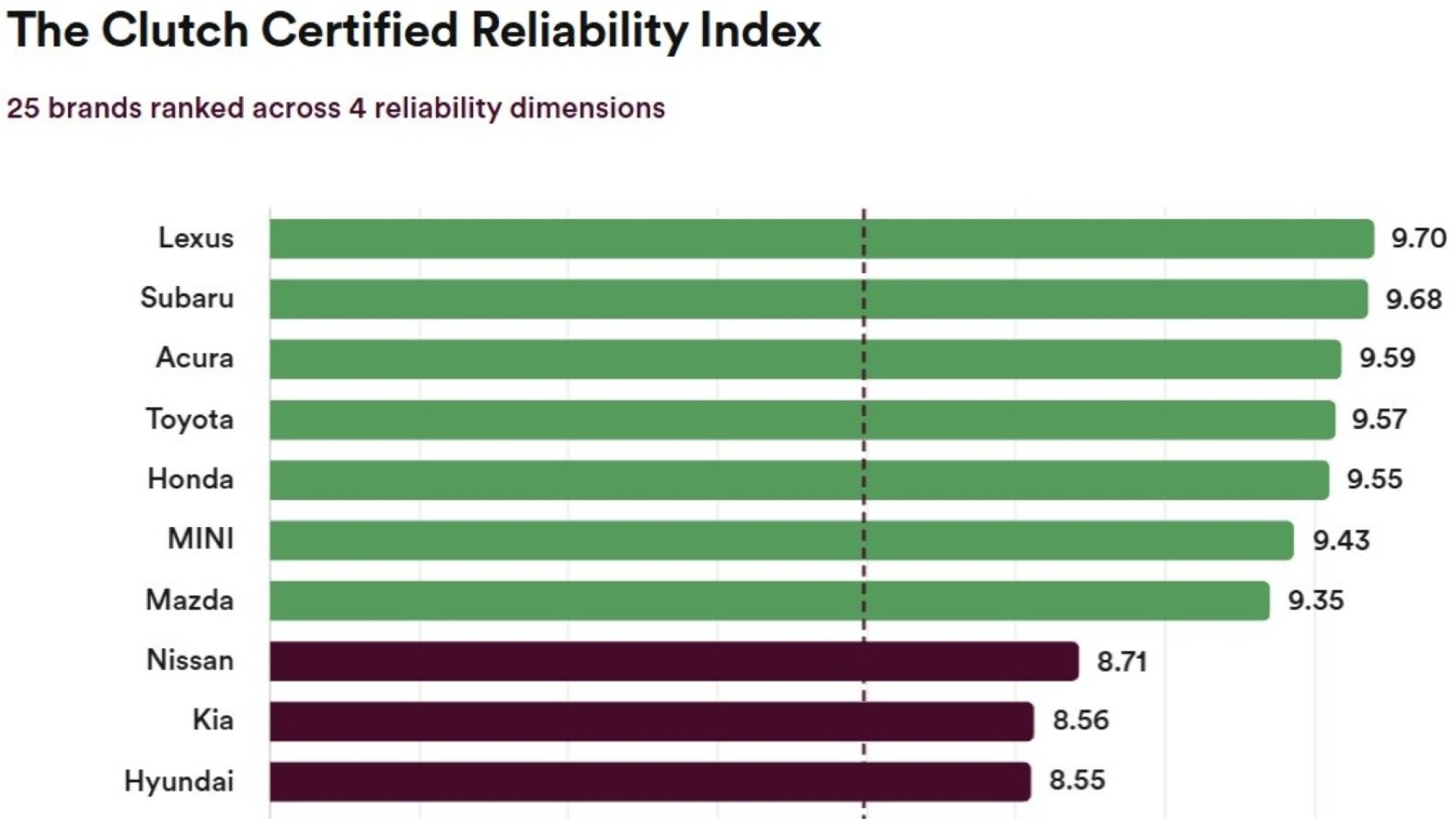
Image courtesy of Clutch.
By subscribing, you agree to receive communications from Auto Remarketing and our partners in accordance with our Privacy Policy. We may share your information with select partners and sponsors who may contact you about their products and services. You may unsubscribe at any time.
If you’re looking for a reliable car, it’s not about mileage or brand.
It’s about where.
According to data from Canadian online used-vehicle retailer Clutch, country of origin is the best indicator of quality over time — more accurate than brand prestige, price tag, fuel type or mileage.
The Clutch Certified Reliability Report found German brands, including premium makes BMW, Mercedes-Benz and Audi, fail Clutch’s certified pre-owned inspection 39% more often than Japanese brands once the vehicles reach 100,000 kilometers. The average American car, the report found, fails inspection 60% more often than Japanese cars.
Not surprisingly, then, Japanese brands swept the top five spots in the Clutch Certified Reliability Index. Lexus led the way with a score of 9.70 on a 10-point scale, followed by Subaru (9.68), Acura (9.59), Toyota (9.57) and Honda (9.55).
The score is based on four weighted factors: frequency of 90-day post-sale warranty claims, pass-fail rate of nine vehicle systems in Clutch Certified’s 210-point inspection, cost of reconditioning and returns based on vehicle problems through the retailer’s 10-day return policy.
Subscribe to Auto Remarketing to stay informed and stay ahead.
By subscribing, you agree to receive communications from Auto Remarketing and our partners in accordance with our Privacy Policy. We may share your information with select partners and sponsors who may contact you about their products and services. You may unsubscribe at any time.
“With our Clutch Certified criteria, it becomes clear that the common marker of quality for consumers — brands and price tag — doesn’t hold up once a vehicle is driven and used,” CEO Dan Park said. “A premium price doesn’t guarantee a premium ownership experience.
“Engineering origin continues to be a key indicator of long-term quality, with Japanese-engineered nameplates delivering long-lasting vehicles across luxury and affordable price points.”
The report showed Audi (7.58), Mercedes (7.27) and BMW (6.63) all fell below the overall average of 7.99 for the 25 brands rated, due to higher pre-sale repair costs, warranty claim rates and vehicle-issue return rates.
Clutch said the price of upkeep is a major factor in that result, noting luxury vehicles are more difficult to maintain, requiring premium parts and specialized labor. When that upkeep lags, the vehicles depreciate faster.
According the report, electric vehicles fail inspection more often than hybrids and gas vehicles, with the highest failure rate for 0-3 and 3-6-year-old vehicles — but only when Tesla is included.
Teslas, which make up 78% of the EVs Clutch acquires have the highest issue rate among EVs for brakes and suspension, electrical, body, interior and HVAC, leading to an index score of 6.92. Clutch said Tesla’s core EV architecture holds up well — powertrain, safety and driver-assist technology.
EVs other than Tesla are on par with gas and hybrid quality, the report said, also noting hybrids perform similar to gas vehicles for the first six years, but surpass them after that.
The full report is available here.