
Wolters Kluwer notices simultaneous improvements in credit availability & digital adoption
Graphics courtesy of Wolters Kluwer Compliance Solutions.
By subscribing, you agree to receive communications from Auto Remarketing and our partners in accordance with our Privacy Policy. We may share your information with select partners and sponsors who may contact you about their products and services. You may unsubscribe at any time.
Credit availability and digital adoption are running in the same upward direction, which is creating positives for dealerships and finance companies booking loans and lenders eventually using them in securitizations.
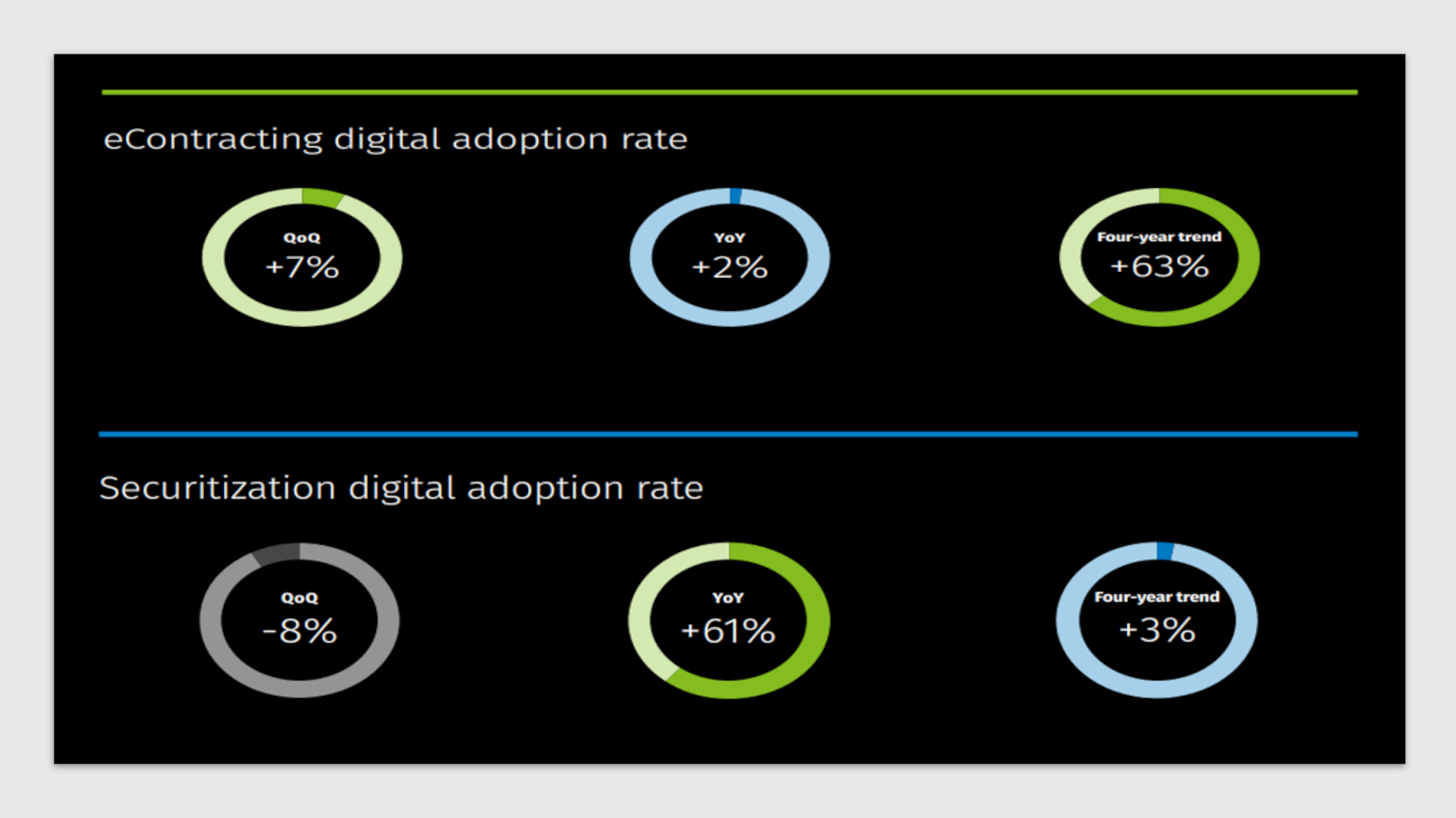
Wolters Kluwer Compliance Solutions on Wednesday released its Q2 Auto Finance Digital Transformation Index, highlighting that eContracting volume increased by 7% sequentially and 2% year-over-year.
Analysts pointed out the four-year trend now shows digital adoption growth of 63% dating back to Q1 2022, up from the 61 percent trended figure reported last quarter.
Wolters Kluwer noted the trends surfaced during the same period as the Dealertrack Credit Availability Index climbed to 104.6 in June, its highest level in more than a decade.
Other key findings from the Q2 index connected with eContracting included:
—Broad-based growth among established digital lenders: Several of the industry’s largest digital lenders posted meaningful quarter-over-quarter gains, showing that adoption is deepening among existing users.
Subscribe to Auto Remarketing to stay informed and stay ahead.
By subscribing, you agree to receive communications from Auto Remarketing and our partners in accordance with our Privacy Policy. We may share your information with select partners and sponsors who may contact you about their products and services. You may unsubscribe at any time.
—Captives drive momentum: Captive and manufacturer-affiliated finance companies were among the strongest contributors to Q2 growth, reflecting continued investment in digital origination.
—Fintech lenders sustain momentum: Fintech and digital-first providers remained among the most aggressive adopters of digital workflows, continuing to outpace the broader market.
—Dealer-to-lender platforms accelerate adoption: Dealer-to-lender connectivity platforms were major accelerators of growth, reflecting increased transaction volume flowing through for lenders.
—More diversified ecosystem: Growth was supported across captives, fintechs, platforms, and established lenders rather than any single segment.
Wolters Kluwer then turned its attention to securitizations.
According to the index update, digital securitization transactions decreased 8% from Q1 to Q2, while increasing 61% year-over-year.
The four-year Wolters Kluwer trend continues to show consistent and steady growth in digital adoption dating back to Q1 2022.
Other key findings from Q2 in the securitization space included:
—Credit union participation continues to expand: While credit union-related transactions appeared in both 2025 and 2026, index data showed more active credit union securitization issuance in the first half of 2026 than in the same period of 2025.
—Issuer base continues to diversify: The issuer base for digital securitization continues to diversify. Recent activity includes credit unions, specialty auto finance companies, fintech lenders and captives, reflecting broad market use of digital collateral processes.
—Repeat issuance signals operational adoption: Several issuers moved from single transactions toward repeat issuance activity in the second quarter, suggesting digital securitization is increasingly becoming an operational funding strategy.
—Credit performance diverges by borrower tier: The growth in digital securitization volume comes as broader auto asset-backed securities (ABS) credit performance shows a widening divergence by borrower tier.
Recent industry analysis noted that super-prime auto collateral continues to perform well even as the higher-loss prime segment, made up largely of used-vehicle loan pools, shows greater sensitivity to affordability pressures.
Matthew Babcock heads up digital lending product strategy for Wolters Kluwer and offered this observations after reviewing the index findings.
“Q2 shows digital adoption maturing into a genuinely ecosystem-wide trend,” Babcock said in a news release. “eContracting growth this quarter wasn’t limited to fintech disruptors or a handful of early movers; captives, established finance companies and dealer connectivity platform transaction facilitators all contributed meaningfully to the gains.
“On the securitization side, the sequential decline masks a much larger year-over-year story: digital securitization volume is up nearly 61 percent from a year ago, and credit unions in particular are emerging as a durable new source of issuance,” he continued. “As more issuers move from single transactions to repeat activity, digital documentation is proving itself to be core infrastructure for how auto finance gets funded, not a pilot program.”
For more information about Wolters Kluwer, visit www.wolterskluwer.com.