Fed well aware of inflation, but credit costs hampering auto financing
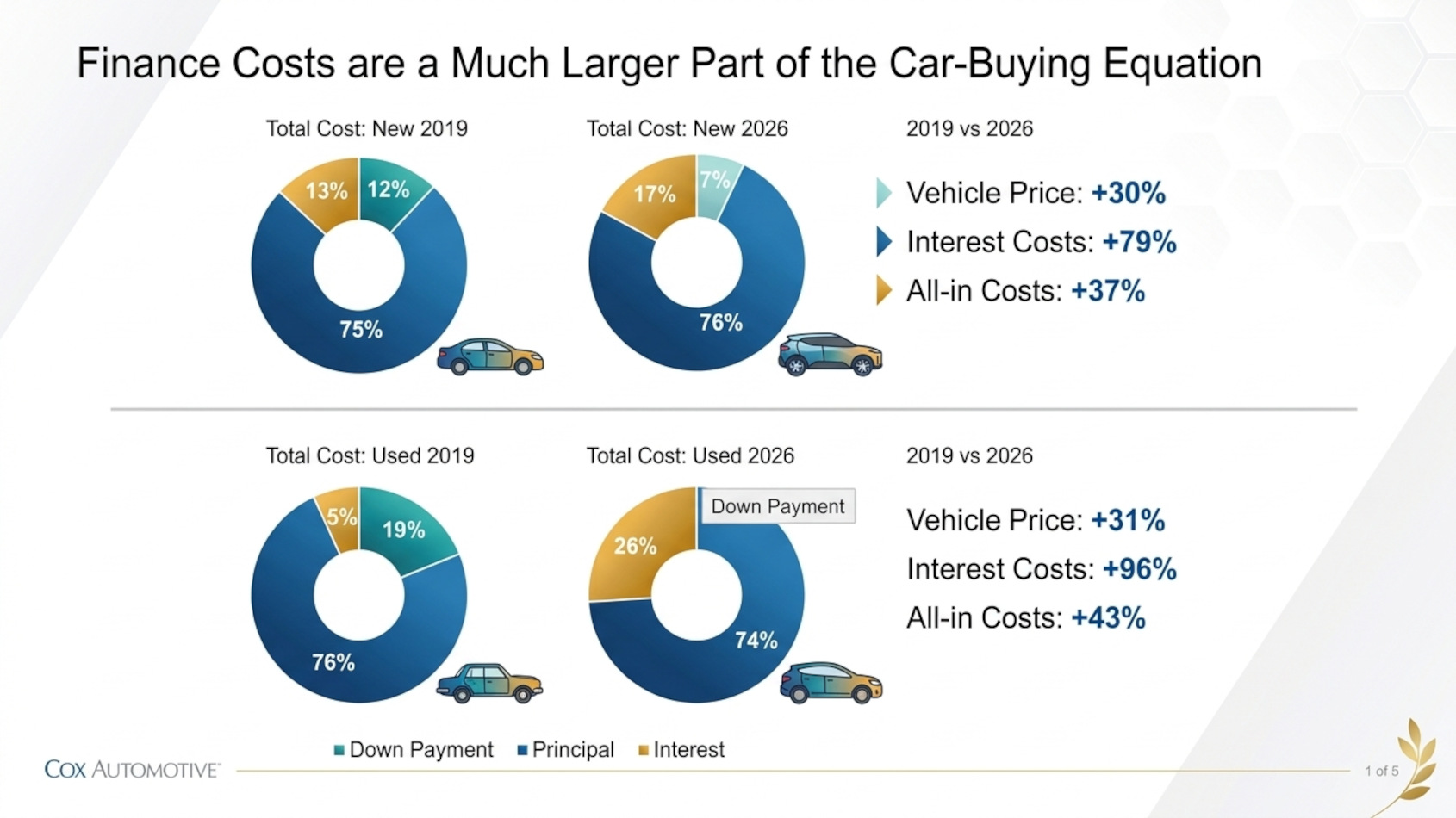
Charts created with Cox Automotive data using Nano Banana 2.
By subscribing, you agree to receive communications from Auto Remarketing and our partners in accordance with our Privacy Policy. We may share your information with select partners and sponsors who may contact you about their products and services. You may unsubscribe at any time.
While touting some parts of the economy are doing well, Federal Reserve chair Kevin Warsh on Wednesday acknowledged inflation is still creating a significant headwind, as policymakers left the federal fund rate unchanged at 3.75% to 4%.
And Cox Automotive explained ahead of the Fed’s decision explained how the higher cost of credit is making things more complicated for the car business
But first, here is what Warsh said after the Federal Open Market Committee finished its next-to-last meeting of the year.
“Economic activity is expanding at a strong pace. While uncertainty remains — owing, in part, to geopolitical developments — domestic spending has been resilient. Productivity growth is strong, and capital investment robust. Job gains have kept pace with the workforce, and the unemployment rate has changed little,” Warsh said.
“But inflation remains elevated. The committee believes that the accumulation of more information will help it determine the policy stance appropriate to ensure a timely return of inflation to the 2 percent goal. The committee will deliver price stability,” he continued.
The U.S. Personal Consumption Expenditures (PCE) price index rose 0.5% in September, pushing the annual inflation rate up to 3.6%, according to the Bureau of Economic Analysis.
Subscribe to Auto Remarketing to stay informed and stay ahead.
By subscribing, you agree to receive communications from Auto Remarketing and our partners in accordance with our Privacy Policy. We may share your information with select partners and sponsors who may contact you about their products and services. You may unsubscribe at any time.
Had the Fed lifted the funds rate, it would have marked the second increase in as many opportunities for the FOMC.
“Since our policy action in September, we have started to see some changes in financial and credit conditions,” Warsh continued on Wednesday. “They have tightened for some businesses and households, much as we would expect. Market participants are becoming somewhat more discerning in their capital allocations. And while overall financial conditions are tighter, I’m unwilling and unable to call them tight.
“But broadly, these developments go in the direction of achieving a longer, more durable period of economic growth and price stability. Over the last couple of days, the committee had a good discussion of the changes in the economic and financial landscape that marked this inter-meeting period. We discussed geopolitical developments and fast-moving changes in technology,” Warsh said.
“We observed — but were not surprised — that financial markets showed bouts of volatility and shifting correlations. So as we widen the frame to survey the broad economic and financial picture, real activity is clearly pointing in the right direction. That’s good news. But inflation is too high,” Warsh went on to say. “Energy and related prices have moved higher again in recent weeks. And our job is to ensure that relative price changes in some sectors do not broaden out across the economy, and that inflation expectations remain as they are anchored.”
Until the Fed actions somehow cool inflation — perhaps by another interest-rate uptick — Cox Automotive chief economist put some numbers together about how a higher cost of credit is impacting car retailing and financing.
“One factor impacting the vehicle market is the cost of money becoming a much larger part of the equation, with interest on a typical new-vehicle purchase up 79% since 2019 to $10.1K and up 96% to $10.9K for a used vehicle over the life of the loan,” Robb wrote in his Auto Market Weekly Summary released on Monday.
“In fact, due to higher financing costs, the average used-vehicle down payment has dropped to nearly 0% of a typical loan. This has helped push the all-in cost higher by 37% for new and 43% for used versus 2019, outpacing the roughly 30% rise in vehicle price alone,” he continued.
One other point to mention about down payments. Consumers sometimes use savings to satisfy lender stipulations, especially if escalating negative equity is involved. Bill Adams, chief U.S. economist at Fifth Third Bank, examined what’s going on with consumer savings.
“Monthly personal income and outlays data will likely show spending outpaced income growth again, pushing the saving rate down to the lowest since 2022,” Adams said on Tuesday. “The saving rate is on a long-run downtrend, in part because of demographics — retirees are spending down savings — and in part because capital gains are an increasingly important driver of consumer spending power and are not counted in personal income.
“But over shorter time horizons like the last six or 12 months, the falling saving rate points to stress on household budgets, especially those of lower-income and rural households who are harder hit by rising gas and diesel prices,” Adams added.
Furthermore, Surveys of Consumers director Joanne Hsu at the University of Michigan said its news consumer sentiment reading held steady in October but it’s 10% below a year ago and 15% less than February, just prior to the Middle East conflict starting and igniting fuel costs.
What might happen next?
“Further increases in rates will likely push consumers to wait it out,” Robb wrote.