EY study shows Canadians still cautious about AI but using it more for everyday activities
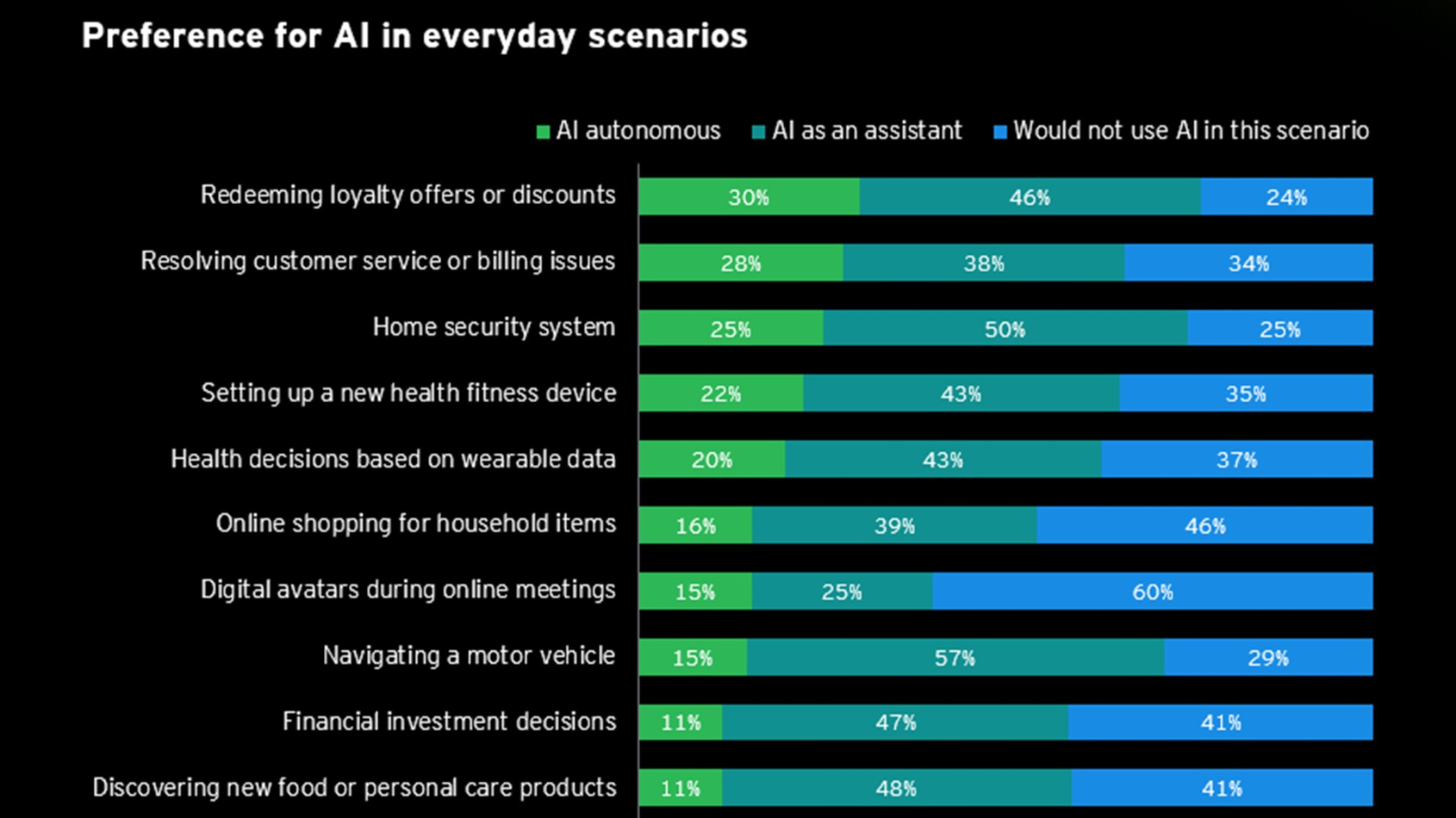
Chart from the 2026 EY AI Sentiment Study courtesy of Ernst & Young Canada.
By subscribing, you agree to receive communications from Auto Remarketing and our partners in accordance with our Privacy Policy. We may share your information with select partners and sponsors who may contact you about their products and services. You may unsubscribe at any time.
This artificial intelligence is pretty smart, eh?
That sentiment might be held by at least some Canadians who are already embedding AI into everyday decisions, often in ways that extend beyond simple assistance into early autonomy, even while concerns about security, accountability and control remain high.
That’s the primary finding released on Monday from the 2026 EY AI Sentiment Study compiled by Ernst & Young Canada.
“What we’re seeing is less about blind trust and more about conditional permission,” EY Canada chief technology officer Biren Agnihotri said in a news release. “Canadians are comfortable with AI in familiar, low–risk moments, and that everyday experience is reshaping how trust actually develops.”
The study showed 13% of Canadians have used autonomous AI in the past six months, systems that go beyond recommendations to act on a user’s behalf. While still a minority, this group signals where Canadians are beginning to grant AI deeper authority.
Researchers also found that comfort with autonomy is strongest in everyday moments such as redeeming loyalty points, resolving customer service issues and managing home security systems.
Subscribe to Auto Remarketing to stay informed and stay ahead.
By subscribing, you agree to receive communications from Auto Remarketing and our partners in accordance with our Privacy Policy. We may share your information with select partners and sponsors who may contact you about their products and services. You may unsubscribe at any time.
“These are decisions that are easy to review, reverse or correct, allowing trust to build through experience rather than assumption,” EY Canada said.
Study findings also indicated Canadians who already use AI are significantly more open to autonomous decision making than non–users, suggesting exposure — not persuasion — is the strongest driver of acceptance.
Beyond autonomy, EY Canada discovered AI has quietly become part of daily routines for most Canadians.
The research highlighted 78% of Canadians having used AI in energy and mobility activities such as route optimization, travel planning or managing home energy consumption.
Findings also showed 67% have interacted with AI in customer experiences, including chatbots, recommendations and personalized offers.
Researchers went on to note that technology and entertainment is another major touchpoint, with 61% of Canadians using AI for content recommendations or smart–device management.
They added health and wellness adoption is also growing, with 55% using AI for health information, symptom checking or wearable–driven insights.
Despite this momentum, EY Canada acknowledged trust remains fragile.
The study revealed 71% of Canadians worry about AI systems being hacked or breached, making security the top concern related to AI adoption.
Only 39% trust companies to protect their data when it is used by AI, according to EY Canada.
Beyond cybersecurity, researchers mentioned two–thirds of Canadians worry organizations won’t be accountable for AI–driven harm, with 59% fearing AI decisions may conflict with personal values, and 72% saying human oversight remains essential, even when AI systems perform accurately.
The full study can be found via this website.