
3 banking priorities surface from Jack Henry’s eighth annual Strategy Benchmark
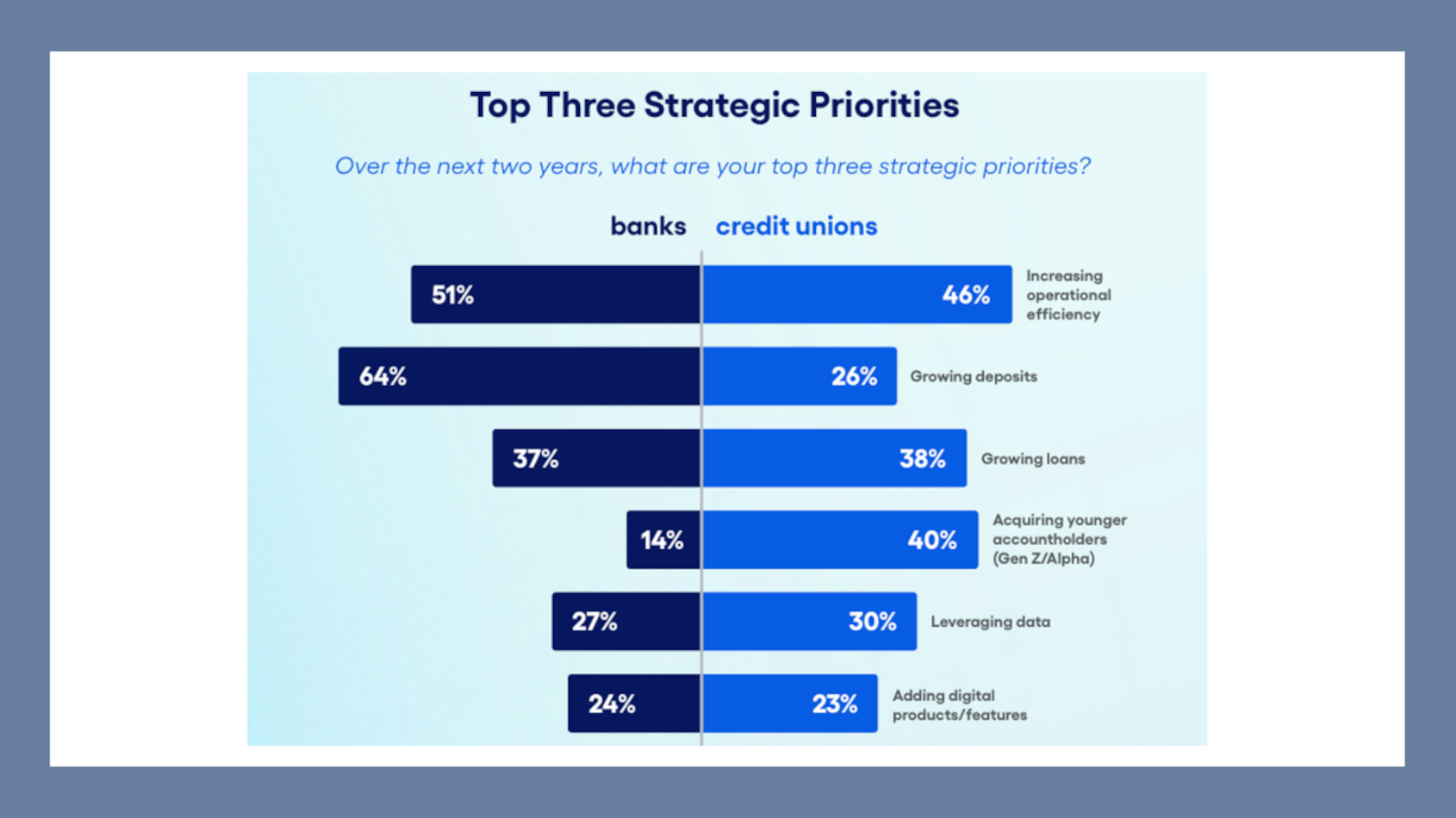
Screenshot courtesy of Jack Henry Strategy Benchmark.
By subscribing, you agree to receive communications from Auto Remarketing and our partners in accordance with our Privacy Policy. We may share your information with select partners and sponsors who may contact you about their products and services. You may unsubscribe at any time.
Jack Henry’s eighth annual Strategy Benchmark — with findings from an online survey conducted in January and February of a diverse sample of clients with assets ranging from less than $500 million to more than $5 billion — pinpointed three priorities of banks and credit unions.
According to survey results released on Tuesday, institutions are prioritizing operational efficiency, deposit growth, and new payment capabilities as they navigate economic uncertainty and increasing technological complexity.
Jack Henry surveyed 193 executives from financial institutions using Jack Henry solutions. The survey highlights the industry’s most pressing strategic priorities, top concerns, and technology investment plans for the next two years.
“Banks and credit unions have finally recognized their biggest competitive threat in big fintech and big crypto,” said Lee Wetherington, Jack Henry’s senior director of corporate strategy and lead author of the benchmark.
“As we enter a new hybrid monetary era, the game is changing and charter franchises are under attack,” Wetherington continued. “The goal of strategy is no longer simply to win but to ensure you’re competing to win the right game.”
The survey showed most financial institutions plan to increase technology spending, with 88% expecting to raise their tech budgets over the next two years, up from 76% last year.
Subscribe to Auto Remarketing to stay informed and stay ahead.
By subscribing, you agree to receive communications from Auto Remarketing and our partners in accordance with our Privacy Policy. We may share your information with select partners and sponsors who may contact you about their products and services. You may unsubscribe at any time.
Jack Henry found four in 10 institutions (41%) plan increases of 6% to 10%, compared with 33% a year ago.
Artificial intelligence (48%) is the top planned technology investment for the first time, followed by digital banking (38%) and data analytics (32%).
While banks remain focused on growing deposits (64%) as their top strategic priority in 2026-2027, credit unions (40%) continue to place outsized emphasis on acquiring younger accountholders (Gen Z/Alpha), according to the findings.
“Financial institutions are in a high-stakes race for Gen Z and small business,” said Jennifer Geis, who is senior strategic advisor of corporate strategy at Jack Henry and managing editor of the study.
“Given Gen Z now drives most small-business formation — and given small-business deposits are four to five times larger than retail — understanding and meeting the unique needs of “bizumers” is key to growth, whether you frame it in terms of deposits or demographics,” Geis continued.
Other highlights from the survey included:
Payments
—More than nine out of 10 CEOs (94%) plan to add new payment services within the next two years, yet only 36% have a formal payments strategy in place.
—More than four out of five (82%) financial institutions plan to incorporate tap-to-pay as part of their strategy to add younger accountholders.
—Nearly half (47%) of CEOs plan to embed payments into their digital banking experience over the next two years.
Small business focus
—Three out of four CEOs say they plan to expand services for small- and medium-sized businesses (SMBs).
—The most common planned addition is payment services, including FedNow, request for payment, and tap-to-pay.
Cryptocurrency
—18% of CEOs plan to support stablecoins, tokenized money, and/or cryptocurrency by the end of 2027. This includes tokenized deposits/deposit tokens and support for on-chain wallets for accountholders.
—Ability to orchestrate, exchange, and settle dollars to and from stablecoins/crypto.
—However, only 3% of CEOs report having a formal stablecoin strategy in place.
Getting younger
—The second most important strategic priority for credit unions (and fourth overall) is adding younger accountholders. It is also one of the top three concerns for CEOs.
—More than 40% of credit unions have a formal strategy, compared to just 10% of banks.
—Fintechs and neobanks are considered the biggest competitive threat in this area.
Data analytics and AI
—Leveraging data is the fifth most important strategic priority overall among banks and credit unions.
—Plans to implement AI grew double digits compared to last year.
—1/3 of financial institutions plan to embed data collection/analysis tools within digital banking.
The complete study results and recommendations from Jack Henry can be downloaded via this website.