COMMENTARY: Inventory acquisition in the AI age
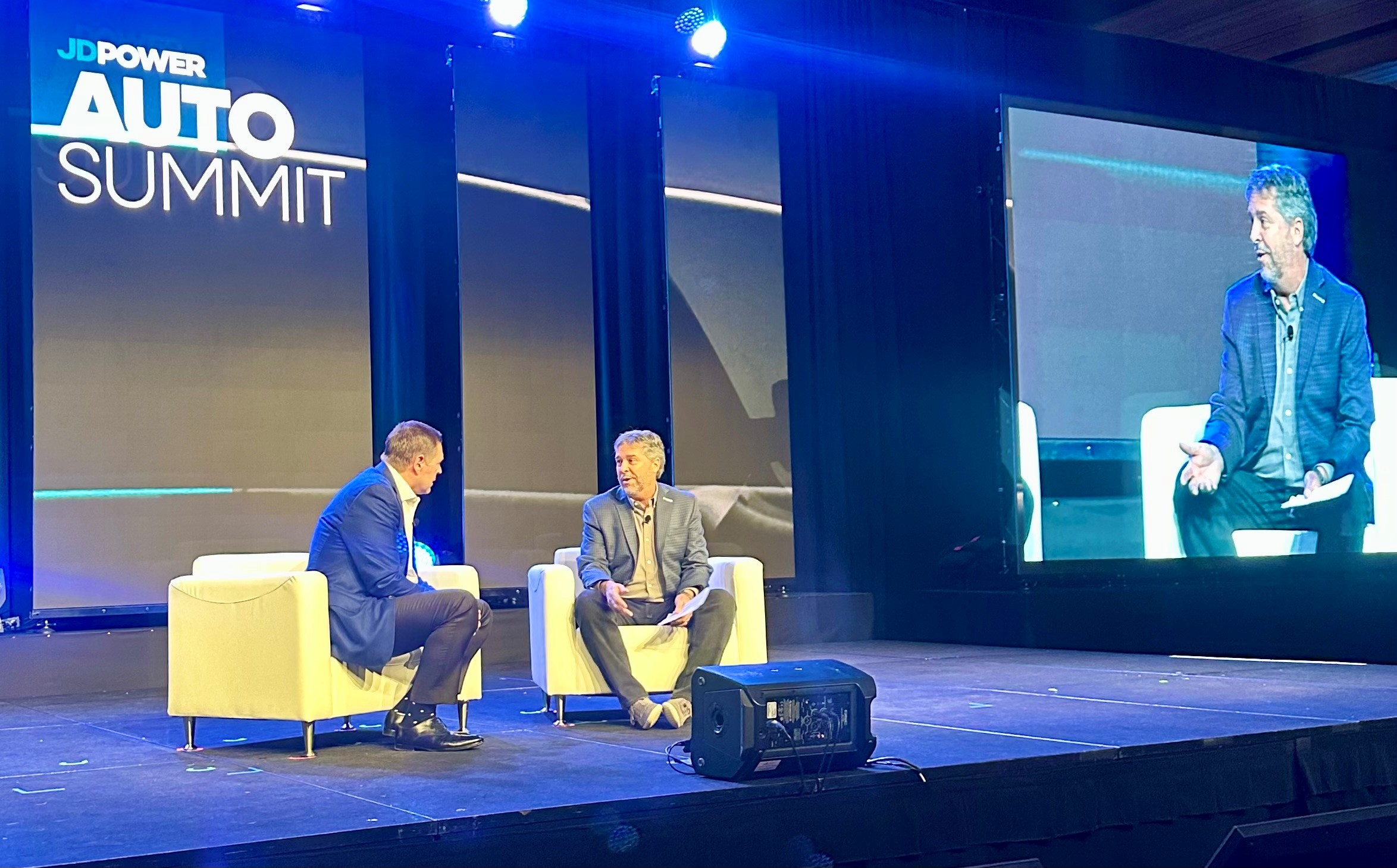
Doug Betts of JD Power (right) during the JD Power Auto Summit earlier this year in Las Vegas. Photo by Joe Overby.
By subscribing, you agree to receive communications from Auto Remarketing and our partners in accordance with our Privacy Policy. We may share your information with select partners and sponsors who may contact you about their products and services. You may unsubscribe at any time.
While many dealers have always “trusted their gut,” the old instinct-driven approach to buying used car inventory is quickly becoming obsolete. For decades, dealers relied on a familiar formula: when a vehicle sold, replace it with another one just like it.
A midsize SUV leaves the lot? Buy another midsize SUV. A pickup sells quickly? Find another pickup at auction.
It was equal parts experience, intuition, gut feel, and self-fulfilling prophesy.
As effective as that was in the past, particularly for those with educated instincts, it has and continues to leave a lot on the table. The modern used-car business has become too complex, too fast-moving, and too financially demanding to operate on instinct alone. Importantly, used-vehicle sales are no longer a sideline to new-vehicle sales.
In the month of April alone, auto dealers sold approximately 951,000 used vehicles at an average price of about $31,000 per vehicle. As a point of comparison, dealers sold 1.1 million new vehicles in April at an average price of $45,990. As consumers continue to feel the pinch of higher costs, used-vehicle sales are expected to keep growing, providing a critical lifeline for dealers.
However, dealers who continue relying on broad categories rather than precise vehicle configurations are increasingly exposing themselves to slower inventory turns, shrinking margins, and unnecessary financial risk.
Subscribe to Auto Remarketing to stay informed and stay ahead.
By subscribing, you agree to receive communications from Auto Remarketing and our partners in accordance with our Privacy Policy. We may share your information with select partners and sponsors who may contact you about their products and services. You may unsubscribe at any time.
Consider the scale of the problem. There are roughly one million unique vehicle configurations in a single model year when make, model, trim, and options are combined. And that figure excludes paint colors. Add in variations between model years, such as choosing between a 2024 model and a low-mileage 2023 or 2022 version, and the number of possible inventory combinations becomes staggering.
No human being can consistently process that level of complexity without technological assistance. If one mid-size SUV of a particular brand was the same as another, in terms of shopper interest, it might be less of an issue. That is not the case.
That is why the most successful dealers today are treating used-vehicle acquisition less like an art and more like a data science operation. Increasingly sophisticated AI-driven tools, fueled by real-time retail transaction data, are helping dealers identify exactly which vehicles consumers want, which configurations turn fastest, and which ones quietly become expensive liabilities sitting on the lot. And, importantly, they deliver this level of specificity in their local market.
Even the least technologically advanced used-car dealer knows not all versions of a vehicle are equally desirable in every market. Every make and model has winning configurations and losing configurations partially based on geography.
One version may sell within days at a strong margin, while another sits for months requiring repeated price cuts. The difference often comes down to combinations of features and options that consumers may not consciously articulate but absolutely respond to in the marketplace. Think of it as the “personality” of the individual used vehicle.
One configuration may emphasize sporty styling and upgraded wheels. Another may prioritize infotainment and technology. A third may focus on cargo capacity, passenger comfort, or fuel economy. Even within the same model line, some combinations align perfectly with local demand while others miss the market entirely.
These days, dealers are no longer choosing between one model and another. They are choosing between thousands of potential variations of the same model, and that creates a challenge that intuition alone cannot solve.
What combinations of options are shoppers in a specific PMA actually searching for? What monthly payment ranges can local buyers realistically afford? How does seasonality affect demand for a certain configuration? Are large numbers of lease returns about to flood the market and depress prices for a specific segment? Those questions now determine whether a used vehicle becomes a profit or a burden.
The dealers outperforming today are the ones using real-time retail data to answer those questions before they acquire inventory, not after. New data-crunching tools are giving dealers visibility into actual retail transaction prices and days-to-turn metrics in specific markets. That matters because historical averages and broad national pricing trends are no longer sufficient. Dealers need to understand what is selling right now, at what price, and to whom in their market.
This shift is changing how inventory is sourced as well. Traditional wholesale auctions once dominated the acquisition process. Dealers physically attended auctions, relied on their experience, and often made buying decisions in seconds using intuition.
Today, digital marketplaces and integrated auction platforms dramatically expand access to inventory while reducing friction in the buying process. Platforms enhanced through integrations with newly available toolsets allow dealers to search for frontline-ready inventory with far greater efficiency and transparency than traditional auction models allowed.
At the same time, VIN-specific build data and valuation intelligence are helping dealers avoid one of the biggest risks in used-vehicle acquisition: buying the wrong configuration. That matters more than ever because used inventory is expensive to carry. Floorplan financing costs continue accumulating while a vehicle sits unsold. A poor acquisition decision is not just an inconvenience. It directly erodes profitability. And unlike automakers, used-car dealers do not have factory incentive budgets to rescue slow-moving inventory. That makes a disciplined acquisition strategy critical.
In this new era, dealers are increasingly using AI-driven forecasting tools not only to understand what sold yesterday, but to anticipate what consumers will likely buy tomorrow. This does not eliminate human judgment.
Dealers still need experience, local market knowledge, and operational discipline. But the dealers thriving in today’s environment are combining that experience with better data, faster analytics, and more precise inventory strategies.
The era of buying used cars based primarily on gut instinct is over. The future belongs to dealers who can identify the exact vehicle configurations that will sell in their zip code, acquire them at the right price, and turn them quickly before the market shifts again.
About the author:
Doug Betts is president of Dealer Solutions at JD Power.