JD Power: Brand loyalty stays strong amid economic headwinds
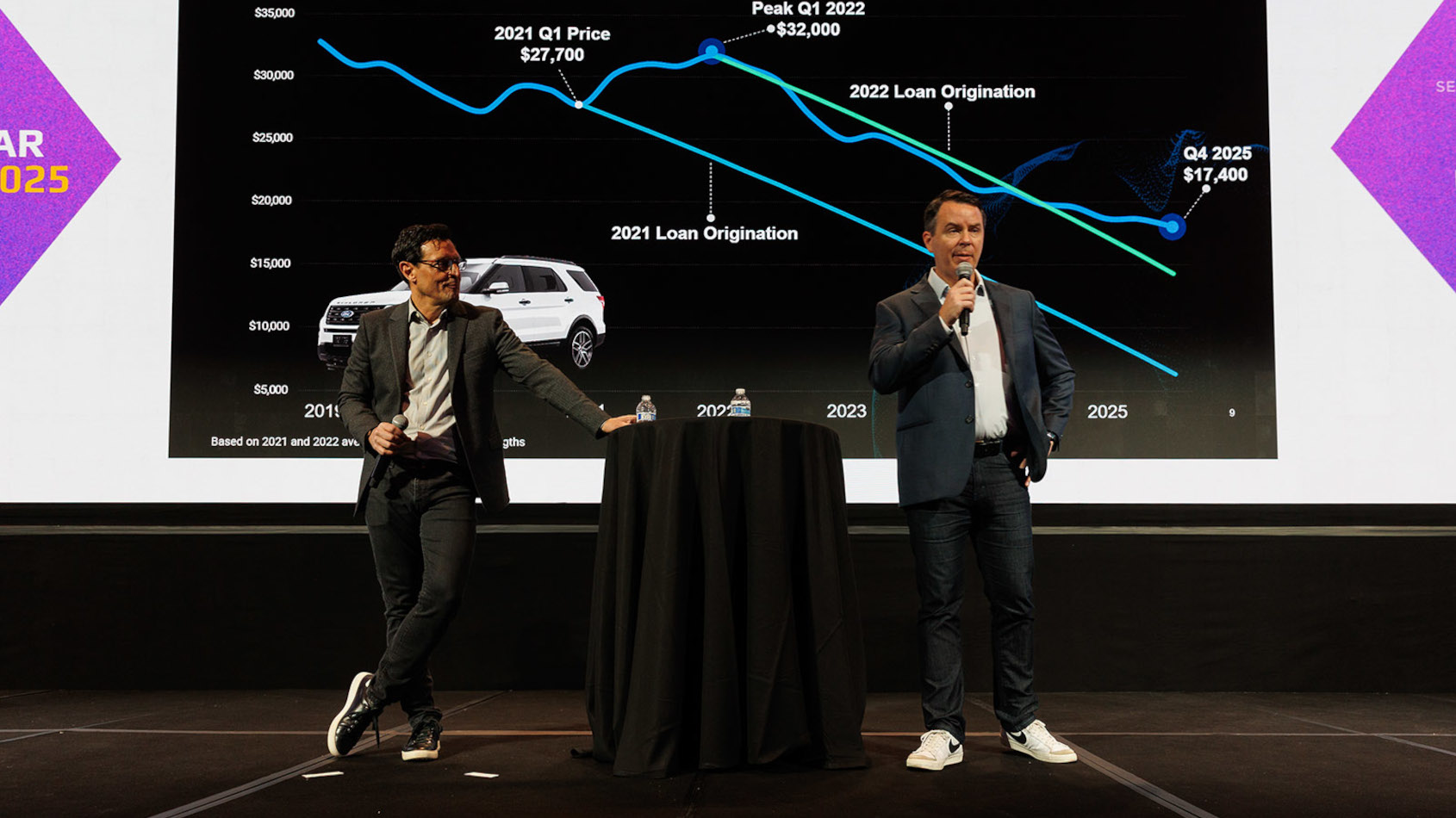
Tyson Jominy (right) and Jonathan Banks of J.D. Power during their presentation at Used Car Week 2025 in Las Vegas. Photo by Jonathan Fredin.
By subscribing, you agree to receive communications from Auto Remarketing and our partners in accordance with our Privacy Policy. We may share your information with select partners and sponsors who may contact you about their products and services. You may unsubscribe at any time.
Affordability challenges and economic volatility certainly have impacted the car business, as the latest financing data from Edmunds showed.
But one place where those headwinds haven’t influenced what’s rolling over dealership curbs came to light on Tuesday, according to the JD Power 2026 U.S. Automotive Brand Loyalty Study.
Researchers said brand loyalty averaged 50.2% across all nameplates and segments, up from 49% last year.
Tyson Jominy, senior vice president of OEM customer success at JD Power, explained that tariffs and economic uncertainty could have caused major disruption to brand loyalty, but automakers largely absorbed additional costs, so that disruption never happened.
“In many ways, this was a year of avoided chaos,” Jominy said in a news release. “Many of the leading brands import top-selling models, and if tariff costs were passed through to consumers, loyalty could have suffered. Instead, loyalty is getting stronger.
“Very few brands ever reach a 60% loyalty rate, yet four of this year’s five highest-ranked brands are in the 60% range, and some segments are closing in on pickup truck loyalty levels, a sector well-known for its exceptional loyalty,” he continued.
Subscribe to Auto Remarketing to stay informed and stay ahead.
By subscribing, you agree to receive communications from Auto Remarketing and our partners in accordance with our Privacy Policy. We may share your information with select partners and sponsors who may contact you about their products and services. You may unsubscribe at any time.
Porsche ranked highest among premium car brands for a fifth consecutive year, with a 61.3% loyalty rate. BMW came in second at 49.3%.
Lexus placed highest among premium SUV brands for a third consecutive year, with a 59.2% loyalty rate. Again, BMW landed second at 56.4%.
Meanwhile, Toyota ranked highest among mass market car brands for a fifth consecutive year, with a 64.8% loyalty rate. Honda followed at No. 2 with a rate of 57.5%.
Toyota also topped the charts among mass market SUV brands, with a 63.8% loyalty rate. Like BMW, Honda claimed another second-place spot at 63.0%.
Finally, Ford ranked highest among truck brands for a fifth consecutive year, with a 66.2% loyalty rate, which was the highest loyalty rate in the study. Toyota wasn’t far off that pace at 62.2% for a second-place ranking.
Now in its eighth year, the U.S. Automotive Brand Loyalty Study uses data from the Power Information Network (PIN) to calculate whether an owner purchased the same brand after trading in an existing vehicle on a new vehicle.
JD Power explained that customer loyalty is based on the percentage of vehicle owners who choose the same brand when trading in or purchasing their next vehicle. Only sales at new-vehicle franchise dealers qualify.
The study includes brand loyalty across five segments:
—Premium car
—Premium SUV
—Mass market car
—Mass market SUV
—Truck
The 2026 study calculations are based on transaction data from last September through August and include all model years traded in for a new vehicle.
“The U.S. Automotive Brand Loyalty Study gives auto manufacturers critical insights into trends in customer loyalty and brand advocacy to help guide brand development and conquest strategy,” JD Power said.