Bain survey reinforces value of dealers around the globe
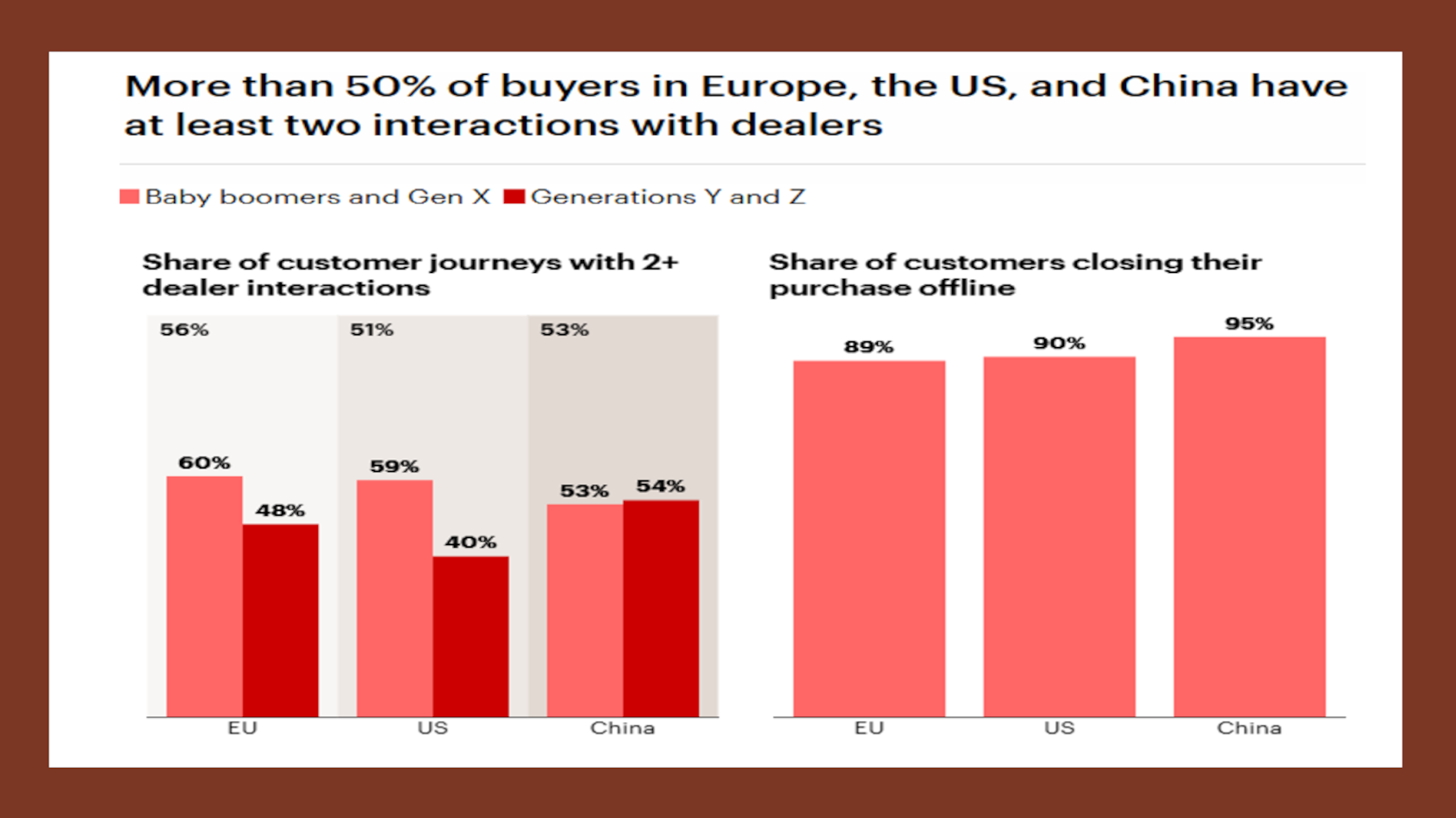
Chart courtesy of Global Automotive Consumer Survey by Bain & Co.
By subscribing, you agree to receive communications from Auto Remarketing and our partners in accordance with our Privacy Policy. We may share your information with select partners and sponsors who may contact you about their products and services. You may unsubscribe at any time.
Even a global examination of car buying placed dealerships at the center along with their notable value to process.
From the United States to Canada, the United Kingdom, Germany, France, Italy, United Arab Emirates, China, India, Indonesia, and Japan, Bain & Co. found that dealers are one of the most important parts of transactions.
More than 80% of car buyers globally now combine online and offline channels, yet nine in 10 still complete their purchase at dealerships. That’s one of the top findings from Bain’s new Global Automotive Consumer Survey, based on responses from more than 12,000 car buyers worldwide.
Researchers said new technologies — including artificial intelligence — are changing how consumers research and choose cars around the globe. Brand loyalty is decreasing and price continues to play a powerful role in purchasing decisions in the U.S. and Europe, but less so for Chinese buyers, according to Bain.
The survey showed price remains the top consideration when buying a car in the U.S. and Europe, cited by 68% and 62% of consumers respectively, while technology and features (58%) rank ahead of price in China.
Bain also noticed loyalty to established automakers also varies considerably. U.S. buyers remain the most committed, while newer Chinese brands are entering consideration in Europe.
Subscribe to Auto Remarketing to stay informed and stay ahead.
By subscribing, you agree to receive communications from Auto Remarketing and our partners in accordance with our Privacy Policy. We may share your information with select partners and sponsors who may contact you about their products and services. You may unsubscribe at any time.
Experts explained their findings come as legacy automakers face weak industry growth and continued pressure on profitability, alongside rapid advances in electrification, artificial intelligence and autonomous driving.
“The car-buying journey is changing quickly, but what stands out is how differently consumers across the globe are responding to that change,” said Klaus Stricker, leader of Bain’s global automotive and mobility practice.
“Technology can be a powerful differentiator for some buyers, while for others, price and brand remain decisive. We find that car buyers are increasingly using AI to compare brands, models and options,” Stricker continued in a news release.
Digital part of car buying accelerates
Researchers said the way consumers choose cars has become increasingly digital.
Bain reported that more than 80% of respondents globally now combine online and offline interactions during the purchase journey, while more than six in 10 start the buying process online.
China is further ahead, with 95% using both online and physical channels and more than eight in 10 willing to consider completing their purchase online, according to the survey.
But Bain pointed out that greater use of digital channels has not diminished the importance of physical dealerships.
Experts reiterated nine in 10 consumers globally still complete their purchase offline, and more than half of buyers in Europe, the U.S. and China have at least two interactions with dealers along the way.
Bain added that artificial intelligence is also reshaping how consumers research and compare cars.
AI is already widely used by car buyers across several Asian markets and UAE, reaching more than 90% in Indonesia and close to 80% across age groups in China.
In Japan, Europe and the U.S., adoption is more concentrated among younger buyers, with 52%, 61% and 55% respectively using AI, more than twice the share of older consumers, according to the survey.
A look at electric vehicles
Bain acknowledged consumer interest in battery electric vehicles (BEVs) is strong, particularly among younger buyers.
Researchers said younger consumers (Generations Y and Z) in general are more likely to buy BEVs, but in China, willingness to buy BEVs is high across both younger and older generations.
For consumers still reluctant to buy a BEV, the survey showed cost and charging remain the biggest sticking points.
In the U.S. and Europe, Bain determined around six in 10 individuals are unwilling to pay more for a BEV than for a comparable combustion-engine car, while almost half cite charging times as a concern.
Bain explained that closing the price gap and making charging more convenient will be critical to persuading more consumers to make the switch.
Bain cited an example in Germany where BEV-buying decisions shifted once price parity narrowed. In August, BEV registrations jumped 75% year-over-year to reach around 32% of new car sales.
“New government incentives and rising fuel prices drove the change, in addition to new strong BEV models entering the market,” researchers said.
Bain also noted that getting more buyers behind the wheel provides another opportunity.
The survey indicated consumers who have already test-driven a BEV are up to 2.2 times more willing to consider purchasing one than those who have not.
Yet mass-market buyers in Europe and the U.S. are less likely to have tried a BEV, compared to premium buyers.
“With many potential buyers yet to try one, making test-drives easier to access could be one of the most effective ways for automakers and dealers to encourage wider BEV adoption,” researchers said.
Autonomous driving could challenge traditional brand loyalty
Bain wrapped up its survey findings by mentioning the appetite for autonomous-driving technology is substantially stronger in China and several Asian and Middle Eastern markets than in Europe and the US.
About 84% of Chinese consumers would consider buying a vehicle offering at least Level 3 (L3) autonomy, compared with 47% in Europe and 40% in the U.S.
Researchers explained L3 allows a car to drive itself under certain conditions but requires the driver to take over when prompted.
Interest is even higher in the UAE, India and Indonesia, according to Bain.
Experts added that greater interest in autonomous driving could also weaken traditional brand loyalty.
“Consumers most interested in the technology are more willing to switch manufacturers for better functionality, with premium buyers in Europe and the U.S. particularly open to changing brands. In China, willingness to switch is more widespread,” Bain said.
“For automakers, better autonomous-driving functionality could therefore become an increasingly important way to attract customers from competitors,” the firm went on to say.
“Technology is now part of the reason customers choose one manufacturer over another,” Stricker added. “That raises the stakes for automakers.
“Brands need to understand where customers are willing to pay for innovation, where affordability remains the overriding consideration, and where better technology could be enough to persuade a customer to switch. That requires a much more precise understanding of what different customers value,” Stricker said.
The entire survey report is available online.