
Mixed October details as Dealertrack Credit Availability Index ticks up for sixth straight month
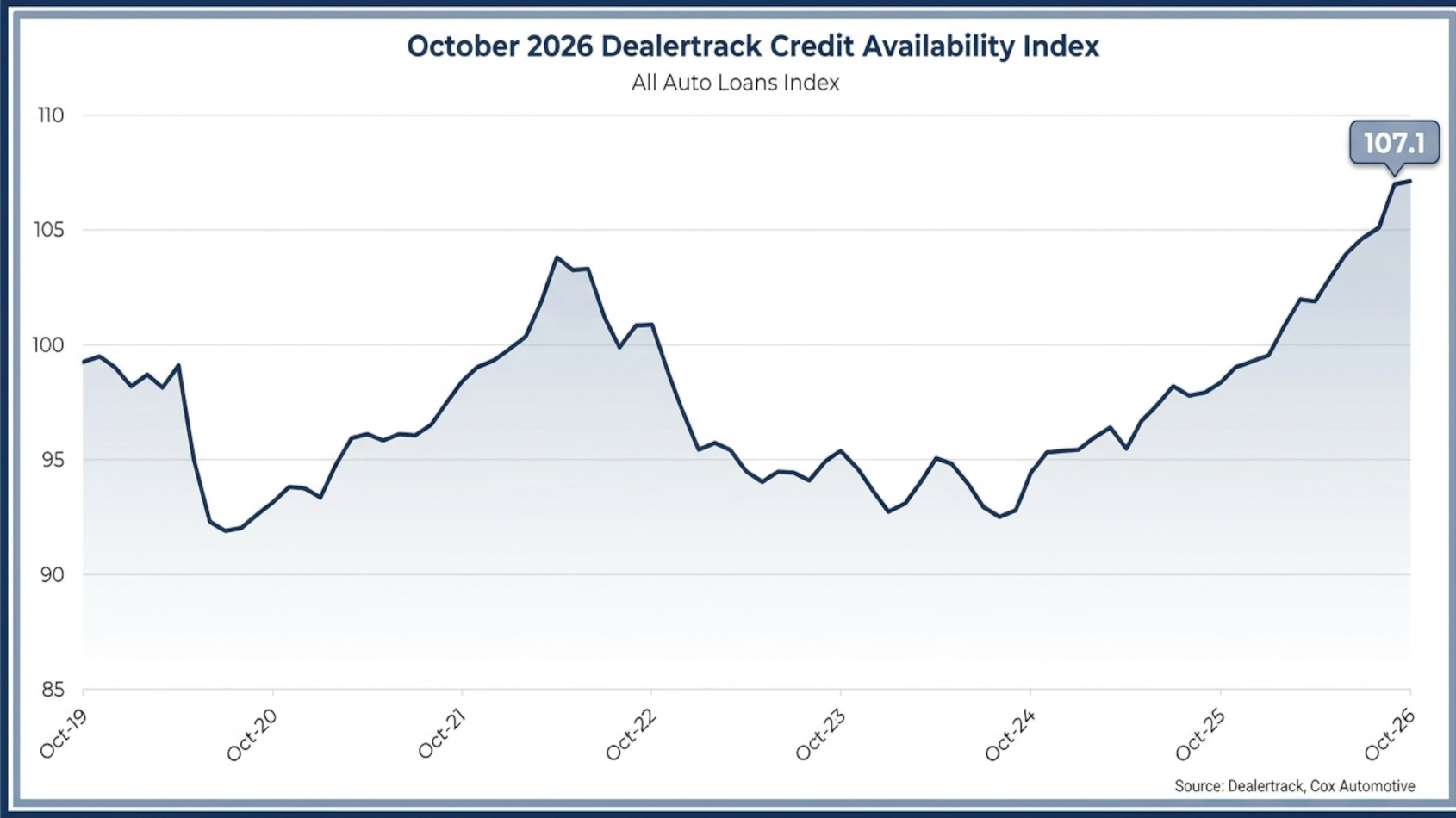
Graphic generated from Cox Automotive information using Nano Banana 2.
By subscribing, you agree to receive communications from Auto Remarketing and our partners in accordance with our Privacy Policy. We may share your information with select partners and sponsors who may contact you about their products and services. You may unsubscribe at any time.
The Dealertrack Credit Availability Index ticked up again in October, as auto credit access improved for the sixth consecutive month, reaching its highest level since April 2015.
But Scott Vanner, a manager of economic and industry insights at Cox Automotive, explained why the lenders’ credit spigots might not necessarily be flowing like the volume of pumpkin spice lattes at Starbucks.
Cox Automotive reported on Tuesday that the index increased 0.1% to 107.1 from September’s revised reading of 107. It also was 8.9% higher than October 2025.
“The gain was the smallest of the six-month streak, and the results underneath were much more mixed than in September, when every component contributed,” Vanner wrote in his analysis that accompanied the newest index reading.
“Three components added to the index while three offset most of those increases. A higher subprime share was the largest contributor, while a lower share of long-term loans and a wider yield spread were the biggest drags on the October index,” Vanner continued.
Cox Automotive found that the share of loans to subprime consumers rose to 17.9% in October, an increase of 50 basis points from September and the third consecutive increase.
Subscribe to Auto Remarketing to stay informed and stay ahead.
By subscribing, you agree to receive communications from Auto Remarketing and our partners in accordance with our Privacy Policy. We may share your information with select partners and sponsors who may contact you about their products and services. You may unsubscribe at any time.
Year-over-year, the share was up 180 basis points, according to Cox Automotive tracking.
“The increase was broad, with higher subprime shares across all four lender types and every channel,” Vanner said. “The rise was the single largest contributor to October’s index gain.”
With subprime playing that role, Cox Automotive the overall contract approval rate rose 20 basis points in October to 73.9%. That’s 240 basis points above what analysts saw a year ago.
“The increase came despite lower approval rates in most channels and lender types and largely reflected the exit of a near-prime lender whose low approval rate had previously weighed on the overall average,” Vanner said.
Cox Automotive calculated the yield spread widened 11 basis points, moving from 6.42% to 6.53%.
Analysts further determined that the average contract rate rose 24 basis points to 11.46%, its highest level since March, while the five-year Treasury yield rose 13 basis points to 4.93%, its highest level since June 2007.
“Contract rates rose across all lender types and channels,” Vanner said. “Year-over-year, the spread was 102 basis points below the 7.55% recorded in October 2025. The widening of the yield spread was one of the two largest drags on the October index.”
And when it comes to that booked paper, Cox Automotive indicated the share of contracts with terms longer than 72 months fell to 31.1% in October. That’s down 70 basis points from September’s record high and the first monthly decline since March.
“The decline was broad, with the share falling in most channels and lender types,” said Vanner, who also noted it was the fifth consecutive month the share was at or above 31%.
Vanner added that the share was 340 basis points higher year-over-year, but the sequential decline in the share of loans with terms longer than 72 months was another factor that “weighed on the index.”
Two other components to mention from the October update were connected to negative equity and down payments. Here are those details from Vanner and Cox Automotive:
— The share of loans with negative equity rose to 58.7%, an increase of 90 basis points and the third consecutive increase. It was the highest reading since March when it was 59.2%.
“The increase was concentrated in the used channels,” Vanner said. “Negative equity was 490 basis points above the 53.8% recorded a year ago and above every monthly reading recorded from 2015 through 2019.”
—Down payments rose to 13.0% in October, up 20 basis points from September’s 12.8%.
“The increase was broad, with higher down payments across all channels and most lender types,” Vanner said. “The share was 30 basis points below the 13.3% recorded in October 2025.”
Vanner wrapped up his analysis with views through the prism of consumers and lenders.
“More borrowers carried negative equity into their loans in October, with 58.7% of loans financing more than the vehicle’s value. Although fewer loans exceeded 72 months than in September, the share remained above 31% for a fifth month,” Vanner said. “These structures can make a purchase easier to fit into a budget up front, but they come with higher total borrowing costs and less flexibility to sell or trade the vehicle later if circumstances change. Higher contract rates in October add to that cost.
“The yield spread widened in October because contract rates rose more than the five-year Treasury yield, reversing September’s pattern,” he continued. “This could indicate that contract rates are beginning to catch up with higher Treasury yields. Lenders continued to take on more risk through a higher subprime share and more negative equity, which raises potential losses if borrowers default. If contract rates keep rising, higher payments could make vehicles harder for borrowers to fit into their budget, which may limit how much further loan structures and credit mix can stretch.”