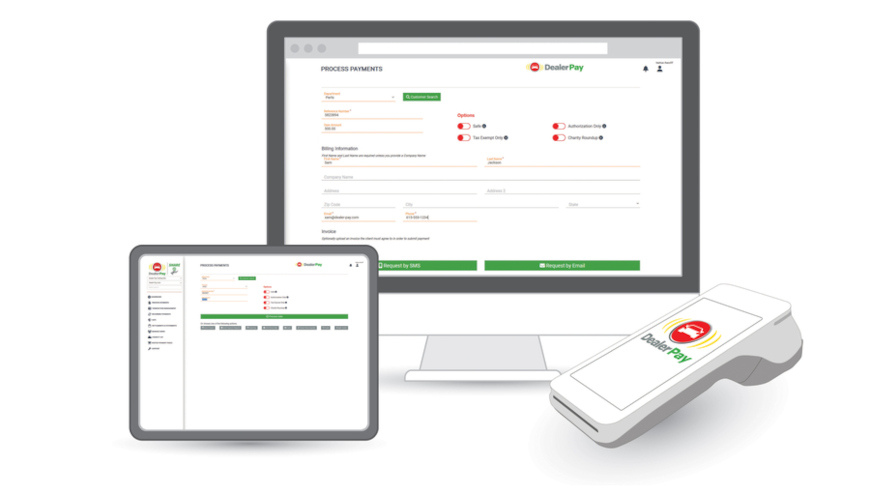
Dealer Pay understands that funds are taken from customers at multiple locations with a single dealership.
For more than two decades, Dealer Pay has provided payment acceptance and point-of-sale (POS) solutions, exclusively to dealerships, and now the company has additional offerings, including:
—Transaction Management Tool that can helps users search, filter, sort, void/refund, receipt, and more, keeping with the highest security standards. Additionally, the detailed reporting and data collection can reduce the time spent managing payments.
—Send Payment Request” enables dealers to collect payments directly from the customer via text (SMS) or email. Not only can customers pay how they choose, but it also reduces receivables faster. Recent consumer research revealed that sixty percent of consumers read business text messages within 5 minutes, and thirty-five percent of customers want to pay by text message.
Leveraging Dealer Pay’s SPR with their DMS-integrated partners, dealers have a solution that can send a copy of the invoice (RO, parts ticket, etc.) to the customer to be authorized with a digital signature. Not only does this streamline the process, and reduce receivables, but it also helps prevent costly chargebacks adding another win in the cost reduction column.
The company said leading DMS Dealertrack DMS, AutoMate, DealerBuilt and CDK have validated the importance of Dealer Pay by offering Dealer Pay to their dealership eco-system.
The real-time integration (live push and pull of data) can reduce the steps (and errors) involved in completing and accounting for transactions.
In addition, by linking each transaction to the DMS, Dealer Pay helps the office with their daily batch, creating a simple general ledger post for accounting.
Other features of Dealer Pay’s POS include charity round-up, cash receipts, and dashboard analytics. The company said the entire platform is PCI-DSS and FTC Safeguards Rule compliant, providing Advanced Security Options, including IP filtering, multi-factor authentication, and other internal limits/controls to prevent fraud and loss.
“We are thrilled to release these exciting features knowing that dealerships will inherently improve both business operations and customer satisfaction. We will continue to add new features with the input of our dealer advisory board and current clients. Buy Now, Pay Later, Self-Pay Kiosk/EV, Rewards/Loyalty, and 2-way Communications are just some of the features on deck and coming soon,” Dealer Pay CEO and president Julie Douglas said in a news release.
RouteOne highlighted five capabilities of the new dealership F&I tool it rolled out last week.
The company explained RouteOne Insights can provide users instant access to web-based data analytics that are fully customizable to a dealer’s unique processes and requirements.
RouteOne said this tool can allow users to understand and explore critical business data, creating valuable insight into F&I performance. Using these insights, RouteOne users can manage and elevate operations to drive customer value and profitability.
RouteOne pointed out that its platform can allow data to be arranged easily with drag-and-drop functionality for each user’s preferences. RouteOne Insights can enable dealers to dive into PVR, products per unit sold, and average gross at a group, dealership, or individual manager level, plus see trends in data over time.
The company also mentioned RouteOne Insights can integrate directly with DMS data and offer full control to users to build customized reports meaningful to a dealership’s business. Live reporting allows data to be seen at a dealership level, personnel level, or monthly performance reporting.
Data stories can be curated with the following:
• Data visualization: Transform available data sets into easy-to-interpret charts and graphs with the click of a button.
• Trend analysis: See trends in key metrics to make data-driven predictions and understand where growth opportunities lie and the impact of changes implemented over time. (Up to 13 months of data in a single report can be compared)
• Live reporting: Instant access to data insights at a dealer’s fingertips, no waiting for downloads.
• Report scheduler: Users can choose the day, time, and frequency of desired reports and have them emailed – WTD F&I Performance Summary can be delivered every Friday morning before heading into the busy weekend.
• Quick Email Reports: If users see something that needs to be addressed, they can quickly share reports via email directly from the RouteOne Insights application.
“We are excited to bring customizable reporting and data visualization to our customers with the launch of RouteOne Insights, making our reporting platform more powerful than ever,” said Alex Mandeville, director of Business development – menu.
Dealers interested in RouteOne Insights and the suite of menu solutions should contact their routeone business development manager at (8660 768-8301 or visit routeone.com/salesteam.
Here’s more evidence of why the “I” in your dealership F&I department could be more important than ever.
Polly released an in-depth study Thursday focused on shopper expectations about insurance.
The embedded insurance marketplace for automotive retail found 72% of recent vehicle buyers saying that they would like an opportunity to get auto insurance at the dealership.
The study also revealed that compressed consumer budgets and inflation, along with shifts in insurance buying preferences, are reshaping consumer expectations about insurance in the dealership.
Here are more key study insights included in a news release from Polly:
• Dealers are missing the embedded insurance opportunity.
Polly said customers want convenience and simplification, as 70% agree buying a vehicle together with insurance would make things easier and more convenient.
Many dealers, however, aren’t yet bringing insurance into the conversation. Polly learned 42% of respondents said that their dealer didn’t do anything to connect them with any insurance options.
• Economic pressure will accelerate the need for dealers to diversify revenue streams.
Total cost of ownership is to be top of mind for consumers, according to the survey, with more than 86% of respondents stating it was important to them.
Given the current economy and respondents’ anxiety around vehicle purchases, Polly explained demand for add-ons and dealer protection products is likely to decrease.
• Customers want options when purchasing insurance.
Polly reported customers are open to purchasing insurance online and in-person at the dealership.
The company added that millennials are significantly more likely to engage with new channels, with 64% saying they would be likely to purchase insurance from a digital auto insurance platform inside the dealership.
Given that consumers are open to purchasing insurance from different channels, Polly said the study underscores the importance of making insurance options available at every step of the customer journey.
“It’s not surprising that consumers are focused on total cost of ownership, including insurance, now more than ever,” said Wayne Pastore, president and COO of distribution for Polly, “This is a huge opportunity for dealers to include insurance in the car buying process.
“If a car buyer saves money through insurance, they could apply it to F&I products or other upgrades. Additionally, embedded insurance can provide dealers with a recurring income stream to help offset expected reductions in overall dealer profits,” Pastore continued.
Jeff Mongeon, co-founder and head of carrier relations for Polly, added, “Consumers are actively shopping their insurance to combat premium hikes.
“Our car and insurance buyer study shows that they want options at every step of the car buying journey and that savvy dealers with an embedded insurance partner will have the happiest customers,” Mongeon went on to say.
For more information about Polly’s Car and Insurance Buying study, visit this website.
Most dealers who participated in a new survey from eLEND Solutions acknowledged they have a serious problem in connection with digital retailing and many do not have a proven strategy to solve it.
According to the fintech company’s new report titled, “Is Identity Fraud Jeopardizing Digital Retailing Profitability,” 60% of participating dealerships reported the loss of three or more vehicles to identity fraud during the past year.
Furthermore, the report based on a survey of more than 700 auto dealerships across the U.S. also revealed that while dealerships cite identity fraud as their top fraud challenge/concern, they almost unanimously agree that its increase is because of the increased digitization of the deal, since 67% lack adequate identity fraud protections.
“The pandemic changed a lot of things in the auto industry — and that is particularly true when it comes to fraud which, as this report underscores, is causing more and more losses for dealers — an estimated $619 million for franchise dealers alone,” eLEND Solutions CEO and founder Pete MacInnis said in a news release.
“Economic conditions and, especially, increasing digitization of the car buying process are driving more fraud but, unfortunately, this report reveals that most dealerships have not implemented ID verification technologies that can prevent it,” continued MacInnis, who is among the speakers set to appear during Used Car Week, which begins on Nov. 14 in San Diego.
According to the report, 84% of dealerships have directly experienced identity fraud at their dealership since the pandemic, with a third seeing an over 20% increase in identity fraud-related activities since the pandemic started.
And in just the past year, eLEND Solutions 79% of dealerships directly experienced an identity fraud-related vehicle loss at their store.
When asked to explain the increase in identity fraud, 95% of survey participants related it directly to the increase in the digitization of the deal and remote buying experiences, with 86% predicting that as more of the transaction moves online, identity fraud will increase and become harder to prevent.
The report also showed that losses are not limited to identity fraud, with most dealerships reporting an increase in credit application fraud in the past year.
According to the findings, 77% saw a 10-20% increase or more, with more than one-third reporting that one in every 100 applications at their dealership was fraudulent.
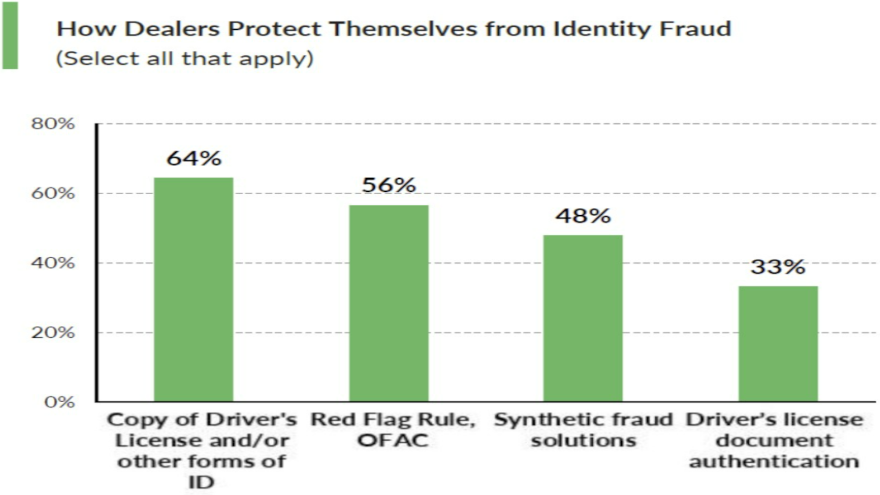
The report also investigated what dealerships have been doing to prevent fraud with photocopying the driver’s license / ID coming in No. 1 with 64% using this strategy, and the “Red Flags Rule” coming in second with 56% of stores doing this process.
Only 33% reported using critical document authentication as part of their process, a significant disconnect, according to eLEND Solutions.
“Without actually validating/authenticating ID documents and buyer identities, dealerships remain particularly vulnerable,” MacInnis said in the news release. “As more of the transaction becomes digital, embracing ID verification technologies that include forensic authentication of the driver’s license document, in conjunction with matching data extracted from the document against hundreds of databases, can easily help dealers minimize fraud risks before it becomes an expensive problem.”
Dealers were also asked about the timing of their credit pulls, a practice that rapidly evolved once the pandemic prompted more of the process to move online.
As compared to 2018, when only 8% of dealers said they pulled credit before the test drive, today 40% report doing so, with only 20% today waiting until right before the F&I handoff, versus 39% in 2018.
“This shift in credit pull timing is a dramatic and positive change in the way auto dealerships do business and, with the right technology in place, has positive implications for preventing fraud if dealerships take the opportunity to validate customer identity upfront with the simple swipe of a driver’s license — but only if document authentication is part of that process,” MacInnis said.
Other key data takeaways from the report included:
• 84%, say there has been a noticeable increase in identity fraud since the pandemic.
• 79% of dealers experienced an identity fraud-related vehicle loss at their dealership in the past year.
• 79% say that identity fraud has increased in their dealerships by over 10%, and nearly one-third say it has increased between 21% and 30%, or more.
• 60% reported a loss of three to five vehicles, or more, in the last twelve months.
• 89% of dealerships report an increase in loan application fraud in the past year.
• 34% report that one in every 100 applications at their dealership was fraudulent.
• 95% track identity fraud to the expansion of remote buying experiences and the digitization of the deal.
• 86% agree that as more of the transaction moves online, identity fraud will continue to grow and become even more challenging to prevent.
• 67% do not include driver’s license document authentication to protect themselves from identity fraud.
• 40% report pulling credit before the test drive, vs 8% in 2018.
• 93% say that if a driver’s license scan could be converted into a consumer consented pre-qualification it would be a meaningful benefit.
The complete report can be downloaded via this website.
U.S. Bank announced this week that it now can provide funds to auto dealers instantly after the contract is finalized by the bank.
Following a successful pilot completed in June, U.S. Bank said it already has enabled more than 800 dealers to receive funds from auto financing via a real-time payment.
The bank expects to deliver the solution to more dealers in the coming months as the bank continues to improve operational efficiencies for auto dealers.
While the traditional ACH payment method for funding auto loans can take several days — especially when sales are made outside of banking hours — U.S. Bank explained that real-time payments to dealers are fast, secure and available seven days a week, including holidays.
U.S. Bank also pointed out that dealers using real-time payments gain a competitive advantage, with greater control over cash flow and improved contract-in-transit metrics, a key performance indicator for auto dealers and their employees.
Furthermore, the solution is also available to recreational vehicle dealers, according to a news release.
“U.S. Bank is focused on delivering innovative real-time payment solutions to resolve what our customers tell us are their payments pain points,” said John Hyatt, president of dealer services at U.S. Bank. “We’re simplifying loan payment processes to help our dealer clients better control their cash flow, which gives them a competitive edge and peace of mind.
“Dealer interest in this solution over the last few weeks has grown rapidly, with many particularly excited about finalizing their deals within moments after a consumer is approved for a loan, especially during the evenings and even on Saturdays and Sundays,” Hyatt continued in the news release.
Earlier this year, U.S. Bank announced that it worked with Lithia & Driveway to help Driveway.com become the first online dealership to pay customers over the RTP network.
With The Clearing House’s RTP Network, the first new payment rail in the U.S. in more than 40 years, U.S. Bank can help businesses send and receive payments instantly 24 hours a day, 365 days a year.
U.S. Bank, which participated in the first ever payment on the RTP Network, is one of the top senders of RTP transactions in the U.S.
“The bank is continually developing new ways for companies to utilize real-time payments, such as a new solution to provide greater speed and security to money movement between individual investors and broker dealers,” the bank said.
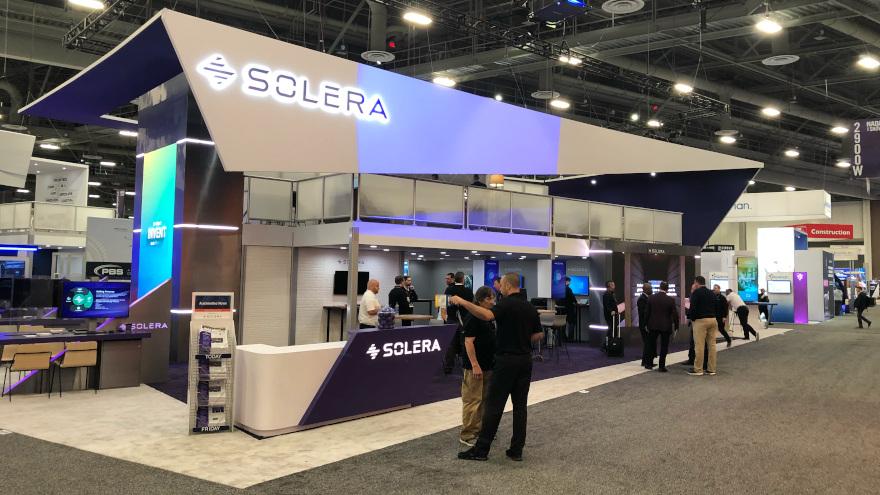
According to a news release a pair of independent dealerships in the Southeast are among the stores already seeing the advantages of using Solera Auto Finance (SAF) after receiving rebate checks as part of the finance company’s rewards program.
Drive a Dream, an independent dealership in Marietta, Ga., earned a rebate check that reduced its DMS cost by 40%.
“Click and get paid. It’s just that simple,” Drive a Dream general manager Bill Dangra said in the SAF news release. “We sent over deals, received good financing terms, and hit our goal numbers with no effort.”
The news release also mentioned Wine Automotive in Chesapeake, Va., saw similar success by utilizing SAF, earning a 19% rebate toward its DMS.
“I’m thrilled with the rebate,” Wine Automotive director of finance Brian Korich said in the news release. “The partnership with Solera Auto Finance helps us close deals quickly, and the rewards program is an added bonus.”
After launching in March, SAF said it has quickly gained momentum and bettered its initial growth estimates, expanding to 37 states with plans to be operational in all 50 states by 2023.
By providing a “captive-like” financing solution to the non-prime segment of used-vehicle buyers, SAF said it can level the playing field for independent and franchised dealers and fund deals quickly.
“SAF’s goal has always been to provide a superior car-buying experience that accelerates the funding process and reduces operating costs for dealerships,” Solera Auto Finance chief executive officer Kenn Wardle said. “Dealers who are using SAF are starting to see the value of our innovative solution.”
Details about SAF’s rewards program, including how to enroll, are available at www.solera.com/solutions/auto-finance/ or via email: [email protected].
While Bitcoin may not yet be accepted as a medium of exchange for everyday items, at least one luxury model dealership as well as a digital asset advisory firm both are seeing a notable increase in customers wanting to transact in digital assets, primarily Bitcoin and Ethereum.
Digital Asset Investment Management (DAIM), headquartered in Newport Beach, Calif., recently recapped the experience Marino Performance Motors (MPM), which retails exotic vehicles and other high-line models in West Palm Beach, Fla.
MPM sales and finance manager Gil Courchene said the opportunity to take advantage of this growing customer base.
“In the past year we have had so many people ask about paying for cars in crypto. We had clients flying in from across the U.S. looking at specific cars but they were intent on paying with cryptocurrency. I didn’t want that to be a dealbreaker for us,” Courchene said in a news release distributed by DAIM
Courchene set up the dealership to transact in Bitcoin and Ethereum, acknowledging that finding a trusted partner is the most important piece to supporting these transactions.
Courchene said using a licensed and experienced digital asset manager reassured the dealership that the transaction will go smoothly. That’s why the store teamed up with DAIM, which offers crypto advisory and management services.
“There are people who want to accept crypto and people who want to spend it, but there is a lack of familiarity with the process so finding a partner I could trust was paramount,” Courchene said. “Buyers who want to pay with crypto need to know the risks have been removed from the transaction.”
DAIM chief operating officer Mike Soroudi thinks it is important luxury retailers such as Marino Performance Motors become comfortable transacting in cryptocurrency.
“People see crypto as this confusing blackbox where transactions are flying around anonymously. Once the client sends a transaction, we tell them and the vendor to go on a block explorer and view the transaction in real time,” Soroudi said.
“Retailers can match the transaction ID, addresses, and amount and begin to understand the legitimacy and clarity of the system. At three confirmations they know the process is complete. In actuality there is more transparency and faster transaction finality than the legacy banking options available,” he continued.
DAIM sees what’s happened at Marino Performance Motors as a small step toward more efficient and open payment processing as well as improved treasury management.,
“We can get the transaction completed fairly quickly. Usually, the vendor will receive the cash back within the hour,” Soroudi said. “Interestingly, as companies complete more and more transactions, we see them wanting less and less cash back. They are becoming more comfortable with the idea of converting only the portion needed for immediate liquidity needs and keeping the rest in digital assets.
“Bitcoin is an excellent store of value, and in a low interest rate and high inflation environment keeping excess money in cash erodes the holder’s purchasing power immensely. Another strategy, we’ve used is keeping the money in a stablecoin with a 5% to 8% yield before deploying the capital,” Soroudi went on to say.
CDK Global recently pinpointed the impact artificial intelligence (AI) is having on dealerships.
According to a study by the retail technology company, approximately 68% of dealerships believe adoption of AI has had a positive impact on their businesses, stemming from an increasing amount of data created by dealers, manufacturers and vehicles.
AI technologies can provide significant and measurable benefits across other industries.
In a separate survey by McKinsey & Company, 63% of respondents reported revenue increases due to the use of AI applications with average gains of around 10%.
Within automotive retail, CDK Global said AI can be used to solve some of today’s biggest dealer challenges, including:
— Addressing employee and skills shortages by replacing resource-intensive tasks and augmenting employee skills
— Attracting customers by looking at existing sales and service profiles and determining their propensity to buy
— Retaining existing service customers through proactive and personalized service and by better predicting potential vehicle issues.
CDK’s Artificial Intelligence in Automotive Retail Report highlighted the use of AI tools in automotive retail and the optimism for the benefits it will provide dealerships in the future. Some of the major findings included:
— Dealers are familiar with artificial intelligence (75%), with 40% feeling extremely or very familiar with the topic.
— Dealerships are already using AI or plan to do so within the next three to five years (68%).
— Dealers who don’t use AI today, but plan to in the future, anticipate positive outcomes (56%).
— Only 2% of the respondents said that they didn’t see their dealership using AI-based applications in the future.
CDK Global chief product and technology officer Mahesh Shah highlighted that automotive retail is investing in AI and is already seeing the benefits.
Whether a dealership is currently using AI or plan to, Shah pointed out that nearly all the respondents believe AI will be an integral part of dealership operations.
“Today’s world is undoubtedly data driven, and every transaction that happens between the dealers, manufacturers and consumers is an essential data source that can be used to build more simple and convenient buying and ownership experiences,” Shah said in a news release. “For this to happen, we must come together as an industry to exchange data in a fast, reliable and secure way through platforms that are built on modern, cloud-based architectures.
“The results of our research are encouraging and tell us dealers are excited about the possibilities of AI and how it will help them meet their financial and customer satisfaction goals,” Shah went on to say.
The CDK Global Artificial Intelligence in Automotive Retail Report was conducted in October among a national sample of 243 dealership department heads and executives.
The interviews were conducted online by CDK Research & Insights across a representative mix of roles, location, departments and sales volume.
To view the full report, go to this website.
Especially in the advent of digital retailing, CDK Global sought to gauge how much dealerships are looking to protect themselves and their customers from online threats.
According to findings from a CDK Global study released on Wednesday, rising concerns of ransomware and phishing attacks impacting have prompted nearly half of dealers surveyed to plan for increased investments in cybersecurity in 2022. That’s compared to only 24% of dealers that invested in security measures in 2020.
“Meeting consumer demand for online automotive retailing while operating on an outdated framework can create a perfect storm for a cybersecurity breach,” said Joe Bell, vice president of IT solutions and global network architecture at CDK Global.
“By adding protective layers of security through integrated visibility and monitoring tools, dealerships can mitigate their risk of lengthy downtime for data recovery,” Bell continued in a news release.
CDK Global pointed out that IT-related business interruptions can be costly errors for dealerships, impacting businesses an average of 16 days in lost revenue if targeted by a cyberattack. Company expects said that recovering from a data breach and restoring a dealer’s reputation is both costly and time intensive, and automotive retailers may fall prone to meeting cybercriminals’ demands to keep their dealerships running.
In fact, recent data by ransomware specialty company Coveware shared in the CDK Global news release showed that payouts by businesses nearly quadrupled from 2019 to 2020, jumping from nearly $44,000 to $169,000.
CDK added that its cybersecurity report highlighted the need for dealerships to put necessary preventative measures in place to stem future incidents, including:
— While dealerships recognize there is an increased sense of urgency to prioritize cybersecurity relative to other operational areas (85%), only 49% believe they currently have adequate protection against cyberattacks.
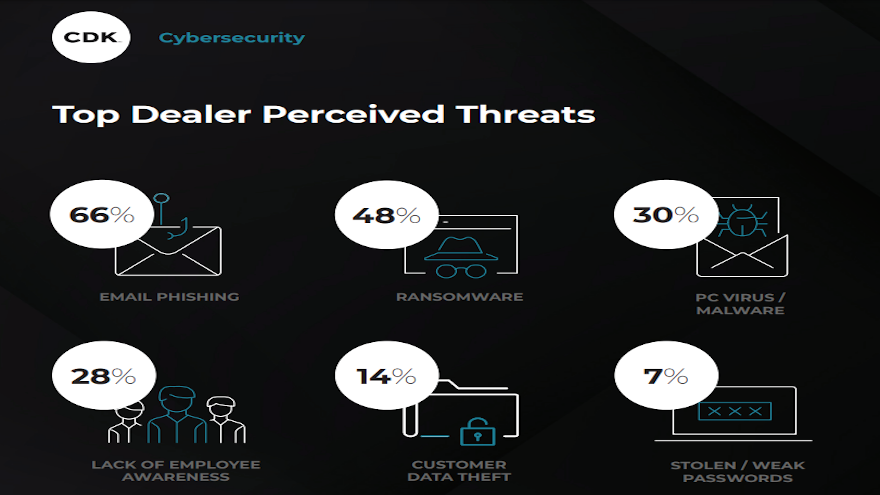
— Employee email phishing remains the biggest perceived threat to dealer businesses (66%), but less than a third of employees have received formal security training on how to avoid it. Additional concerns include ransomware (48%) and malware (30%).
— A total of 65% of dealerships are regularly backing up data, system images and configurations and keeping the backups offline, but 73% are not testing their cyberattack incident response plan.
“Investing in modernizing aging security products, educating employees on increasingly sophisticated and frequent threats, and solidifying disaster recovery plans before an incident occurs can uphold a dealership’s reputation in the marketplace,” Bell said.
“If an automotive retailer’s cybersecurity plan for prevention, protection and response is firmly in place, dealerships can focus on strengthening the consumer buying experience while building trust,” he continued.
The company recapped that the CDK Global inaugural Dealership Cybersecurity Report was conducted in June among a national sample of 135 dealerships. The interviews were conducted online by CDK Research & Insights.
Participants included dealer executives, IT decision makers and departmental influencers within the dealerships.
To view CDK’s Dealership Cybersecurity Report, go to this website.
Sanjiv Yajnik, the president of financial services at Capital One, shared high praise for how well dealerships have navigated through the pandemic and adjusted to a retail environment driven by digital advancements.
In this episode of the Auto Remarketing Podcast, Yajnik also discussed what could be impacting auto financing for the rest of the year and beyond.
To listen to the episode, click on the link available below, or visit the Auto Remarketing Podcast page.
Download and subscribe to the Auto Remarketing Podcast on iTunes or on Google Play.