Catalyst IQ & JD Power explain underlying reasons why retail prices for used cars keep rising
Charts courtesy of Catalyst IQ
By subscribing, you agree to receive communications from Auto Remarketing and our partners in accordance with our Privacy Policy. We may share your information with select partners and sponsors who may contact you about their products and services. You may unsubscribe at any time.
Catalyst IQ and JD Power each offered some clarity for why used-car retail prices are climbing even faster than ones for new models, which are just $30 below the record level seen in July 2023.
And perhaps more importantly for dealerships, Catalyst IQ also provided six recommendations to help stores navigate affordability pressures potential buyers are facing.
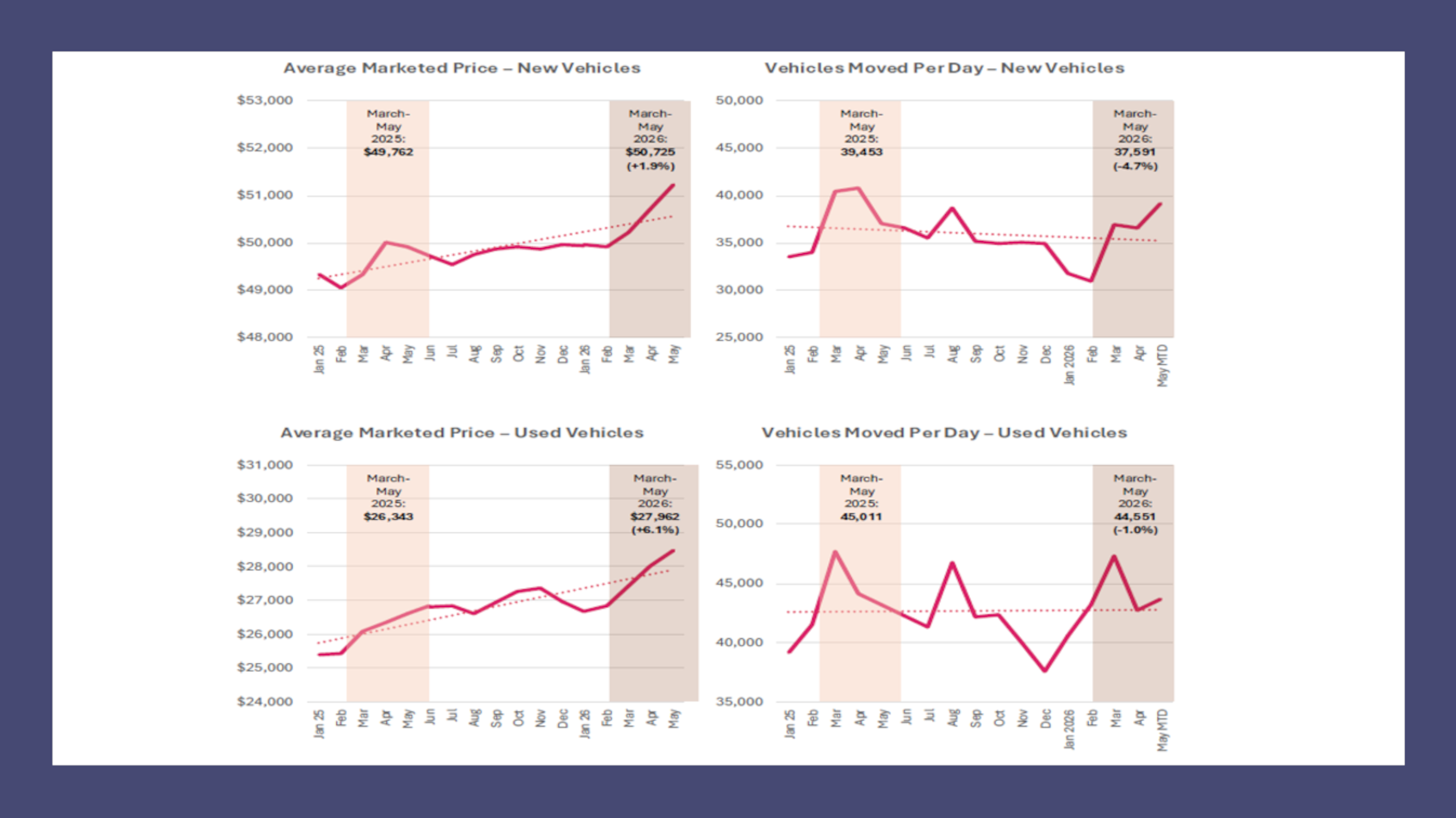
According to exclusive information shared with Cherokee Media Group on Friday, Catalyst IQ new-vehicle prices have climbed almost $1,000, or 1.9%, year-over-year, while vehicle movement per day has dropped by almost 5%.
Used-vehicle prices, meanwhile, have jumped even more at 6.1%, with vehicle movement down by just 1.0%, according to Catalyst IQ.
“We’re seeing a significant affordability impact on the used-car market with used vehicle prices increasing 6.1% year-over-year compared with 1.9% for new vehicles,” said Rick Wainschel, vice president of data science and analytics at Catalyst IQ.
“As we saw earlier this week in the (Wall Street Journal), consumers are still moving into used inventory, but affordability pressures are impacting all aspects of this market,” Wainschel continued in the message to Cherokee Media Group.
Subscribe to Auto Remarketing to stay informed and stay ahead.
By subscribing, you agree to receive communications from Auto Remarketing and our partners in accordance with our Privacy Policy. We may share your information with select partners and sponsors who may contact you about their products and services. You may unsubscribe at any time.
“While the data doesn’t point to a specific price threshold, it does show that as new vehicle prices move above $50,000, many consumers continue searching for lower-cost alternatives. It’s also important to understand that used vehicle movement has declined far less than new vehicle movement (1.0% vs. 4.7%), suggesting consumers still view used inventory as a relative value alternative even as prices rise across all sectors,” Wainschel went on to say.
So, that analysis likely prompts this question. How did we get here?
Well, following the publishing of that article by the Wall Street Journal that Wainschel mentioned, JD Power’s Tyson Jominy added more context to the company data cited by the newspaper.
Jominy, who is senior vice president of data and analytics at JD Power, pushed back on the thinking that new-car sales suddenly fell off the table, creating an unexpected dearth in the used-vehicle market. Rather, Jominy explained in this LinkedIn post that the deterioration of new-car sales has been happening for a decade that’s compounding the price and affordability situations.
“Industry total sales peaked in 2016 (2015 for retail sales), which means we are over a decade removed from peak vehicle sales in the U.S.,” Jominy wrote. “We aren’t just losing a million sales this year; we have been losing sales every year for a decade.
“We lost 3 million during COVID alone, then another 3.7 million during the supply chain crisis,” he continued. “Cumulative sales losses are 16.1 million over the past decade, nearly matching our forecast for the year.
“In short, the industry has lost an entire year’s worth of new-vehicle sales over this past decade,” Jominy went on to state.
And perhaps in a twist, as those sales are declined, prices have rocketed higher.
Catalyst IQ data shows average marketed price (AMP) is approaching an all-time high, reaching $51,610 on May 26, just
Over the past year, AMP increased by $1,896 with almost 85% of that growth taking place since March 1 alone. Coupled with affordability pressures, higher interest rates, and fuel prices approaching all-time highs—up more than $1.50 per gallon over the past eleven weeks—this rapid price growth is creating additional challenges for dealers entering the summer selling season.
“Historically, rising new-vehicle prices have created tailwinds for used demand as affordability-conscious consumers shifted into pre-owned inventory. That dynamic still appears to be playing out today, but with important limitations,” Wainschel told Cherokee Media Group.
Through a separate news release, Wainschel gave more insight through the prism of new models.
“Historically, higher vehicle prices were often temporary and corrected quickly through incentives or discounting,” Wainschel said. “This shift is fundamentally different for the industry. Several of the most profitable vehicle categories — including full-size trucks, full-size SUVs, heavy-duty trucks, and luxury midsize SUVs — are reaching all-time highs. These MSRP-driven price increases are resetting long-term pricing levels, making them more difficult to reverse.”
Catalyst IQ then explained this environment creates both opportunity and risk as consumer shopping behavior is influenced unevenly across segments, geographies, and vehicle configurations.
“It comes down to understanding where demand remains resilient and looking for pockets where affordability resistance is emerging,” Wainschel said. “Dealers who understand that every segment, trim and brand behaves differently in this market will be the ones who are successful in keeping business steady and earning customers’ business as they navigate current economic conditions.”
Easier said than done, right? Well, Catalyst IQ offered a few recommendations in a blog post that accompanied its data.
Here are six strategies Catalyst IQ suggested for dealerships operating in this higher-priced market.
- Audit price position, then act surgically
“As pricing rises, not every VIN requires the same strategy. Use VIN-level market intelligence to identify which vehicles remain competitively positioned and which are beginning to face price resistance. Protect margin where demand supports it, while making targeted adjustments only where needed.”
- Use lower-priced new, used, and certified inventory as affordability release valves
“As vehicle prices climb, a focus on more affordable models and trims informs consumers that there are still accessible choices to consider (see list below*). Additionally, used and certified inventory can become increasingly important alternatives for payment-sensitive shoppers. Dealers that strategically position vehicles that are within the means of a larger proportion of consumers can be better positioned to preserve volume and retain consumers who are stretching on affordability.”
- Protect volume by strengthening top-of-funnel visibility
“In higher-priced segments, shoppers often take longer to make decisions and compare more options before converting. Maintaining strong upper-funnel visibility helps ensure your dealership stays in the consideration set without relying too heavily on broad discounting.”
- Rebuild the message around total value, not just sticker price
“As affordability pressure increases, consumers look beyond monthly payments alone. Reinforce ownership value, capability, warranty coverage, fuel efficiency, and real-world usefulness consistently across digital advertising and vehicle detail pages.”
- Expand reach selectively based on demand signals
“Broader geographic or platform expansion can create opportunity, but only when supported by data. Use localized demand and inventory insights to identify where incremental reach is most likely to drive efficient results.”
- Monitor market resistance and adjust quickly
“In a fast-moving pricing environment, conditions can shift rapidly by segment, geography, and even individual configurations. Dealers that regularly evaluate pricing position, demand signals, and inventory efficiency will be better positioned to respond before resistance turns into aging inventory and wasted spend.”