
Here comes the sun: Spring on the way brings optimism to dealers after Q1 struggles
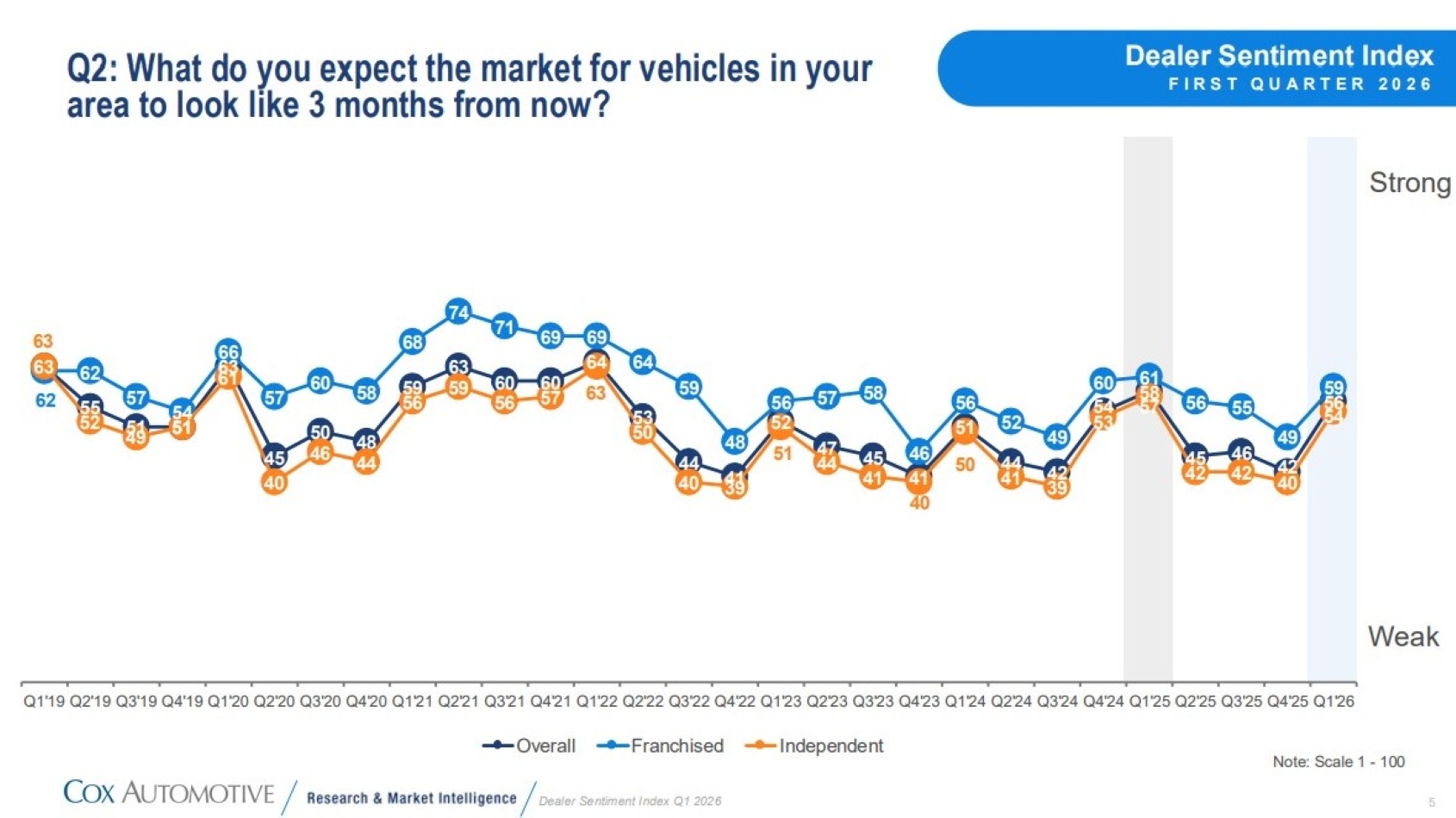
Image courtesy of Cox Automotive.
By subscribing, you agree to receive communications from Auto Remarketing and our partners in accordance with our Privacy Policy. We may share your information with select partners and sponsors who may contact you about their products and services. You may unsubscribe at any time.
Ask car dealers how things have been going and they’ll likely tell you not so good.
But ask them about what’s ahead and the answer shifts to the positive.
Spring is coming, and dealers see the sun shining and business poised to pick up, according to Cox Automotive’s Q1 2026 Dealer Sentiment Index.
The index, based on a survey of 532 franchised and 499 independent dealers conducted from Jan. 28 to Feb. 10, showed dealer optimism soaring as a slow winter transitions into what they see as a promising spring, with expectations of stronger demand, falling interest rates and growing consumer confidence.
While dealers rated the current market solidly in the weak range with an average index score of 41 on a 100-point scale, their assessment of the market in the coming three months shot up from 42 in the Q4 survey to 56, putting it into the strong category.
Franchised dealers’ score rose six points, from a slightly weak 49 to a secure 59, while independents’ expectations took a giant leap from 40 to 54, though Cox Automotive did note those scores are still slightly less than those on a year ago, “suggesting optimism remains guarded.”
Subscribe to Auto Remarketing to stay informed and stay ahead.
By subscribing, you agree to receive communications from Auto Remarketing and our partners in accordance with our Privacy Policy. We may share your information with select partners and sponsors who may contact you about their products and services. You may unsubscribe at any time.
“Our dealer sentiment index got its typical ‘spring bounce’ in Q1,” deputy chief economist Mark Strand said. “While current market conditions are still challenging, the sharp improvement in outlook reflects growing hope for a stronger spring selling season. Dealers are looking for relief from interest rates, a good spring selling season and a pickup in consumer confidence to help turn that optimism into sustained momentum.”
During the first quarter of 2026, though, momentum seems hard to come by. Dealers reported customer traffic at very low levels, with the index dropping to 28 from an already low 31 in Q4. That decline was fueled by independent dealers, whose assessment fell from 30 in Q4 to 26, while franchises remained stable at 34.
Not coincidentally, profits were down as well, with both sectors’ scores sinking as the overall average hit 32, the lowest profit mark since it hit bottom at 17 during the COVID lockdowns of Q2 2020. That’s also due in part to operating costs, which dealers ranked in the “growing” range at 71. And despite used inventory levels sitting on the tight side at 45, dealers said the pressure to lower prices remains high, rating it at 64.
One area that has improved for franchised dealers is the used-vehicle sales environment, which they rated as good with a score of 57, up four points quarter-over-quarter, while independents’ view held steady at just 39.
One reason for the rise could be the fall of the new-car market, which the index shows has fallen from a strong 58 to a weak 48 in the past two quarters, pushing franchises to rely more on their used-car operations. Franchises are also looking at their service departments to pick up the slack, assessing future fixed ops opportunities as growing.
On the downside, franchise dealers reported electric vehicle sales plummeted in Q1 compared to last year, falling from an index score of 40 in Q4 all the way to 25 — down from 51 a year ago. That’s well below independents’ rating of 38, an indication that the market for used EVs is now stronger than that of new ones. New EV sales have fallen sharply since the elimination of the federal EV tax credits last fall, Cox Automotive said, while sales of used EVs continue to increase as the wave of off-lease EVs has begun to hit the market.
Both franchised and independent dealers saw the economy as the No. 1 factor holding back their business, selected by 53% of independents and 49% of franchises, but after that their views are decidedly different.
Franchises ranked interest rates (40%) and political climate (36%) second and third, while those factors ranked fourth (32%) and seventh (30%) among independents. Meanwhile, independents’ second-biggest concerns were market conditions and expenses (both 38%), but for franchise dealers market conditions was fourth on the list at 34% and expenses ranked a distant eighth (23%).
The full index report is available here and Cox’s full commentary can be found here.