
Study finds AI raises dealerships’ internet lead responsiveness, but creates added risks
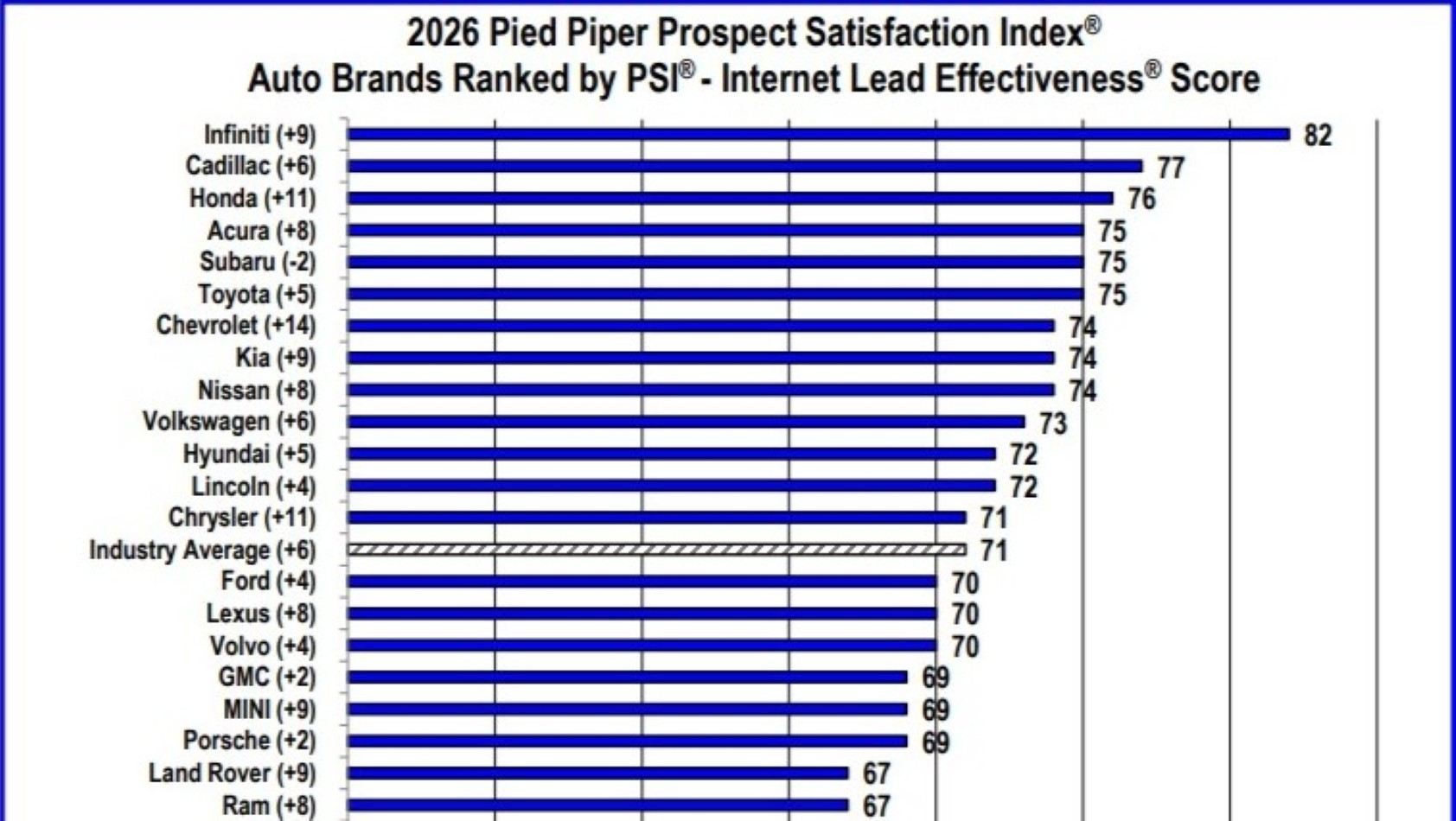
Image courtesy of Pied Piper.
By subscribing, you agree to receive communications from Auto Remarketing and our partners in accordance with our Privacy Policy. We may share your information with select partners and sponsors who may contact you about their products and services. You may unsubscribe at any time.
They say records are made to be broken.
In the case of auto dealerships’ responsiveness to internet leads, it seems they’re made to be broken every year.
For the fourth consecutive year, the industry average for responding to inquiries submitted through dealership websites soared to an all-time high in the 2026 Pied Piper PSI Internet Lead Effectiveness Auto Industry Study.
The study, in its 15th year, showed franchise dealerships representing 33 brands averaged an Internet Lead Effectiveness score of 71 on Pied Piper’s 100-point scale, a six-point jump from last year’s average of 65. The top brand, Infiniti, also shattered a record with an average score of 82 among its dealerships, up nine points year-over-year and well above the record of 77 set last year by Subaru.
Cadillac (77) was second in the 2026 brand rankings, followed by Honda — up 11 points to 76 — and Acura, Subaru and Toyota tied at 75.
In all, 26 of the brands improved their scores from the 2025 study, three of them gaining more than 10 points, while just six declined. Chevrolet was the most improved, rising 14 points to 74 and lifting its ranking from 25th to seventh.
Subscribe to Auto Remarketing to stay informed and stay ahead.
By subscribing, you agree to receive communications from Auto Remarketing and our partners in accordance with our Privacy Policy. We may share your information with select partners and sponsors who may contact you about their products and services. You may unsubscribe at any time.
The score is based on more than 20 weighted metrics taken from the responses to secret shopper inquiries submitted through the websites of 3,290 dealerships, Pied Piper said.
The inquiries asked a specific question about a vehicle in inventory and included a unique customer name, email address and telephone number. Pied Piper evaluated the speed and quality of dealership responses by email, telephone, text message and chat over the next 24 hours.
That marked improvement, the company said, has been driven in large part by increasing proactive, multichannel outreach and ad using artificial intelligence-powered automation for simple inquiries.
As a result, the study found, 51% of dealers provided what Pied Piper calls a “perfect response” — an answer to a customer’s question through multiple paths, including emails, texts and phone within 15 minutes — twice the rate of five years ago.
But, the company noted, while AI lifts the averages it can also hide failures, with overreliance on AI automation introducing two types of “digital handoff risk.”
One is the risk of system-to-system breakdowns occurring when data fails to pass correctly between a dealership’s DMS, website, CRM, AI tools and outbound communication systems such as email, texting or phone platforms. So even when a response is technically triggered, incomplete data, misrouted inquiries or failed communication integrations can prevent a customer’s question from being answered.
Also, Pied Piper said, when AI encounters a complex inquiry and sends it to dealership staff, human follow-through becomes the “critical variable.” If the staff assumes the system is handling the situation or is not prepared to step in, the inquiry can stall without resolution.
It’s not a surprise, then, that the 2026 study found situations requiring human help scored nine points lower on average, and in those instances customers were twice as likely to receive no personal response.
The company said those breakdowns often don’t show up on CRM dashboards, as the system can show activity even when the customer experience failed.
“Automation and AI have improved dealer responsiveness,” Pied Piper vice president of metrics and analytics Cameron O’Hagan said. “But the greatest risk is in the handoffs between systems and from AI to dealership staff.
“Teams assume automation is working and that someone will step in if it fails. Too often, no one does. Independent measurement such as ILE reveals those hidden breakdowns before they cost sales and erode brand trust.”
AI wasn’t the only factor affecting the scores, the company said, also citing greater use of text to answer questions (54% of the time, up from 38% in 2025) and a rise in phone calls from 66% to 75%. This year’s study also showed a large increase in dealerships doing both, with 62% using a combination of a phone call and email and/or text, compared to 49% last year.
Pied Piper also added a new measurement to this year’s study to show how consistently dealerships appear on ChatGPT and other AI-powered search tools, and how effectively they’re presented when local car shoppers use AI as a guide.
The company established a benchmark by adding a ChatGPT first step to its standard evaluation process for a representative sample of dealerships. For each dealership, ChatGPT was prompted as a local customer from the target dealer’s zip code, asking about a specific vehicle known to be in the dealership’s inventory.
The results showed what Pied Piper called “clear visibility gaps” as well as opportunities for dealerships to track and improve how they appear in AI-driven searches.
ChatGPT listed the target dealership first 77% of the time, but in 14% of the cases, that dealership was not the first one listed. And in 9% of those searches, the dealership was not mentioned at all, even though it was the closest dealer to the shopper’s address and had the requested vehicle in stock.
In addition, ChatGPT confirmed the vehicle was in inventory 70% of the time, but test drive availability was confirmed just 36% of the time and 30% of responses included a direct link to the exact vehicle on the dealership’s website.
Pied Piper said the test results illustrate a new risk for dealers, showing even well-stocked dealerships can be “digitally invisible” to potential customers in their local area if their information is not structured for AI discovery.