
CarEdge introduces Transparency Index to grade dealerships’ pricing practices
Screenshot courtesy of CarEdge.
By subscribing, you agree to receive communications from Auto Remarketing and our partners in accordance with our Privacy Policy. We may share your information with select partners and sponsors who may contact you about their products and services. You may unsubscribe at any time.
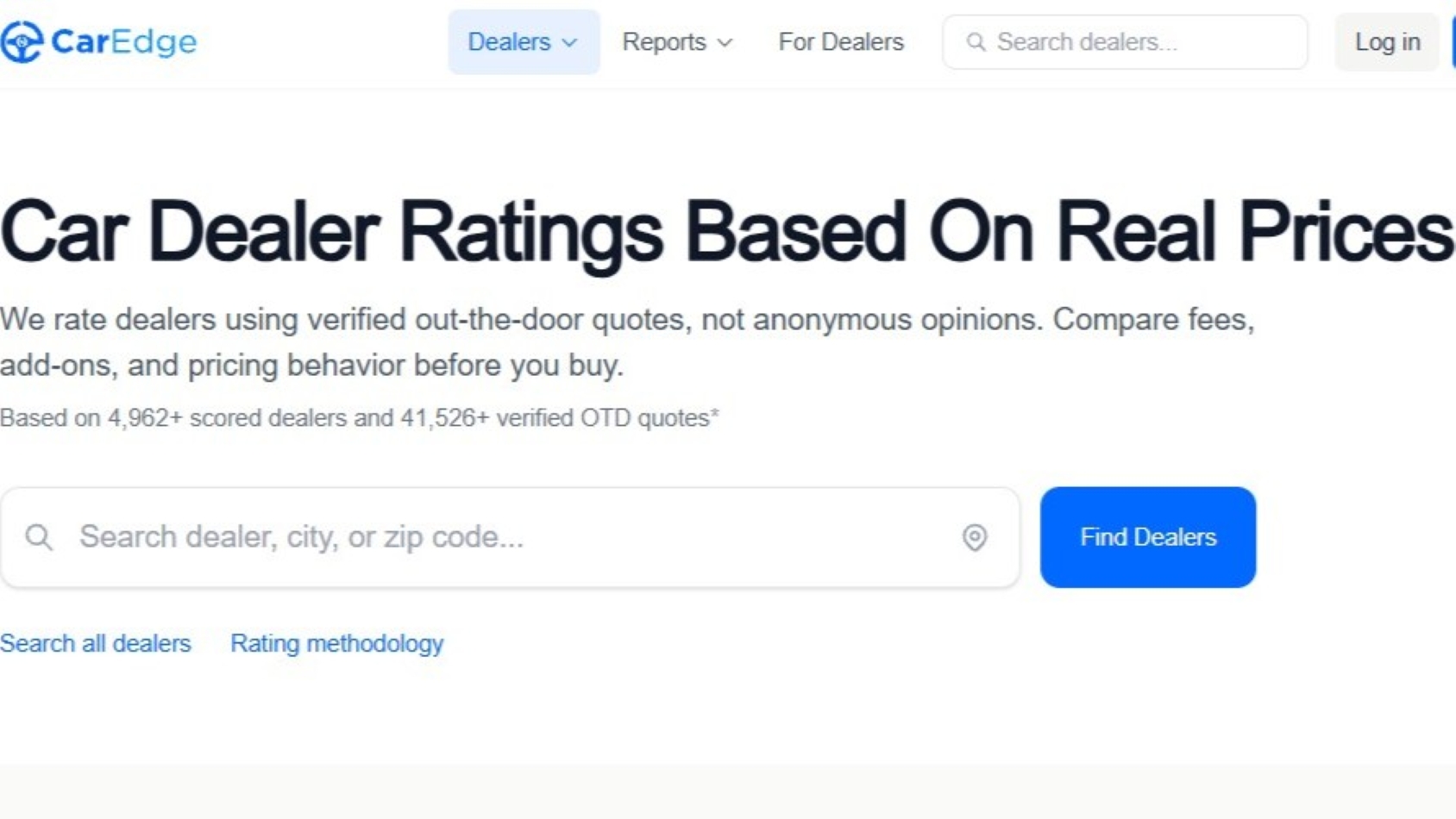
CarEdge, an artificial intelligence-powered car-buying platform, has launched its Dealer Transparency Index, a free public scoring system that the company said provides “independent verification that a given dealer’s consumer-facing pricing practices are real and honest, not just a marketing tactic.”
The company said the index “solves a longstanding problem the industry has been unable to fix on its own” by grading more than 4,600 U.S. dealerships on their pricing behavior.
Its scores are calculated from more than 40,000 “verified out-the-door quotes” collected through CarEdge’s AI negotiation platform.
In a news release, CarEdge emphasized dealers cannot pay to improve their score and no brand or group receives preferential treatment.
Every dealer is scored on a 100-point scale with a corresponding A-t0-F letter grade.
The score is a weighted composite of four components: fee transparency (30%), which measures documentation fees compared to the market median (currently $499); add-on behavior (30%), evaluating how often mandatory add-ons are included and their cost; dealer markup (30%), measuring fees added above the listed vehicle price (excluding government-controlled costs such as sales tax and title/registration fees); and data quality (10%), which rewards dealers who provide complete, itemized quotes with a full breakdown of all fees and charges.
Subscribe to Auto Remarketing to stay informed and stay ahead.
By subscribing, you agree to receive communications from Auto Remarketing and our partners in accordance with our Privacy Policy. We may share your information with select partners and sponsors who may contact you about their products and services. You may unsubscribe at any time.
The full methodology can be found here.
Car Edge said dealers who earn an A or B grade receive tools to use their transparency as a competitive advantage, including:
- A Verified Transparency Badge that links to their DTI profile and can be placed on their website; a dedicated dealer profile page showing their grade, score breakdown, state ranking and pricing history. A-rated dealers rank first in local search results on the CarEdge platform.
- State and brand-specific rankings, with top dealers appearing in state-level leaderboards. CarEdge said the pages are “built for search engines” with the leaders showing in searches for “best dealers” for a brand in a state.
- The company said “transparent dealers” can apply to join the CarEdge Dealer Network, designed to connect them directly with pre-qualified, research-stage buyers from CarEdge’s consumer platform, fed by self-directed web submissions, AI-assisted buyers who have evaluated pricing, and concierge buyers with the highest purchase intent.
Using the data from CarEdge AI dealer outreach sessions, which negotiates deals for consumers on the CarEdge platform, the company found:
- The national average doc fee is $417, ranking from $85 in California (capped by law) to nearly $1,000 in Florida.
- 25% of scored dealers charge zero add-ons. When present, add-ons average more than $1,500 per deal.
- The average listing-to-out-the-door markup is 7%-8% before tax and title. A car listed at $40,000 typically costs more than $43,000 at signing.
- 36 states have no doc fee cap. Eight states — Arizona, California, Iowa, Minnesota, New York, Oregon, Texas and Washington — have legislated limits.
CarEdge said the DTI introduces something new in the auto retail sector: a “public, continuously updated, independently calculated measure of dealer pricing integrity.”
The company added the methodology is transparent, and scores update as new data comes in. Dealers who lower fees, remove mandatory add-ons and provide upfront OTD pricing will improve their grades over time.
“We’re not anti-dealer,” CEO Zach Shefska said. “We’re anti-deception. The majority of dealers we’ve scored are running honest businesses. The problem is there’s been no way for consumers to tell the difference — and no way for those honest dealers to prove it. The Transparency Index changes both.”