
Carvana’s 43% growth in retail sales brings business closer to 3M goal
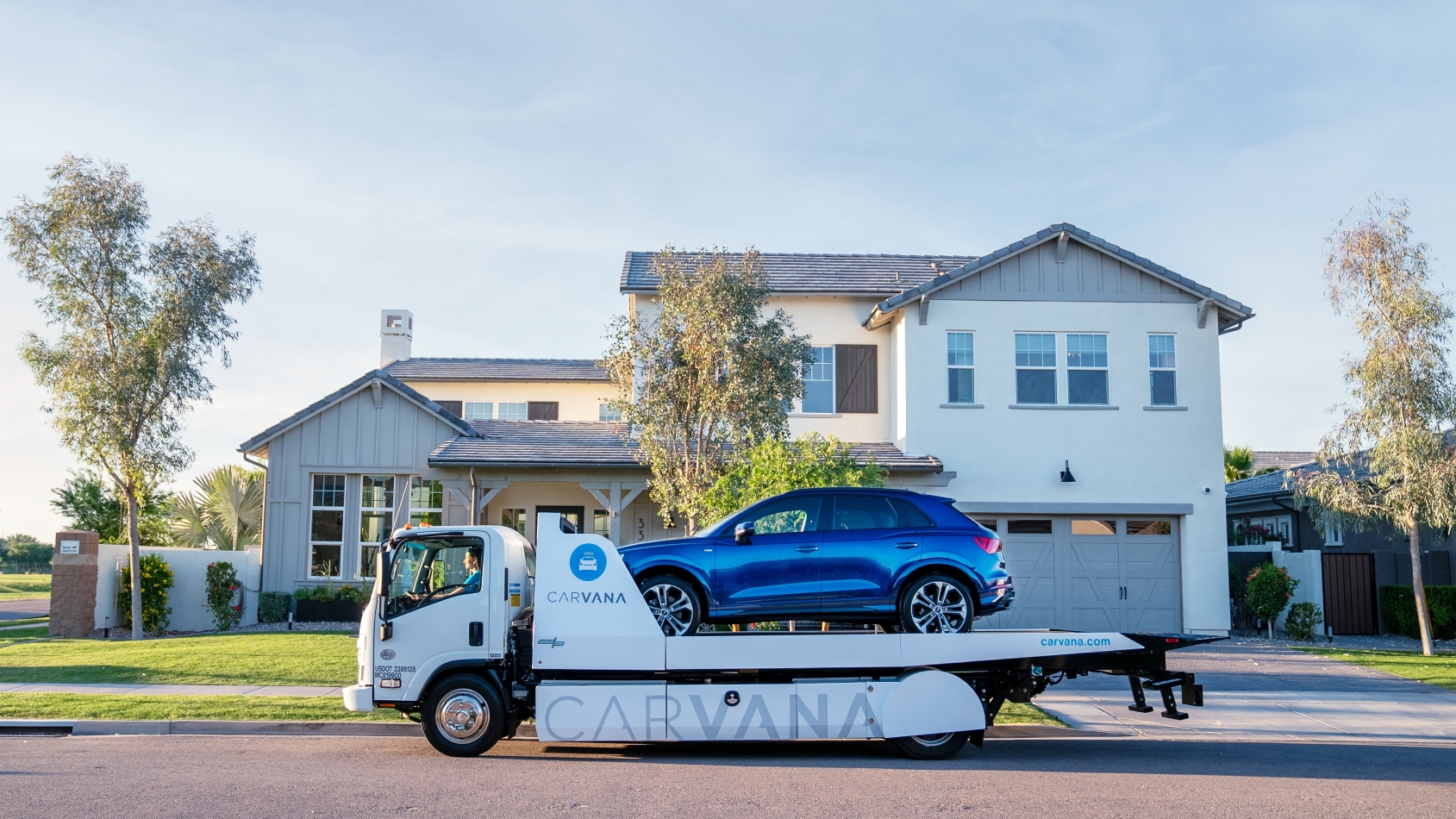
Image courtesy of Carvana.
By subscribing, you agree to receive communications from Auto Remarketing and our partners in accordance with our Privacy Policy. We may share your information with select partners and sponsors who may contact you about their products and services. You may unsubscribe at any time.
After announcing a 43% increase in retail sales in 2025, bringing total retail sales to 596,641, the Carvana executive team talked about everything from recon and GPU health to artificial intelligence and post-sale opportunities on their most recent earnings call.
Looking back at the year, the quarter, and the company’s current position, Carvana CEO Ernie Garcia said that there are a few key takeaways on the leadership team’s minds.
Over the past year, Carvana managed to cut a full day off its average vehicle delivery times.
Carvana is working to “put more cars closer to our customers,” said Garcia. This led to an average of $60 in savings on shipping fees for customers as well.
Further, Carvana customer APR rates are down by about 1% relative to industry benchmarks.
Garcia said during the Q&A portion of the earnings call that the lowering of APR had the anticipated impact on unit growth.
Subscribe to Auto Remarketing to stay informed and stay ahead.
By subscribing, you agree to receive communications from Auto Remarketing and our partners in accordance with our Privacy Policy. We may share your information with select partners and sponsors who may contact you about their products and services. You may unsubscribe at any time.
“I think as it relates to kind of like the immediate-term elasticity as we are passing some of that rate back to customers over the last couple of quarters, I think, yes, we believe that we saw the impacts that we would have expected,” said Garcia.
With a more than 40% increase in unit sales last year, Garcia said the company is achieving the compounding annual growth rates needed to hit its retail unit goal of 3 million units a year by 2030 to 2035.
Mark Jenkins, Carvana’s chief financial officer, also said that in Q4, Carvana sold over 164,000, a new company record.
These sales helped drive a 58% increase in annual revenue, which came in at $5.66 billion.
“With the quality of our customer offering and the positive feedback in our business, we believe there is plenty of fuel to get us to our 3 million unit goal and beyond,” said Garcia. “But we have a lot of work to do and to keep scaling our operational machine to handle all that volume.”
Carvana has the infrastructure to scale; “we just need to execute,” he said.
Recon is central focus of improvement in drive to 3M
According to Garcia, the most operationally intensive part of the Carvana business is vehicle reconditioning.
“Continuing to scale reconditioning quickly, cost efficiently, and at high quality has been, currently is, and for the foreseeable future, a central focus,” said Garcia.
The company is well-positioned to scale recon, as it already owns the real estate to accommodate 3 million units per year. And Carvana has already invested in facilities to bring its production capacity to 1.5 million cars per year.
“Our systems that manage the entire process flow through our reconditioning centers are more capable and robust than they have ever been,” said Garcia. “And we have more locations that are capable of reconditioning cars, 34 as of today, than we have ever had, meaning we can scale hiring and production faster because of access to more people and more geographies.”
However, he said this reconditioning focus remains challenging, and the company has significant room to push more of the complexity of managing cars through these locations into systems, with the goals of continually improving consistency across locations and making scaling easier.
“I think for any operational business, oftentimes the most difficult parts are the parts where you’re moving the most people and things. For us, that’s reconditioning centers,” said Garcia. “And so that tends to be the most difficult area to scale.”
Recon costs were a challenge for Carvana in Q4 compared to prior quarters.
Garcia said, “There’s no unique dynamic that instantaneously changed. I think the execution of that team has been exceptional for a very long time, and we haven’t discussed it much. Still, if you look back over the last 10 years, the areas where we’ve run into more issues over time tend to be in reconditioning because it is fundamentally a very hard operational problem.”
However, wherever there is operational complexity, there’s room for variation, Garcia said.
“I really do believe that in six months, we’re going to be in a better spot than we would have been if we didn’t have a fourth quarter miss. I think the dynamics are straightforward,” said Garcia. “We’ve opened a lot of facilities. We’ve grown quickly. We were growing inventory quickly in the fourth quarter. We’re hiring new managers and reorganizing some management layers to put us in a position to continue growing quickly.”
Jenkins said Carvana expects recon costs to remain high in the first quarter.
“I think a lot of that is driven by the success that we’ve had, adding new locations … but I think our reconditioning team had an exceptional year in 2025, growing locations more than 40%, growing total production more than 40%,” said Jenkins. “I think our total production growth in 2025 is one of the biggest years in the history of our industry in terms of increasing overall production.”
Sequential improvement in GPU expected in Q1, beyond
During the Q&A session on the call, the executives were asked about an expected GPU uptick in the first quarter and throughout 2026.
“We do expect those cost dynamics to play out in Q1 as well and do expect our non-vehicle costs to be up on a year-over-year basis in Q1,” said Jenkins. “Despite that, we expect a sequential increase in retail GPU in Q1. So we expect to overcome those cost headwinds and demonstrate a sequential increase.”
However, although moving inventory closer to customers and cutting down on shipping costs are good for consumers and businesses, from a financial standpoint, the move may undermine a potential driver of higher GPU.
“The simplest way to think about that is year-over-year by positioning cars closer to customers, our logistics expenses were reduced by about $60, and our shipping fees were reduced by about $60, basically making it kind of a breakeven from our perspective, but making it $60 better for our customers,” Garcia said.
Garcia said that by passing these cost savings straight to customers, the value is in continuing to separate the offering.
“You can see in our financial performance and our growth in our NPS, we are dramatically separated from the outside industry offering, but we want to continue to separate,” said Garcia. “And we think that the more that we separate, the louder customer support becomes and the more quickly we can take over more of the market, which is absolutely our aim.”
These moves show the company focusing not on fundamental gains, but on supporting growth on a larger scale.
“The thing that we can most impact is the quality of our offering relative to the rest of the market,” Garcia said. “And to do that, that’s kind of that term fundamental gain that we throw around a lot… It’s how do we lower our cost to give customers the same experience or get more efficient with our revenues.”
For example, lowering customer rates by 1% while keeping GPU relatively flat last year. Garcia was asked how the company managed those simultaneously.
“We built better systems and processes … and we lowered our underlying cost of funds by bringing on additional partners and getting more efficient in the way that we’re structuring transactions and then that meant value for our customers,” Garcia said.
Garcia said the company is in a position to “share with customers.”
“The benefit of that is that it creates affordability for them and separates us further from the economic quality of the outside offering and drives long-term growth,” he said.
Carvana ‘uniquely positioned’ to benefit from AI
During the Q&A portion of the earnings call, Garcia was asked about the company’s AI brand and what kind of uses they were exploring, as they may be uniquely poised to benefit from what’s happening in AI.
Garcia began by citing an interesting stat: 30% of the company’s retail customers complete the purchase process without speaking to a Carvana representative until the vehicle is delivered.
“We have 60% of our customers who sell cars to us who go through the process without talking to anyone until they drop off their car,” said Garcia. “That’s only possible because of the systems that we’ve built and those systems being intuitive and automated and straightforward.”
One major set of tools that contributes to this automation is Sebastian, and other tools that emerged from Carvana’s AI brand. Sebastian is the AI agent that Carvana uses to guide customers through the buying and selling paths. To make both Sebastian and the company more effective in working with customers, Carvana also created CARE (Conversation Analysis Review Engine). This AI-powered platform pulls insight from every customer touchpoint to keep improving models.
“That’s a very clear place where we’re getting more scalable, where we’re reducing costs. And I think very importantly, where we’re improving customer experience,” Garcia said.
For example, customers who experience the process entirely digitally have significantly higher NPS scores than those who call in. In fact, since integrating Sebastian, Carvana call-ins have decreased by over 50%.
“That also speaks to the power of those systems,” Garcia said.
Garcia said Carvana has been focused on automation and AI for the past several years but said it’s still in the early stages.
“I think that is still relatively early. The last year has been a massive step-up in the quality of these tools … the last three to six months have been another very large step-up in the quality of these tools,” he said.
One question many in the industry are asking is: What does AI mean for auto companies in the long term? Garcia said there are still areas that are not subject to AI disruption in the immediate term.
“I think we’re sitting here talking about the realities of our business, including financing and logistics and reconditioning and these difficult operational things,” said Garcia. “I think that those are other areas of the business that are very important to deliver a great customer experience, and those are areas that are not subject to AI disruption in the immediate term.”
Garcia said Carvana thinks it’s positioned to be an AI winner rather than a business disrupted by AI.