COMMENTARY: Shipment fraud is the automotive industry’s quiet problem — and it’s getting worse
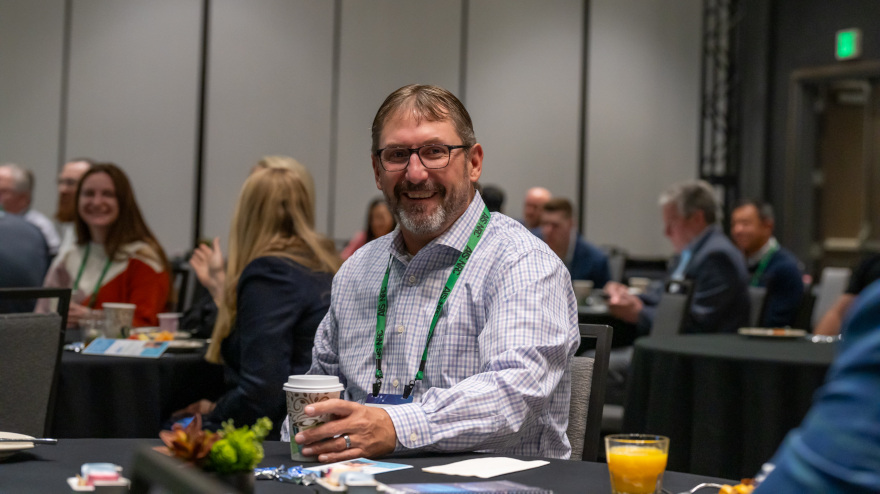
Brad Smith is pictured at 2024 Auto Intel Summit in Cary, N.C. Photo by Annie Kimura.
By subscribing, you agree to receive communications from Auto Remarketing and our partners in accordance with our Privacy Policy. We may share your information with select partners and sponsors who may contact you about their products and services. You may unsubscribe at any time.
The automotive wholesale ecosystem has always relied on trust.
Dealers trust auctions. Auctions trust carriers. Carriers trust brokers. And somewhere in the middle of that chain, vehicles move across the country every day with the expectation that they will arrive where they are supposed to, in the condition they were sold.
Most of the time, they do.
But when they don’t, the system shows its cracks.
Shipment fraud, carrier misrepresentation and double brokering are not new issues. What is changing is the frequency, sophistication and economic impact. As volume increases and logistics networks become more fragmented, the opportunities for bad actors expand alongside them.
This is not yet a headline issue across the industry. But it is becoming a persistent one.
Subscribe to Auto Remarketing to stay informed and stay ahead.
By subscribing, you agree to receive communications from Auto Remarketing and our partners in accordance with our Privacy Policy. We may share your information with select partners and sponsors who may contact you about their products and services. You may unsubscribe at any time.
A system built on assumptions
At its core, the vehicle shipping process still operates on a series of assumptions.
—The person picking up a vehicle is assumed to be the authorized driver.
—The carrier is assumed to be who they say they are.
—The chain of custody is assumed to be intact from pickup to delivery.
Verification, in most cases, is manual and situational. A driver presents identification. A dispatcher confirms details. A gate release is granted. Once the vehicle leaves the lot, visibility often diminishes until delivery.
This model worked reasonably well in a more localized, relationship-driven environment. It becomes far less reliable at scale.
Digital load boards, broker networks and increasingly distributed carrier relationships have introduced efficiency, but also new points of vulnerability. Double brokering, identity spoofing and unauthorized pickups are no longer edge cases. They are known risks.
And when something goes wrong, the industry falls back on reconstruction.
The cost of ‘figuring it out later’
When a vehicle goes missing or arrives with an issue, the process that follows is familiar.
Phone calls. Emails. Documentation reviews. Disputes over who had custody and when. In many cases, there is no single, agreed-upon record of events. Each party relies on its own system, its own timestamps and its own version of the truth.
Even when resolved correctly, the cost is real.
There is direct financial exposure of loss or damage. There is the operational cost of arbitration and investigation. And there is the less visible but equally important cost of time — time that vehicles are not sold, capital that is not turning, and relationships that are strained.
The industry has accepted this as part of doing business.
It does not have to be.
The missing layer: Shared verification
Most systems in automotive are systems of record. They capture information within an organization. What is missing is a shared system of verification across organizations.
—What if identity could be verified in a way that did not rely on visual inspection alone?
—What if pickup and delivery events were recorded in a way that all parties could reference?
—What if the chain of custody was not reconstructed after the fact, but established in real time?
These are not theoretical questions. They are architectural ones.
Other industries facing similar coordination challenges have begun to adopt models where verification is not owned by a single participant but shared across a network. Identity, events and transaction state are recorded in a way that is consistent, tamper-resistant and accessible to authorized parties.
The automotive industry has not yet widely adopted this approach, but the need is increasingly clear.
Why cooperation matters
This is not a problem that can be solved by a single company introducing a better tool.
Shipment fraud exists in the gaps between systems, between organizations and between points of accountability. Closing those gaps requires coordination, not just innovation.
—A dealer cannot solve this alone.
—An auction cannot solve this alone.
—A carrier or broker cannot solve this alone.
The solution requires a shared approach to:
—Verifying identity
—Recording key transaction events
—Establishing a consistent chain of custody
That implies a level of cooperation that is not typical in traditional vendor-driven models.
It also represents an opportunity.
When participants operate against a shared, verifiable record, disputes decrease. Fraud becomes more difficult. Operational processes become more efficient. Trust, instead of being assumed, becomes measurable.
A shift already underway
Over the past several years, there has been increasing discussion around blockchain and digital assets in automotive. Much of that conversation has focused on payments, tokenization or future-state concepts.
Those conversations are valid, but they often skip a more immediate and practical application: verification.
Blockchain, at its core, is not about cryptocurrency. It is about establishing a shared, tamper-resistant record across multiple parties that do not fully trust each other.
That is precisely the problem vehicle logistics is trying to solve.
By applying these principles to identity and event verification, the industry can move from a reactive model to a proactive one. Instead of asking “what happened?” after an issue occurs, participants can rely on a system that shows what is happening as it unfolds.
Looking forward
The path forward does not require replacing existing systems. It requires connecting them through a layer that provides shared verification.
In the near term, that means better identity credentialing for drivers and carriers, and more consistent recording of pickup and delivery events.
Over time, it leads to a more coordinated environment where operational workflows and financial processes begin to align. Transactions become more certain. Settlement becomes more efficient. Risk becomes more manageable.
This is not a distant future concept. The building blocks already exist.
What remains is industry alignment.
Final thought
Shipment fraud is not the largest problem facing automotive remarketing today. But it is one of the clearest examples of how fragmentation creates risk.
The industry has an opportunity to address it not through incremental improvement, but through a more fundamental shift in how trust is established and maintained.
That shift will not come from any one participant.
It will come from the willingness of the industry to work together to solve a shared problem.
Brad Smith is president and CEO of Block Bridge.