Cox Automotive reaches milestone in EV battery recycling
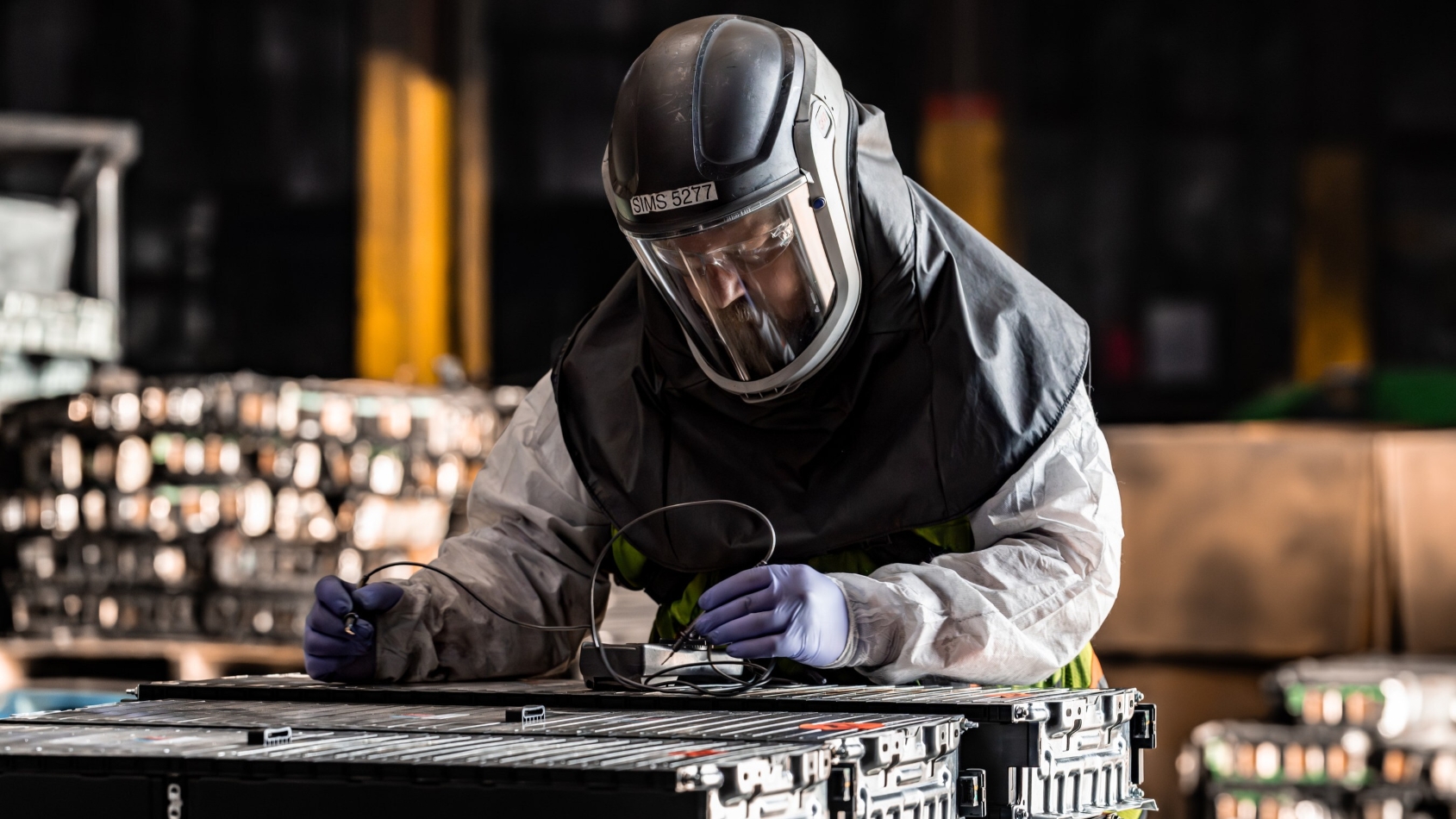
An operator performs a voltage test as part of a safety inspection during the EV battery recycling process. Photo courtesy of Cox Automotive.
By subscribing, you agree to receive communications from Auto Remarketing and our partners in accordance with our Privacy Policy. We may share your information with select partners and sponsors who may contact you about their products and services. You may unsubscribe at any time.
Cox Automotive’s EV Battery Solutions business isn’t done even when a battery is.
The company announced it has reached a milestone in electric vehicle battery recycling, having processed and recovered more than 10 million pounds of black mass — material containing minerals that can be refined and reused to help produce new batteries — from discarded batteries.
In a news release, Cox said the mark illustrates its role in managing the full EV battery lifecycle, from safe handling and logistics to repair, remanufacturing and end-of-life recycling, “helping customers and communities scale electrification more responsibly.”
“This milestone is proof that circularity in the EV battery ecosystem is moving from concept to scale,” EV Battery Solutions director of battery recycling Brian Skalovsky said. “Every pound we recover represents valuable materials kept in circulation, and a more responsible path forward as more EVs enter the used market.”
A wave of used EVs is beginning to hit the market, with EVs expected to account for 12% of all lease maturities in 2026, according to Cox, and projected to reach as much as 23% by 2028 — a subject to be explored in depth during the EV Day track at the upcoming Used Car Industry Summit next month in Miami.
As a result, more EV batteries will require safe service, second-life pathways and responsible recycling to keep materials in productive use and support a more sustainable battery supply chain.
Subscribe to Auto Remarketing to stay informed and stay ahead.
By subscribing, you agree to receive communications from Auto Remarketing and our partners in accordance with our Privacy Policy. We may share your information with select partners and sponsors who may contact you about their products and services. You may unsubscribe at any time.
Cox said recycling is one part of its strategy to extend EV battery life through repair, refurbishment, remanufacturing and, when necessary, recycling.
“This is about building the infrastructure that makes electrification work in the real world,” Cox Automotive vice president of EV Battery Solutions Lea Malloy said. “By extending battery life through repair and remanufacturing, and responsibly recycling at the end of life, we’re helping close the loop for electric mobility.”
The company said EV Battery Solutions’ proprietary depowering and dry-shredding technologies help minimize fire risk and support safer processing. At its battery recycling center in Oklahoma City, Okla., technicians use a patented dry recycling process designed to eliminate water and chemical treatments and reduce environmental impact.
Through mechanical disassembly, shredding and air-based separation, the team extracts high-value materials for reuse, achieving up to 94% material recovery, Cox said.
Black mass is the dark, powder-like material produced when lithium-ion batteries are mechanically processed for recycling. It contains battery materials, often including lithium, nickel, cobalt and manganese, that can be refined and reintegrated into new battery manufacturing, reducing reliance on virgin mining.
The 10 million-pound landmark supports Cox Enterprises’ sustainability commitment through Cox Conserves, the company’s environmental program focused on leaving a better planet for future generations.
Since it was founded in 2007, Cox Conserves has funded more than 500 sustainability projects, the company said, including 70 alternative energy initiatives, with more than $165 million invested to help reduce waste, conserve energy and water, and promote biodiversity.
Cox Automotive said it supports practices that enable the extension of EV battery first lives and end-of-life reuse and recovery treatments, including a variety of storage, logistics, diagnostics, repair and remanufacturing services conducted at the company’s EV battery service facilities in Oklahoma City; Belleville, Mich.; Las Vegas; Conyers, Ga.; Ede, Netherlands and Rugby, U.K., as well as select Manheim operating locations.