This week, Copart opened its sixth location in North Carolina, rolling out a facility in Lumberton consisting of 89 acres.
The development represented the second Copart opening in the Tar Heel State. In March, the company unveiled a location in Concord.
“We're happy to offer a new location in North Carolina for our buyers and sellers,” Copart president Jeff Liaw said in a news release. “We are delighted to continue the expansion of our global network of facilities to better serve our customers.
“We thank the Copart team members whose hard work enable our growth,” Liaw continued.
Eligible buyers can register and join auctions to bid on inventory through the Copart website or via the Copart Mobile App for iOS and Android devices.
“Copart Lumberton is a large state-of-the art facility, located just three miles from Interstate 95 in southern North Carolina,” Copart Lumberton general manager Dave Morris said. “We look forward to serving the wonderful community of Lumberton.”
Visit the Copart Lumberton page on Copart.com to view the location's contact information, sale lists and inventory. To see all of Copart's locations, visit Copart.com/Locations.
Uneven floors aren’t good for a house as far as its construction or current state.
And uneven floors potentially are causing some issues for dealers at the auction, too, as mentioned in the latest COVID-19 Market Insights from Black Book.
Black Book reported the continued seasonal decline in values for both cars and trucks, while analysts dissected what remarketers are doing with their units, which in some cases are actually running down the lanes again.
“With the exception of select trims and models that have seen lower demand, remarketers have reported taking a break from dropping floor values,” Black Book said in the report.
“However, volume has been increasing so it is expected that floor adjustments will be required again before the end of the year,” analysts added.
That projection arrived after Black Book noticed a “significant” drop in sold volume in both September and October on a month-over month and year-over-year comparison. Analysts pointed out that many remarketers were not willing to adjust price floors during that timeframe.
Black Book also said rental companies pulled back on de-fleeting in case vehicles were needed in areas impacted by hurricanes. And analysts added that repossession volume still remains uneven because of pandemic-created impacts.
What about the most recent value movements? They’re continuing to move lower at a pace Black Book has seen for much of the past several weeks.
Beginning with volume-weighted car information, the update showed overall segment values decreased 0.84% over the past week; a bit more than the decline of 0.78% analysts saw a week earlier.
The mainstream subcompact, compact and midsize car segments continue to experience the largest depreciations each week, with their latest drops coming in at 1.07%, 1.30% and 1.19%, respectively, according to the report.
Also of note, Black Book mentioned sporty cars continue their traditional seasonal declines with a slight increase in depreciation this past week, sliding another 0.77% after softening 0.72% during the prior week.
Moving over to the truck segments, Black Book volume-weighted information showed values for the overall segment (including pickups, SUVs and vans) decreased 0.52% last week, nearly mirroring the prior week’s drop-off of 0.50%.
Analysts discussed minivans in more details after values for those family haulers dropped 1.35% to lead all truck segments.
“Minivans have been on a wild ride throughout the pandemic,” Black Book said. “Most segments fell and have experienced a strong rebound before stabilizing, but Minivans is one segment that never rebounded to a level above this same time last year.
“With these low retail prices, it is no surprise that we’ve seen week-over-week declines increasing,” analysts continued.
Black Book also touched on one of the most popular segments — full-size pickup trucks — as depreciation for those units came in at 0.33% last week, similar to the prior week’s dip of 0.31%.
“I think I was born to play the drums,” Tom Kontos says in a mid-October phone interview.
Long before the KAR Global chief economist was crunching numbers and dispensing auction market analysis, he was taking his mom’s silverware and tapping on tables as a child.
Or, to the chagrin of his teachers, turning a rhythm in his head into a bongo beat on his desk at school.
Kontos said he eventually made “a more productive use” of his inclination to drum, taking lessons beginning at around 10 years old at a local drum shop in the Washington, D.C., area and starting to play gigs with a local Greek music band before he could even drive.
These days, the rhythm Kontos keeps is that of the auto industry, particularly the wholesale auction side of it, and the melodies of macro-economic factors at work.
Kontos, who still jams with other musicians, is a “rock star” in his own right within the remarketing industry. He has a knack for taking even the most complicated economic and market phenomena and distilling it down to easily digestible analysis for auction industry stakeholders, media, company clients and others.
And last month, Kontos celebrated 20 years with ADESA and its parent company, KAR Global.
While he said it’s hard to pinpoint the exact correlation between drumming and the work of an economist, Kontos did make this analogy: “A drummer is always someone who accompanies another musician. You're not going to be the person that's going to go on stage by yourself, unless you're on 'America's Got Talent' … so my role is to support the rest of the effort within my company and within the industry.”
That support extends to providing context that helps in company decision-making and forming strategies, and even “tactical things” like determining the return on investment in vehicle reconditioning, he said.
Before COVID-19 impacted the industry, that work for Kontos involved a lot of traveling for conferences or client meetings. It was something he enjoyed, but it didn’t afford him as much time at his desk as he currently has, which has changed the “cadence of information” when it comes to data analysis.
“It used to be, I kind of looked at things monthly. And that gave me a good sense of the pulse on what was going on,” Kontos said. “But more recently, especially during the pandemic, I was going daily and then going maybe towards a weekly cadence. (That) seems to be where I’m at right now. So that makes for a fairly busy week.”
His weeks also involve a ton of reading, even beyond automotive and into broader economic and political analyses. That is necessary in understanding any potential impact to the auto industry, as Kontos said he fields questions on everything from fuel prices to the potential impact of political candidates to the economy.
“If you’re intellectually curious anyway, you’re going to want to do a lot of reading. So, it's actually kind of not a tedious (task) in any sense. It is challenging to keep up. But the interest in the information, it's there and like you said, it's got to be pretty broad, because you just never know what factors might become important,” Kontos said.
For instance, Brexit.
While that may seem like a world away from the U.S. auction industry, it could impact a macroeconomic variable that ends up affecting the industry down the road, Kontos said.
And then there’s the more micro piece of it: the meat-and-potatoes process of keeping tabs on all the data points within the auction industry, which can change daily.
And that’s something Kontos appreciates about this business.
Before joining ADESA in 2000, he was at ADT Automotive, having been hired from the metals and mining industry, which Kontos said is more product-oriented than the auction industry, which is more service-oriented.
“There's so much you can apply from general economic understanding … the understanding that I have of economics from having worked in the mineral industries and just from my training, I found great application within the auction industry, because there's so much daily information that's coming out on vehicle values,” Kontos said.
“That’s one of the great things about this business, from an economist's perspective, it's an industry that really is a competitive marketplace, with vehicle values being established on a one-by-one basis between buyer and seller,” he said. “And those transactions are then captured and aggregated, providing wonderful data for analysis for a guy like me.”
So how does a guy like Kontos keep tabs on all that data, which tends to change daily?
From the outset of days at ADESA, he made sure to use the most comprehensive data set possible to provide him the best understanding.
“And I knew, no matter which company I worked for, if I only used the company's data, I would only have a subset of the total market. So, early on in my days at ADESA, I made sure I started accessing what's called AuctionNet data, which is the NAAA and NADA joint venture to capture auction transactions, not only at ADESA but at all the major auctions in the U.S.,” Kontos said.
“Having that data, building sort of a data infrastructure to capture and maintain that data was one of the first things that I did when I joined ADESA,” he said.
"One of the things I wanted to do was make sure I could (make) that data one or two steps better by maybe looking at model class segmentation, so I could look at what SUVs were doing versus what small cars were doing,” Kontos continued.
“So, there's work we've done with that database to enhance it, and then of course always cross-referencing that information against other data that I can use directly from ADESA” when it comes to things like vehicle grade or reconditioning data, he said.
And that work to analyze the data ends up helping ADESA and KAR Global, their clients and the industry at large.
All the while, a longtime drummer keeps his beat on the marketplace.
V.I.P. Auctions said on Tuesday that with its new camera-based artificial-intelligence technology, it will be one of the first vehicle auction companies to use automated vehicle-inspection systems to evaluate tires and underbody components for used-vehicle inspection.
The company, which is located near Atlanta and serves Southeastern franchised dealerships, commercial fleets and lending institutions, said the new technology will save time and reduce costs.
Stating that nothing tells an owner or end-user more about a vehicle’s actual condition than its underbody, V.I.P. Auctions founder and chief executive officer Jim Smith said the technology would also document vehicle condition and set new auto remarketing industry inspection standards.
UVeye developed the underbody and tire-inspection systems, which are scheduled for installation later this month at V.I.P. Auctions in Cumming, Ga.
Car auction group USS recently installed similar UVeye inspection equipment at its facilities in Japan. USS runs 19 sites and is based in Nagoya, Japan, handling more than 3 million vehicle sales a year.
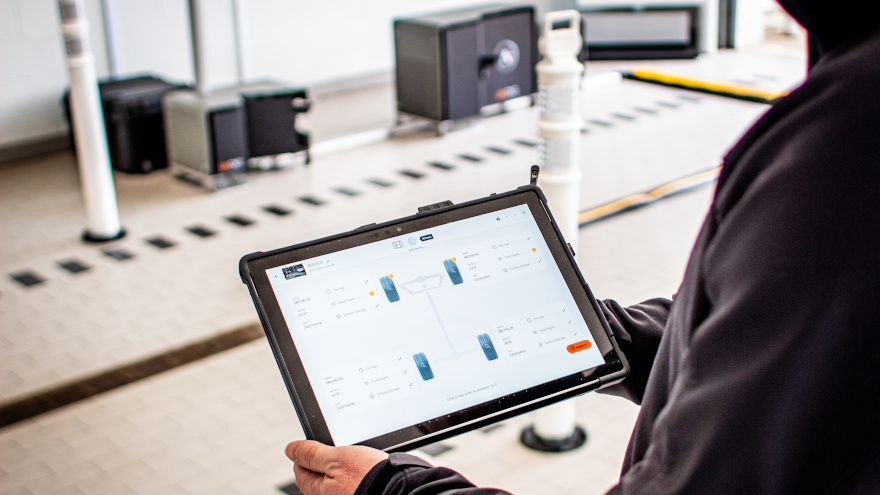
Artemis, UVeye’s tire-quality system, checks a tire’s overall condition, including tire pressure, tread depth, wheel scratches, sidewall damage, abrasions and outside shoulder damage. The company says that within seconds, it can read and recognize a tire’s brand, size-load speed ratings and DOT nomenclature.
The UVeye Helios and Artemis inspection systems being installed at V.I.P. Auctions rely on proprietary algorithms, cloud architecture, sensor fusion, artificial intelligence and machine-learning technologies.
Using various high-resolution cameras, the Helios underbody-inspection system generates thousands of images per second. The company says that can identify damage, missing components and other quality-related issues to support technicians and inspectors. Also with that automation, the company says inspectors can focus their attention on more important items.
Glenn Hemminger, managing director for UVeye’s North American operations, said Helios and Artemis will be important elements in establishing future standards related to certainty and transparency for vehicle inspections. That will be the case at vehicle auctions, dealerships, fleets and independent service garages, Hemminger said.
“These software-focused solutions allow us to continually add new inspection features without the need to add hardware,” Hemminger said.
Elaborating on the importance of the underbody in telling an owner or end-user about a vehicle’s condition, Smith said unusual rust, leaks, cracks, missing parts, modifications and other discrepancies all show up on a Helios scan. The condition of a vehicle’s tires and wheels can affect its value by up to several thousand dollars, he said.
V.I.P. customers now will receive documentation for the condition of each vehicle’s underbody and tires, Smith said, including images of the vehicle’s undercarriage and tires. Trouble areas will be clearly marked. The company said the new UVeye inspections take just seconds to complete.
“Our team at V.I.P. is excited about this new venture with UVeye for the launch of automated vehicle-inspection systems in the United States,” Smith said.
He said detailed evaluations of a vehicle’s underbody and its tires are two major areas missing from vehicle-condition reports provided to auction customers.
“Helios and Artemis will solve that problem by clearly documenting with certainty the condition of each vehicle’s tires and undercarriage,” Smith said.
He said the company expects the inspection technology to have a strong impact on customer satisfaction and a significant increase in sales and service over the next year.
“We’re looking forward to partnering with UVeye as the company introduces its breakthrough technology to automakers, dealerships and major fleet operators in the United States,” Smith said.
The technology was originally unveiled for the first time in North America at the 2020 Consumer Electronics Show in Las Vegas.
Despite challenges that included lower volumes, KAR Global made some big strides in the third quarter, including some progress in its TradeRev business unit, amid a wholesale marketplace that remains largely digital within the company.
Revenue came in at $593.6 million for Q3, down from $701.9 million a year ago. But KAR generated $47.1 million in net income from continuing operations, up from $34.4 million in Q3 2019.
Adjusted EBITDA climbed from $129.2 million to $139.2 million, and operating adjusted net income from continuing operations per diluted share was at $0.45, up from $0.35.
“Really, the bright spots (were) gross profit was up, reflecting the value proposition of a digital marketplace business, as compared to maybe a physically focused auction business in the past, and second was, the ability for us to realign our cost structure in line with current levels of activity,” chief financial officer Eric Loughmiller said in a phone interview Wednesday.
(KAR clarified that the company showed year-over-year and sequential gains in gross profit percent, while gross profit dollars climbed from the second quarter and fell from Q3 2019.)
Along those lines, he added that SG&A expenses as a percentage of revenue were down, which is an area KAR emphasized.
Where the company had some challenges was with volumes. Within the ADESA business unit, for instance, vehicles sold fell from 957,000 in Q3 2019 to 871,000 in the third quarter of 2020.
“Volume started the quarter very strong, and then moderated,” Loughmiller said. “So, we were challenged, in my opinion, through the third quarter, with a lot of market activity that caused some limitations in the number of cars coming to our marketplaces. But we were able to have a very good quarter, despite that.”
Added chief executive officer Jim Hallett, who was also on the phone interview, “Overall, it was a good quarter. I did mention (during the earnings call) that volumes were really strong in July and got a little bit softer as we got into September.”
Asked about the lower volumes, Loughmiller compared the situation to what KAR faced a decade ago after the Great Recession.
This time around, inventory began to build as the market shut down in the latter half of March
“Volumes were quite strong coming out of that, because the industry was full of inventory looking for a home and retail demand was there, so retailers were looking for cars and we had them,” Loughmiller said.
After that inventory was gobbled up, supply has since “been very tight,” similar to the 2010-2012 market, he said.
“Very expensive to buy cars in the wholesale market … As a result, the dealers look for alternative sources. They retail more of the trades they take in, even if those cars historically would not have been ideal for their retail strategy,” Loughmiller said.
"So generally, strong retail demand is not accompanied by strong wholesale supply because dealers were disintermediating the wholesale auction, so that they could make a profit in a very tight pricing environment,” he said. “The other part of this is, retail prices did not increase at the same level as wholesale prices over the summer months. So, they were getting squeezed on gross profit and that's when we typically will see them retail more trades and things like that.”
Loughmiller did note that he believes this situation to be “temporary.” And it was not unexpected, either.
“The volumes we’re experiencing now were the volumes we thought we would be experiencing this fall as COVID-19 impacted our business,” he said. “So, the surprise was June and July, not now."
Conversely, one area that KAR has seen some major volumes gains has been at TradeRev.
Volumes climbed 22% in Q3, with the rate of growth increasing each month, capping the quarter at 30% in September, Hallett said during the earnings call.
“I like the traction that we're seeing in this space, and we are getting this done without incurring losses in the business,” Hallett said in the earnings call. “And to what do I attribute the improved performance of TradeRev?
“First, we have simplified the platform in the U.S. We have listened to our customers, and we made changes to make the TradeRev app easier to use. And we've eliminated the cage match, making it easier for buyers to move quickly when they have won the car. Secondly, we continue to build our buyer base. We believe that this is the key to winning the dealer-to-dealer space in the long run. And last, we have made strides in bringing the ADESA customers into the TradeRev marketplace by enhancing the visibility to inventory on all of our platforms when logging into the adesa.com site.”
KAR has enrolled over 15,000 additional dealers across online marketplaces who had never transacted digitally in the past. Additionally, they have had 12,000 first-time buyers on their ADESA Simulcast platform since April.
“I think that's just reinforcement of just how resilient these dealers are in terms of what they'll do to get the job done and manage the business,” Hallett said in the follow-up call.
As part of Auto Remarketing's 2020 Best Auto Auctions to Work For program, we are featuring Q&As with leaders from some of the honorees.
Next up is Michael Waterman, chief sales officer at ACV Auctions, one of this year's honorees.
That Q&A, available to CMG Premium subscribers, can be found below.
Auto Remarketing: Workplace safety has been a big topic in the auto auction industry, particularly for the traditional brick-and-mortar auctions where cars are running through the lanes. How does an adherence to workplace safety manifest differently in the digital wholesale space, where sales tend to be remote?
Michael Waterman: Although our sales take place 100% digitally, the safety of our team of over 700 inspectors — the largest inspection network in the country — is paramount. In accordance with the Centers for Disease Control and Prevention (CDC) recommendations, we adopted new and enhanced protocols to help keep our teammates safe — both in the field and in the office.
For our office-based teammates, we were able to pivot to a mostly remote, work-from-home workforce while still maintaining best in class service and efficiency. For team members working in the field, we updated our process for approvals, sign-offs and hand-offs of vehicle keys to minimize contact between our customers and our inspectors. ACV inspectors do the vehicle inspections outside at the lots of our dealer partners, which allows for a safe and distraction-free work environment. ACV’s thorough onboarding process includes training on how to properly operate our innovative tools used as part of ACV’s comprehensive True360 condition reports, which are designed to provide the most accurate, transparent view into the vehicle’s condition.
Our auctions take place completely online, where dealers use our detailed condition reports to make confident bidding decisions without needing to be physically present at a traditional auction. Not only does this eliminate the in-person auction experience where cars run through lanes and crowds gather to make purchases, it also provides dealers with a faster, more flexible and more informed way of doing business without the risks associated with physical interactions.
AR: How has the COVID-19 pandemic impacted your safety strategy?
MW: Our inspection process is as contactless as possible, allowing team members to safely distance themselves from others while remaining fully productive in their roles. In light of the pandemic, we have closely followed guidelines from the Centers for Disease Control and Prevention (CDC) and equipped our team members with necessary protective equipment, including masks, gloves and disinfectants, in order to ensure that they can perform their work safely. All measures have been designed to keep both the safety of our team members and our dealer partners in mind. ACV provides virtual training sessions to our field teammates as we introduced new PPE and process updates to ensure everyone feels educated and comfortable working within our “new normal” for business operations.
AR: Training and development is key in any organization, but I imagine it’s especially challenging in the digital wholesale space. What have been some effective approaches you have taken when it comes to training and developing employees?
MW: ACV provides hands-on training for our Vehicle Condition Inspectors (VCIs) both in the classroom (now virtual) and with vehicles. Team members from various departments will do ride-alongs in the field so that Managers are able to assess and help improve processes and vehicle assessments.
We haven't let COVID slow us down from a training perspective. We are continuing to invest in training our team members in new types of inspections including cross-training our VCIs on all three kinds of inspections that we provide (wholesale, retail and off-lease) so they can become experts in each area and grow in their skillset and within the company.
During these challenging times, we are providing additional instructor-led training via online learning as well as socially distant field visual training to enhance their inspection skills and overall knowledge of ACV.
AR: This year’s program had some particularly strong scores with supervisor relationship and overall employee engagement. What are some ways your organization fosters positive professional relationships between supervisors and employees?
MW: ACV’s culture leads with a “You asked. We listened.” mindset. This applies to both our customers and our team members. Given our background as a start-up, our teammates’ feedback has been extremely important to the growth of our company and to our culture. Many of our leading procedures and policies are in direct response to feedback that we have received from our team members.
They know that they can speak up and share their thoughts and they will be heard. ACV is a company without ego. We love great ideas/feedback and take it from our team members and customers alike. This feedback makes us better and more relevant every day.
It’s invigorating to look at our growth over our five-plus years and see how our team members have grown with us. A once junior inspector is now a senior inspector mentoring and coaching new team members as they join ACV. It ultimately comes down to the passion that each and every one of us have for our jobs. We want to be the best we can be in our roles and we want to help those around us be the best as well. It’s in our DNA to help one another from offering tips, answering questions and serving as mentors to one another.
AR: Likewise, what are some ways your organization engages employees?
MW: ACV engages our team members by empowering them and supporting them. We encourage team members to find an area of passion and run with it. For example, our Diversity & Inclusion program was spearheaded by one of our senior teammates from our training department who has both a passion for and experience in leading D&I initiatives.
We also support our teammates in philanthropic efforts that impact them personally or impact the region where they work. We support these team members as they offer charitable assistance across the country to regions impacted by natural disasters and other efforts to help those in need.
COVID-19 has significantly impacted how we can interact with our corporate teammates who are used to seeing one another daily in the office. ACV quickly pivoted to a mostly remote model for our corporate workforce in order to protect their personal health and safety as a result of the pandemic. We pushed through to find new ways to connect, engage and have fun. Various departments have virtual, Zoom-powered happy hours and play games via Jackbox. The ACV HR department also started a monthly all-company Trivia Night on Wednesdays to bring everyone back together.
We now also offer team members free access to online Yoga and Meditation sessions (exclusively for ACV team members) throughout the week to help relieve any added stress that team members may be carrying due to the intensity of our “new normal.”
As part of Auto Remarketing's 2020 Best Auto Auctions to Work For program, we are featuring Q&As with leaders from some of the honorees.
Next up is Bruce Thompson, founder and chief executive officer of CarOffer, one of this year's honorees.
That Q&A, available to CMG Premium subscribers, can be found below.
Auto Remarketing: Workplace safety has been a big topic in the auto auction industry, particularly for the traditional brick-and-mortar auctions where cars are running through the lanes. How does an adherence to workplace safety manifest differently in the digital wholesale space, where sales tend to be remote?
Bruce Thompson: For us, CarOffer needs to mean it’s not just a better, more efficient way to buy, sell and trade used inventory; it needs to work and it needs to be safe. Especially in times when the world seems to stop and it’s the only available option for dealers to acquire inventory.
Being a tech company, we were well-positioned to pivot to a remote working situation at the onset of the pandemic literally overnight so, fortunately, we didn’t miss a beat on product development, client servicing or trading opportunities. When we were able and ready to welcome team members back to the physical office, we followed all CDC recommendations for health and safety protocols.
But our team extends well beyond the people in our headquarters; we have a complex supply chain that we heavily rely on to get cars to dealers’ lots, which includes transportation, condition reporting, inspections and other logistical details. We handle this so our clients don’t have to, and we collaborated closely with our third-party partners to ensure and optimize health and safety protocols at every stage so dealers could safely and reliably stock their lots.
AR: How has the COVID-19 pandemic impacted your safety strategy?
BT: The pandemic and sheltering in place requirements served to remind us of how nimble we are as a company. I am extremely proud of and grateful for our team who adapted to change so seamlessly.
In every crisis situation, there is opportunity to improve one’s response and preparedness strategy. Since our business is inventory management, one of the biggest challenges we faced was managing inconsistent protocols in different states. So, access to some critical services like state inspections, for instance, were delayed. How can we ensure the process continues to move forward during a safety or health issue? We are exploring all aspects of our operations to fine tune the preparedness. If the pandemic has taught us anything, it’s never say never, and keep your crisis plan up to date!
AR: Training and development are key in any organization, but I imagine it’s especially challenging in the digital wholesale space. What have been some effective approaches you have taken when it comes to training and developing employees?
BT: It is common in tech companies to have daily stand-ups, or scrums, because the pace of product development is so fast and constant communication among team members enables swift action. We conduct these informal sessions at CarOffer as it creates a valuable setting for knowledge sharing, collaboration and platform improvements. While nothing is better than the in-person version of a stand-up, we were able to move them to a virtual format which not only kept the work moving along, but it kept our team connected at a time when people felt very isolated.
Training and development are critical to the success of CarOffer — it not only keeps our technology advancing and competitive, but it creates opportunities for our employees to grow and learn and accept new challenges. We strive to create a culture of knowledge-sharing by doing things like role playing how to sell a certain feature or handle a situation, or relaying client needs with the software engineers so we can enhance the platform. And we bring new team members into this culture Day 1. It helps all of us to be better at what we do, regardless of our position or tenure with the company.
AR: This year’s program had some particularly strong scores with supervisor relationship and overall employee engagement. What are some ways your organization fosters positive professional relationships between supervisors and employees?
BT: The CarOffer leadership team is involved in the day-to-day workflow of our operations. We support transparency and have an open-door policy which is well utilized. Because we are growing at such a rapid pace, this culture fosters onboarding and immersion of new employees.
During the strict work-at-home period, we brought our accessibility and open-door policy online and held all-hands meetings weekly, which provided a continuum of connection and engagement while people were not physically together.
As part of Auto Remarketing's 2020 Best Auto Auctions to Work For program, we are featuring Q&As with leaders from some of the honorees.
Next up is Matt Alombro, auction manager at Louisiana's 1st Choice Auto Auction, which has been an honoree in each of the program's five years.
That Q&A, available to CMG Premium subscribers, can be found below.
Auto Remarketing: Louisiana's 1st Choice Auto Auction is the only auction that has made the list of Best Auto Auctions to Work For in each of the award program's first five years. What makes LAFCAA stand out from the pack, and what gives you such a strong workplace culture?
Matt Alombro: Culture, exactly that. We have been open since 2002, 18 years, and our management team has been here for an average of 12-14 years. We stay true to our values and do everything we can to hire people that align with our culture and cherish the same core beliefs. This also attributes to our extremely low turnover rate and allows everyone to work so well together year after year.
AR: Workplace safety has been a big topic in the auto auction industry, particularly for the traditional brick-and-mortar auctions where cars are running through the lanes. How has the COVID-19 pandemic impacted your safety strategy?
MA: Safety is more important now than ever before with the advent of government mandates and stricter health and safety guidelines. Our most valuable asset has always been our team members. COVID brought new challenges to the table with health and safety restrictions that we put in place. We canceled our large all-employee meetings, which has led us to conduct smaller team meetings more frequently. We have several meetings per week, and safety is always the main topic. Safe T. Sam is excellent for our new hires as an introduction, and we always supplement it with the years of experience we have run a safe workplace.
AR: Training and development are key in any organization, but I imagine it’s especially challenging this year. What have been some effective approaches you have taken when it comes to training and developing employees?
MA: The smaller and more frequent team meetings have allowed supervisors and managers a more hands-on approach, increasing communication across all departments. Smaller meetings led to better training and a wealth of new ideas to shorten processes and increase efficiency.
AR: This year’s program had some particularly strong scores with supervisor relationship and overall employee engagement. What are some ways your organization foster positive professional relationships between supervisors and employees? Likewise, what are some ways your organization engages employees?
MA: The last nine months have been more than a challenge to all. Like many others we had to announce employee furloughs for an unknown length of time. Through the first 5-6 weeks, every manager was on the lot moving cars, taking pictures, detailing cars and anything else that needed to be done to continue having a weekly auction. Everything was completed by only about 15 people. This was truly a humbling experience. When our team started to come back 6-8 weeks later, we were still out there with them and getting the job done.
For months we remained with a limited team, and through that time, many close friendships formed. It was a new level of respect for the team tasked with completion, as well as the supervisors and managers who were willing to do whatever it takes to make it happen. That bond made for great ideas and open communication to only further improve the fantastic team we have here at Louisiana’s 1st Choice Auto Auction.
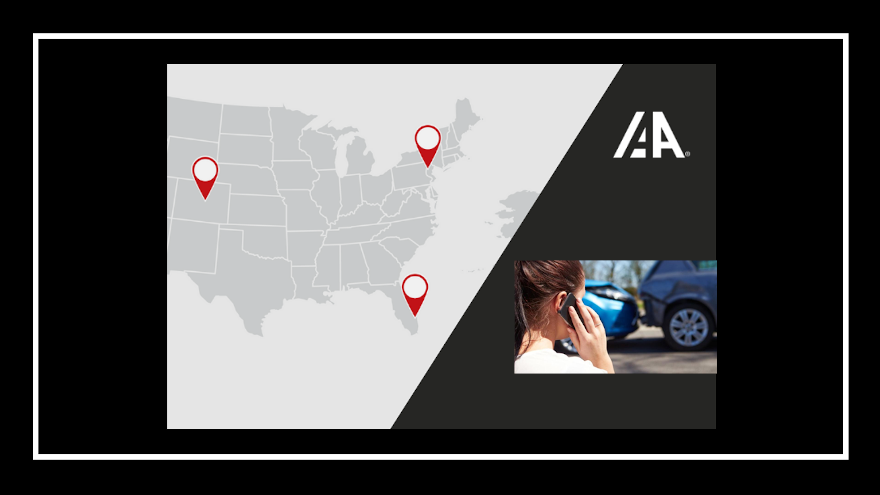
IAA said it would break ground for three new branch locations in Colorado Springs, Colo., West Palm Beach, Fla., and Port Murray, N.J.
Highlights of the new facilities include vehicle inspection center space, a dedicated VIC drop zone area, and covered motorcycle storage.
The company also indicated the new West Palm Beach and Port Murray locations will help boost IAA’s ability to serve the needs of the catastrophe-prone Atlantic coastal region.
IAA said the real estate investments will expand its footprint count across Colorado, Florida and New Jersey to 21 locations.
Conference rooms at the new branch offices will provide customers and employees with expanded meeting and training space.
IAA president of U.S. operations Tim O’Day said IAA’s expansion strategy, which adds more acreage across the three new branch locations, helps IAA anticipate and exceed customer inventory needs.
“We strive to continue evolving and enhancing the vehicle buying and selling experience,” O’Day said in a news release.
In a special preview for our CMG Premium subscribers, Auto Remarketing is offering an early look at the data and insights from our Best Auto Auctions to Work For program for 2020. The full study and feature story will be available in the November issue of the magazine.
But for a sneak peek at the Best Auto Auctions to Work For issue, see Part I of our preview below.
Part I
The Employment Benchmark Report compiled by the Best Companies Group as part of Auto Remarketing’s “Best Auto Auctions to Work For” program contains eight categories of metrics by which employers are rated by their respective employees.
The two categories where this year’s group of Best Auto Auctions to Work For honorees had the strongest scores?
“Relationship with Supervisor” and “Overall Employee Engagement.”
In each of these categories, an average of 92% of the responses were positive.
Bearing that in mind, we asked this year’s honorees, via emailed Q&As, to share ways their organization fosters positive professional relationships between supervisors and employee, as well as how they engage employees. More on that below in this feature story.
First, some background on the program: Auto Remarketing’s Best Auctions to Work For, presented by CARS Recon, is a free workplace study for the auto-auction industry that recognizes the best auto auctions to work for on an unranked basis.
It is designed and intended for individual physical auction locations and digital auctions, as well.
Digital auction honorees are designated as such. It is absolutely free for both physical and digital auctions to participate.
Auto Remarketing, teaming with the Best Companies Group (BCG) in Pennsylvania, underwrites the study. The study is managed by BCG, and the data is analyzed 100% by the staff at BCG. Best Companies Group directly administers all surveys and manages and analyzes all data and information that is gathered.
The Best Companies Group assesses the data from the group of auctions choosing to participate and develops metrics and standards based on that data to determine which auctions are named to the list of Best Auto Auctions to Work For.
Feedback & engagement
At IAA, which had four of its locations make the list, president and chief executive officer John Kett said one resource his company has leaned on is its IAA Ambassador Program.
“This program fosters growth, development and engagement of IAA yard attendants, customer service representatives and title specialists. We pair a seasoned peer with a new hire for a minimum of 90 days,” Kett said.
“We’ve seen great success and improved traction with our new employees. It provides them with support and guidance as they get familiar with IAA and their new role,” he said.
At ACV Auctions, the company has taken a “You asked. We listened” approach, says chief sales officer Michael Waterman.
“Given our background as a start-up, our teammates’ feedback has been extremely important to the growth of our company and to our culture. Many of our leading procedures and policies are in direct response to feedback that we have received from our team members,” Waterman said. “They know that they can speak up and share their thoughts and they will be heard. ACV is a company without ego. We love great ideas/feedback and take it from our team members and customers alike. This feedback makes us better and more relevant every day.”
ACV also fosters engagement by encouraging employees to learn what they’re passionate about and leaning into that. Waterman gave the example of the company’s diversity and inclusion program, which was launched by a senior employee in the training department who has a passion for such initiatives.
“We also support our teammates in philanthropic efforts that impact them personally or impact the region where they work. We support these team members as they offer charitable assistance across the country to regions impacted by natural disasters and other efforts to help those in need,” Waterman said.
“COVID-19 has significantly impacted how we can interact with our corporate teammates who are used to seeing one another daily in the office. ACV quickly pivoted to a mostly remote model for our corporate workforce in order to protect their personal health and safety as a result of the pandemic,” he said. “We pushed through to find new ways to connect, engage and have fun. Various departments have virtual, Zoom-powered happy hours and play games via Jackbox.
“The ACV HR department also started a monthly all-company Trivia Night on Wednesdays to bring everyone back together. We now also offer team members free access to online Yoga and Meditation sessions (exclusively for ACV team members) throughout the week to help relieve any added stress that team members may be carrying due to the intensity of our ‘new normal.’”
Over at Louisiana’s 1st Choice Auto Auction, auction manager Matt Alombro also pointed out the challenge that the COVID-19 pandemic has brought in the area of employee engagement and how his auction has successfully adapted.
“Like many others we had to announce employee furloughs for an unknown length of time. Through the first 5-6 weeks, every manager was on the lot moving cars, taking pictures, detailing cars and anything else that needed to be done to continue having a weekly auction,” Alombro said.
“Everything was completed by only about 15 people. This was truly a humbling experience. When our team started to come back 6-8 weeks later, we were still out there with them and getting the job done. For months, we remained with a limited team, and through that time, many close friendships formed,” he said.
“It was a new level of respect for the team tasked with completion, as well as the supervisors and managers who were willing to do whatever it takes to make it happen. That bond made for great ideas and open communication to only further improve the fantastic team we have here at Louisiana’s 1st Choice Auto Auction.”
Part II of the feature can be found here.
A full list of the 2020 honorees can be found here.