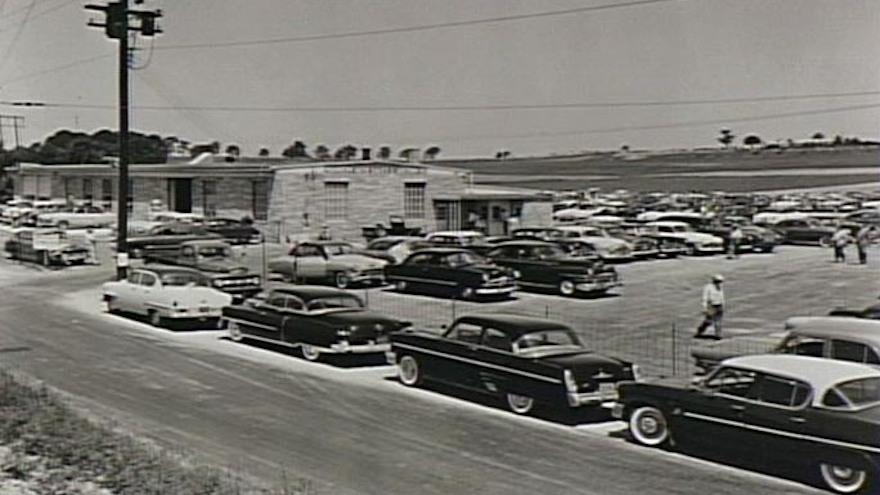
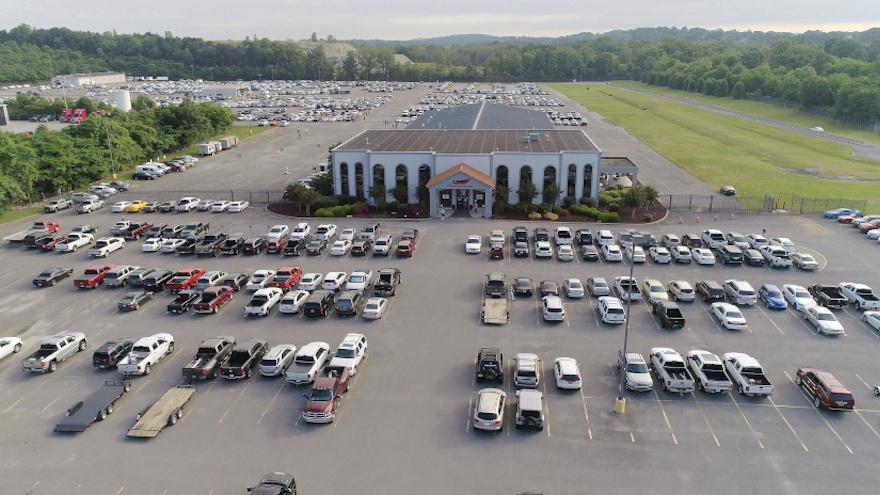
For Manheim, 2020 began as an anniversary year, its 75th. And, of course, it still is.
But for the auction company and wholesale auto industry at large, it has evolved into a milestone year in and of itself.
What started as a year to commemorate a landmark from the past will arguably be looked upon in the future as a year that perhaps changed the auction industry forever.
At Manheim, the largest of the corporately owned auto auction chains, it has been quite a saga since COVID-19 began impacting the U.S. en masse in mid-March.
Manheim had gone simulcast-only starting in March, then began allowing inventory previews on May 1. On June 8, sellers were allowed to return to rep vehicles. The week of June 22, the pilot return of in-lane bidders began at five locations.
That pilot, where vehicles are sold via Digital Block and do not move through lanes, has steadily expanded over the summer, and as of mid-September, more than 50 Manheim locations were participating.
Dealers at these 50-plus pilot locations are able to bid in-lane through Digital Block sales, which include in-lane bidding on site at Manheim auctions with a live auctioneer and simulcast. Vehicles remain stationary and can be viewed on screens. They do not move through lanes.
This new, pandemic-pushed digital way of doing business has led to a subtle, yet noticeable shift in auction sales for Manheim.
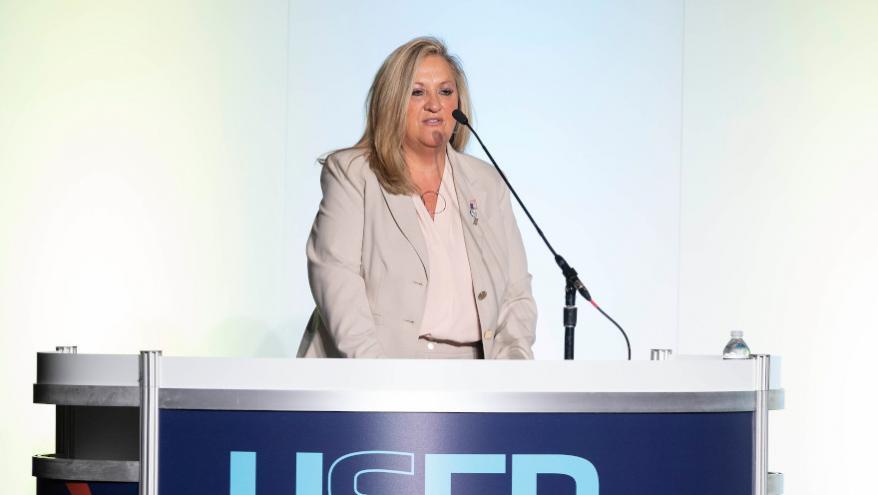
In an August interview for this story, Manheim president Grace Huang said that prior to COVID-19, about 50% of the company’s buyers were online, but activity tended to move “back and forth” from in-lane bidding to Simulcast bidding.
“And right now, the majority of the bidding is happening on Simulcast, obviously, with fewer people in lane. And you can see the dynamics shift. Simulcast is moving so fast, that the in-lane bidders, frankly … they get in and then the next bid is a Simulcast bid and then before you know it, there are 20 Simulcast bids piled on top of each other,” Huang said.
“And you can see the dynamic shift. It’s subtle, right. It used to be a much more back-and-forth between the in-lane and Simulcast. And now it’s the in-lane is participating in a Simulcast sale versus the other way around, Simulcast participating in an in-lane sale. It’s kind of reversed,” she said. “Subtle. But again, it speaks to how things have changed.”
Many if not most of the independents are running vehicles through the lanes again. ADESA, another corporately owned chain, is not.
Will Manheim, eventually? Perhaps.
In answering a question about 2020 being a milestone year, Huang said: “When COVID-19 goes away and our life can go back to the way it was, we know that our operations won’t all just go back exactly the way it was. We’ve learned too much, our dealers have learned too much, that we wouldn’t want to go back.
“Now, the question we always get is, will we ever run cars through the lane? Right now, we’re still listening to our clients every day and we know that there’s probably some segment of cars that will go back in to the lanes,” she said. “But we know that a lot of behaviors have also changed, as well, during this. I think dealers have figured out they can save a lot of time buying online and buying remotely. They can be at their store, doing retail business and continue to be ‘at the auction’ while at the retail store.”
Huang added: “As time goes on, people are finding new ways of working that are more efficient for them. And I think a lot of those habits will stay. Post-COVID-19, we know it’s still going to be a new day.
“Wherever we end up and whether some things go back to ‘the old way,’ I think it’s going to still be the exception, not the rule.”
On the retail side of the auto industry, the digitization of car sales is almost like a hybrid model, where certain elements still take place in person, based on consumer preferences.
To an extent, that may be the case in digital wholesale, an asset-heavy business where you quite literally have many moving parts that require physical maneuvering, storage and so forth.
“We always will have that physical car … in the post-COVID-19 world, Hopefully we’ll be welcoming a lot of our clients back inside our building,” Huang said. “And so, we will still have a lot of face-to-face interactions and the cars will physically still be at the locations. And we still physically do a lot of work to it through reconditioning.
“I tell the team, when I think about digital-first, it’s more of a paradigm shift — that nuance of today, the in-lane bidders are participating in an online sale; versus prior to COVID-19, the online bidders are participating in an in-lane sale,” she said.
“It’s that nuance of how to think about what takes the lead in your mind. And in the past, all of our auctions operated independently as physical locations. And we have found that in this increasingly digital world … where the car sits is less important to the buyer in the future. Because they just want the inventory,” Huang said.
“With that said, that location still plays an important role and that vehicle still has to sit somewhere. But buyers today, we can see, even now, on Simulcast, people are buying cars that are further (away) than what they used to buy.”
Buyers are no longer just going to one or two physical auction locations, she said.
“Now they can attend as many locations as they want in a given week,” Huang said. “So that notion of distance is increasingly disappearing in this digital realm.”
And that digital realm, or as Manheim has called it, a “digital first” strategy, will continue to be an emphasis for the company going forward.
“And when we say digital first, we’re not talking about necessarily just cars being sold online. But again, it’s about making sure that all of our tools and processes and that entire client experience is about this idea that cars will continue to transact digitally into the future. And making sure all the ways our systems have supported locations in the past will now support a digital-first mindset in the future,” Huang said.
“And look, I think we’re probably going to be in a recession as a country, as we get out of this and who knows how long it will be. But we also know that in a recession, it’s really when the auction industry shines. I know it’s counter-intuitive. But it’s really when our big partners need us, (and) we’ll be here, as Manheim and as an entire industry,” she said. “When we go through these transitions, that’s really when we shine. And I’m ready to be there alongside all of our partners, our clients and again show what the auction really is about through the tough times.”
Adapting to the situation presented by the coronavirus pandemic is on full display within the independent auction world.
Russ Smith is owner and general manager of Dealers Auto Auction of Idaho, which recently joined ServNet Auctions.
Smith felt the stress of when business life in just about every way came to an abrupt stop in March as the gravity of the pandemic took hold.
“I guess initially it was concern for my family and my friends health-wise,” Smith said when remembering his initial thoughts when COVID-19 started to become the problem that’s so familiar to the entire wholesale industry now.
“But then eventually, as a business owner, it works its way back to how do we stay open and what do we do to maintain a business and get people a paycheck,” he continued. “Some of those initial projections were so dire, the death toll and everything else that came out made things scary. Fortunately, some of those things didn’t happen as we all made adjustments. It’s a blessing that they didn’t happen, but any loss of life is still tough.”
David Andrews, who also is chairman of the board for the National Independent Automobile Dealers Association, currently owns a pair of independent stores in and near Memphis, Tenn., seven wholesale auctions located throughout Mississippi, Tennessee and Alabama, as well as a management company, a floorplan company and a finance company.
Andrews recalled a frank conversation he had with his spouse back in March when the coronavirus pandemic began to grip just about every part of daily life.
“I remember on March 15, I was talking to my wife when all of the sheltering at home started, never imagining something like this would happen, and I said, ‘Life as we know it may cease to exist. We could lose everything. And I’m talking about 40 years of hard work could go up in smoke.’ Fortunately, the automobile industry has been spared through all of this,” Andrews said.
“If you were in the cruise business or the airline business or hotel business or restaurant business, it’s not fair what’s happened. Even if you had a Ph.D. in economics from the Harvard Business School, I don’t think you would have been studying this scenario. It’s been like nothing I’ve ever seen,” he continued.
Fortunately, Andrews did not lose any of his business enterprises. In fact, he said he did not have any layoffs among his more than 1,000 employees. And perhaps even more importantly, among the handful of his employees who were diagnosed with COVID-19, each one only sustained mild symptoms and have recovered completely.
“It’s certainly unchartered waters for all of us, between worrying about your family’s health and your business health. But thankfully we’re all doing well,” Andrews said.
Like Andrews, Smith said he did not reduce his workforce even though Dealers AA of Idaho didn’t have a vehicle go over the block for nearly a month.
“Part of the scary thing was no one really knew enough about it to tell you what you could and couldn’t do in the very beginning stages, so we just sent everybody home. We paid them. We didn’t have to lay anybody off,” Smith said.
“When we started working back with online only, we would split shifts and worked limited hours,” he continued. “But it became pretty clear to us that online-only wasn’t going to be the answer long term, at least for us. We started running live sales again about six weeks into it once we had some good CDC guidelines to try to follow. At that point, it became the struggle with how do you keep your customers and your employees safe and comfortable.”
Smith explained that his auction closed its kitchen to reduce potential spread of the virus, marked off the facility for social distancing, conducted temperature checks for employees and customers and hired extra crews to clean. All of the efforts worked in tandem so in-person sales could happen again. And as a result, Smith said nearly 80% of vehicles on sales days went home with dealers who needed the inventory to meet growing retail demand.
“We needed to make sure we were invested in our people and the ones who are taking care of the business for us,” Smith said. “We chose not to let anyone go. We wanted them to know we were in it with them and were going to work through it together. As soon as we went back to live sales, we started to sell 70% to 80% of everything that ran across the block. Our buyer count went up by quite a bit. It was a challenge to make sure we had everyone social distanced. That took people. And my people made that happen. Had not we kept everybody, I don’t think we could have provided the service that we needed to when we started picking up new customers and new accounts and selling so many cars.”
Taking care of people has been the path for Andrews and Dealers Auto Auction Group, too.
“We’ve picked up a lot of business for various reasons. We worked with our dealers. We reduced buy fees by $200 per car just to show goodwill for our dealers. That’s a lot of our revenue. But hey, these are our customers. The way we feel about it, if it’s not good for the seller, if it’s not good for the buyer, then it’s not good for the auction. It’s just not a good deal,” Andrews said.
Andrews made those decision while two members of the group also are expanding, including one auction that is building a brand-new facility.
The group announced that Dealers Auto Auction of Memphis is building an all-new, six-lane facility on 100 acres in Eads, Tenn., while Dealers Auto Auction of Mobile is adding more acreage, offices and lanes to its existing facility.
“We are very excited to be able to continue to reinvest into our facilities,” Andrews said in a news release. “As a premier service provider, we have listened to our customers, and will continue to look to improve our facilities to continue to meet the needs of our customers both in-lane and online with our ever-improving technologies.”
The group has targeted both projects to finish this year.
In the release, DAA Memphis general manager Dan Dietsch said: “We are very excited to get into our new facility. The demand that we are receiving is amazing, and having the extra room will certainly allow us to better service our customers”
Added DAA Mobile GM Tom Holton: “Being able to expand our parking and staging area, along with the addition of new office space and new lanes, will really help us take the auction to the next level.”
Smith emphasized that making investments like what Andrews’ group is doing is going to be crucial for independent auctions to thrive — even after the pandemic subsides.
“The independents need to make sure that they are as up to date as they possibly can afford on technology so if there is ever another forced shutdown that we have the infrastructure in place to sell cars online only if that’s what the government forces us to do. We were blessed that we had that in place,” Smith said.
DAA Seattle general manager Dave Blake oversees the McConkey Auction Group operation in an area where the coronavirus first started to appear and many business restrictions remain in place. DAA Seattle is running online-only sales, but Blake is taking the opportunity to improve every operational aspect as he explained in an online video distributed by the Independent Auction Group earlier this summer.
“For myself, it’s been a challenge at times to make sure I’m on the right path. It can be different one week to the next just based on it being such a fluid situation,” Blake said. “Who would have thought three or four months ago that for someone to enter the facility you needed to make sure to take their temperature and ask if they had any symptoms or had been in contact with anyone who had any symptoms and then still sell cars.
“For independents, we’ve always done a great job adjusting to the times or the situation. But this is not just a matter of operations, this is not just understanding the market; this is a matter of our own personal energy and approach. There is a lot demanded of us,” he went on to say.
Like it has with so many other industries, the COVID-19 pandemic has caused a major shift at auto auctions over the last seven months.
Whether that’s putting a greater emphasis on digital sales and not running cars through the lanes — as has been the case with the industry’s two largest corporate auction houses, Manheim and ADESA — or running in-lane sales with social distancing protocols, 2020 has been a year of change in how auctions operate.
In a sense, the same could be said for the organization that represents them.
Typically, this feature profiling the incoming president of the National Auto Auction Association would arrive with the group set to hold its annual convention, and its leadership having toured member auctions throughout the year.
But this is no typical year, and NAAA has had to pivot.
To get a sense of that shift, Auto Remarketing connected with 2020 NAAA president Laura Taylor and incoming president Julie Picard over Zoom in late August.
Safety remains key
Entering her presidency, Taylor’s top priority was safety, with live training programs scheduled for the spring CAR Conference and plans to carry the training beyond managers and owners.
How the importance of safety has manifested itself has changed.
“Workplace violence and safety was on top on everybody’s mind. Well, with COVID striking, it brought out an even different realization of how important this program was going to be. The first direction we went in, we thought it was not quite what we were looking for as far as an active shooter (training session), so we came up with active threat preparedness,” Taylor said
NAAA has been mindful of how a pandemic and its subsequent furloughs, terminations and illnesses, can have on one’s well-being.
“It’s really heightened awareness of things to look for that will pinpoint maybe something we can do to help recognize and intervene before a situation occurs,” Taylor said.
And at the top of NAAA’s webpage is a 13-page document titled “Active Threat Preparedness Plan.”
The “Purpose and Objectives” section of that plan states:
“A priority of the National Auto Auction Association is to assist member auctions in providing a safe workplace for employees, customers, and guests. The Active Threat Preparedness Plan will assist auction members with a training guide to educate staff in preparing for potential risks in the workplace.
“Active Threat training is to provide staff education and planning for:
• The events leading up to and during an active threat (what to look for)
• How to react during an active threat/shooting
• Communication of any suspicious or unusual activity
“The goal is to Be Alert, Not Alarmed.”
And in May, NAAA made a pair of resources available to help members as they navigate the challenges of orchestrating sales and serving their consignor and dealership clients while the coronavirus pandemic continues.
Along with an informational video, NAAA distributed an 18-page document titled, “Playbook: Auction Start-up, Response to COVID-19.”
In addition to safety resources, NAAA has also educated its members about financial relief measures they can utilize. It conducted a webinar with the South Carolina director of the U.S. Small Business Administration to explain the steps auctions need to take for PPP loans and other relief packages, Taylor said.
Staying in touch
Usually, the NAAA leadership would spend much of the year visiting various auctions around the country, keeping abreast of industry issues and keeping in touch with its membership.
In lieu of in-person visits, Taylor and Picard have found other ways of staying in contact with NAAA members.
“Some of the things that I’ve done are actually make phone calls to the members. a lot of them are my dear friends, so of course we checked up to make sure that families were doing good,” Taylor said. “A lot of them had questions, so they would call and ask what we were doing.”
Taylor has also turned to avenues like podcast appearances, webinars, eblasts and even handwritten cards.
And of course, lots of Zoom calls.
Though she acknowledges that “it’s not the same” as in-person visits, Taylor says she has been impressed with the “phenomenal” way the industry has handled a challenging year.
“There may be a shortage in inventory, but the conversion rates have been through the roof,” she said. “Everybody’s really busy trying to stay safe, get everything together that they need. So, we’ve not wanted to overwhelm them with a lot of information.
“But we’ve tried to get as much out there as possible, what we deem necessary for them to be able to look at and follow,” Taylor said. “Hats off to them, though; they’ve really handled this year quite well.”
Picard, NAAA’s president-elect, said that while it has been “disappointing” to not visit as many auctions as she would have liked to in 2020, “but like all of us making our way through this COVID-19 epidemic, we’ve had to rely more on the phone calls, the (Microsoft) Teams meetings, Zoom to keep the lines of communication going. Until which time we’re able to travel to auction locations and attend in-person conferences, I intend to continue to communicate with our members virtually.”
Picard added: “I am currently creating a virtual meeting list with myself and soon-to-be president-elect Charles Nichols and we’ll host weekly meetings with the NAAA members, clients and various industry partners. And we’ll also continue to communicate important industry information through NAAA emails and On the Block.”
Leadership transition
Oct. 8 is NAAA’s official “Presidential Transition Day.” As she takes on the mantle of NAAA leadership, Picard said her top priority will be diversity and inclusion, particularly, but not limited to, bringing more women into the industry.
“It’s definitely an area that, I think, continues to need a lot of focus. First in getting more women and others interested in our business is extremely important,” Picard said. “We need to focus on the recruitment, development and retention of the women, improved opportunities for women and the like. And greater recognition.
“I think this industry, as Laura (Taylor) knows, is an amazing career for women, whichever path you take — operations, finance, reconditioning. You see auto techs out there now that are females,” she said. “And I just think there needs to be a continued focus in that area to continue to get great women, strong women that love the industry the way that Laura and I do and are passionate about the success of being in the industry long-term at every level of the organization.
“Not just the top, not just in miscellaneous functions (or) entry-level (positions), but actually throughout the entire organization,” she said. “And to see continued career paths for women and truthfully, people of color — all diversity is included in this.
“Just sprinkle our industry with great talent,” she said. “That’s going to mean that we have to show up a little bit differently.”
For example, interviewer panels. You might have a diversity in the candidate pool, but if the same people are on the interview committees over and over, “you’re never going to end up with anything different,” she said.
Picard said that there is “a lot of work to do here, but I’m excited about it. And truthfully, I think most people in the industry are excited about the opportunity that we have in these areas.”
Speaking of jobs and bringing new people into the auction industry, NAAA launched AutoAuctionJobs.com last year, with the aim of connecting job seekers with NAAA member auctions with positions to fill.
“As we learn more what post-COVID auto auctions need to be, I think it will be an opportunity for us to expand this website to also cover any additional auto auction opportunities that are out there,” Picard said.
As far as changing skill sets in the auction industry, Picard said; “Like most businesses these days, it’s very important to employ individuals, truthfully, that are comfortable with constant change. Because our industry continues to change by the minute. And as we become more digitized, it allows easier centralization of many of these auction functions, which will allow us to provide a better, more consistent experience for our clients. But this changes the look of auto auctions, as Laura mentioned, how we once knew them.
“As we continue to invest in technology and in our reconditioning facilities in order to better serve new and, truthfully, existing clients, the need for automotive technicians, it doubled,” she said. “And reconditioning roles will continue to be a large focus for all of us as we move forward, because there’s a lot of opportunity on the recon side of the business with the emergence of more fleets, etc.”
Also on Picard’s agenda is continuing NAAA’s safety efforts and continuing to make improvements in auction safety. She also emphasized innovation in the digital and vehicle information spaces as well as creating more efficiencies throughout the industry.
For more with Picard and Taylor, see the below episode of the Auto Remarketing Podcast, recorded this summer.
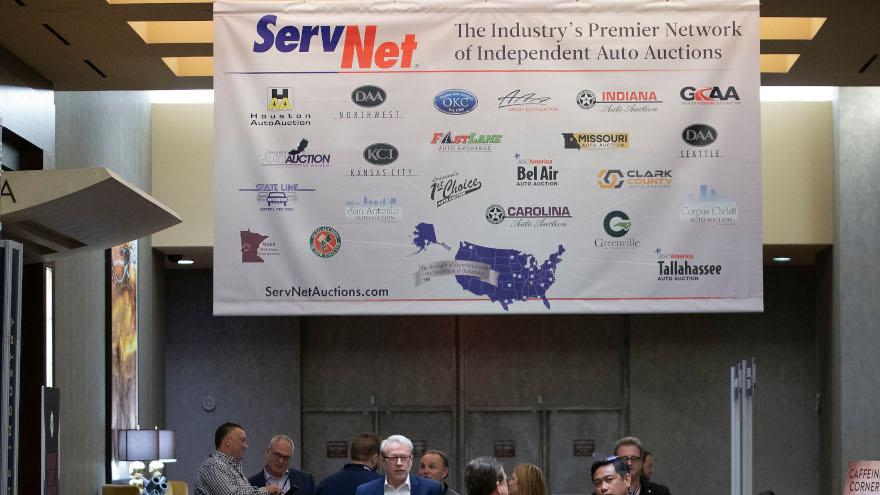
ServNet has added two more auctions to its ranks, both of which are in the Western U.S.
The auction group said in its latest online newsletter that Dealers Auto Auction of Idaho and Dealers Auto Auction of Las Vegas are now members of ServNet.
The latter was recently acquired by the McConkey Auction Group, which is a member of ServNet.
More details on that transaction can be found here.
Regarding DAA of Idaho, ServNet president Bruce Beam said in a news release, “ServNet continues to expand its footprint in the West, and we are happy to announce the addition of DAA of Idaho to our roster of the nation's leading independent auctions.
“We have a long association with Russ Smith, DAA of Idaho's owner and general manager, and admire the market presence he has established since founding the facility in 2001,” Beam said. “As the largest independent auto auction in the state of Idaho, his auction is an important resource for both auto dealers and commercial accounts seeking the service and superior operations that an auction of this caliber provides.”
The auction is located in Nampa, Idaho in the Boise area. It runs 500 vehicles in its Wednesday sale.
“ServNet auctions are well-respected throughout the industry for the strength of their leadership, the quality of their employees, and the superior services they offer,” Smith said in a release. “We’re excited that DAA Idaho is now part of the group representing ServNet in the West, with live sales and responsive ownership, backed by the strength of ServNet's national network.”
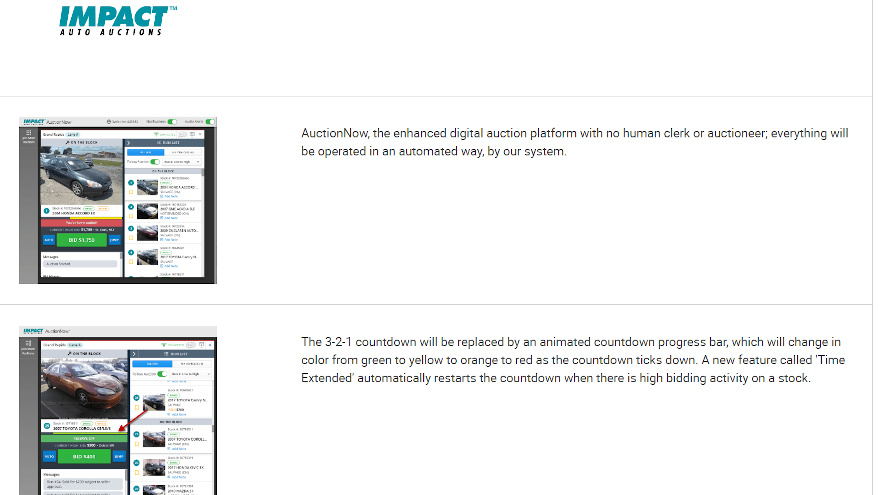
Impact Auto Auctions Ltd., the Canadian business unit of digital global marketplace IAA, said on Thursday it was shifting its online auction platform Impact AuctionNow to a “fully digital experience.”
IAA developed AuctionNow, which is an adaptive platform used in the Canadian and U.S. markets. IAA says it developed the platform “to allow product enhancement that is both proactive and responsive to their dynamic global market.”
IAA says its development of the proprietary AuctionNow platform gave the company full autonomy to “continuously enhance the global buyer experience,” making those enhancements based on customer suggestions and recommendations.
Impact managing director Blair Earle said AuctionNow’s foundation features adaptive technology.
“So shifting all Impact branch locations from a physical to digital experience was seamless,” Earle said in a news release. “Client feedback has been overwhelmingly positive, and our business did not miss a beat.”
The company’s Customer Experience, or CX, discipline and Voice of Customer, or VOC, platform are used to gather, prioritize and build new product features and enhancements.
With the scalable technology, IAA can build and enhance features and functionality quickly, said IAA chief information officer Maju Abraham. That provides “an unmatched experience for our buyers,” Abraham said.
“Understanding the dynamic nature of our business means we develop technology platforms that can move at the speed of our industry,” Abraham said.
Skipco Auto Auction recently conducted its own version of when a movie director announces, “Lights! Camera! Action!”
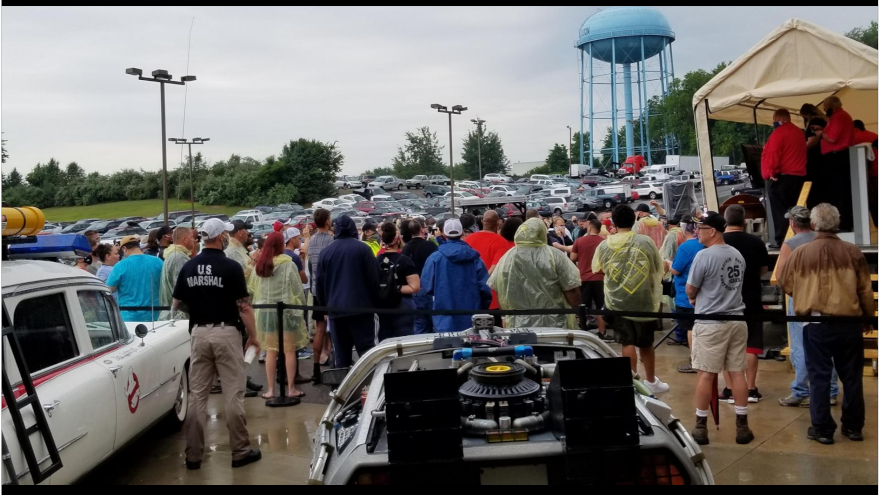
SAA served as a service provider for federal authorities who looked to recovery money stemming from famous movie vehicles included in a $43 million Medicaid fraud case in Youngstown, Ohio.
SAA sold nearly $500,000 in special vehicles that were a part of a U.S. Marshals Service enforcement action. The auction had more than 870 registered bidders online and in the lanes to bid on the “Ghostbusters” Ectomobile, Batman’s “Batmobile” and the “Back to the Future” DeLorean time machine.
The auction said each of the vehicles had more than 200 bids with the “Ghostbusters” vehicle selling for $200,000, the “Batmobile for $171,000 and the DeLorean for $111,000.
SAA noted that all three vehicles were bought by the same out-of-state buyer.
According to a news release from the auction, the U.S. Marshal service sold a total of 15 vehicles for more than $750,000. Janet Duncan, district asset forfeiture coordinator with the U.S. Marshals’ office in Cleveland said, “the cars were seized as ill-gotten gains” and forfeited in the criminal cases.
Skipco Auto Auction general manager Keith Blowers mentioned that bidders in the lanes for this special sale represented more than 15 states.
“It was an exciting day for the attendees and the employees of Skipco,” Blowers said in the news release. “We have been waiting to the sell these vehicles and to have it go off as well as it did, made me enormously proud of our team.”
“It was also great to see the enjoyment of buyers taking pictures with all their favorite movie vehicles,” he went on to say.
Skipco Auto Auction was founded in 1978 by Robert Blowers and hosts Saturday sales open to automotive retailers. The auction offers 500 units weekly across four simultaneous lanes.
In addition to cars and trucks, the sale also includes motorcycles, ATVs, boats, campers, RVs, and powersports equipment. SAA has full reconditioning and mechanical facilities, in-house transportation and trucking services, AutoIMS and full integrated online capabilities.
For more information, visit www.skipco.com.
In light of Hurricane Laura approaching the Gulf Coast as a Category 4 storm, the leadership of the National Auto Auction Association is taking proactive measures reminding members of resources available to them in times of crises — including an auction employee relief fund.
A letter from NAAA president Laura Taylor, sent Wednesday to several auctions in or near the storm’s path, said: “On behalf of all the members of the National Auto Auction Association, we want you to know we are here to support you during and after this weather event.
“If you are not aware, the NAAA has, with the support of member auto auctions, a relief fund for auto auction employees affected by weather events,” Taylor continued in the letter. “We are reaching out to you today to say we are with you, and to remind you when this event is over; we want to hear from you even if it is to say we are all OK.”
Auctions can assess how many of their employees need assistance and email NAAA chief executive officer Frank Hackett and executive vice president Mike Browning, who are coordinating relief efforts.
“We will act quickly and supply gift cards to assist your employees in the recovery,” Taylor said. “Those cards will be sent directly to you for distribution.”
In the letter, auctions were encouraged to notify NAAA of any other auctions potentially in the storm’s path, so the association could connect with them.
“Stay safe, and remember your association is here to help,” Taylor said.
The McConkey Auction Group has hired Joe Lemonds of Carolina Auto Auction to be the new general manager of the DAA Las Vegas auction it purchased earlier this month, while also announcing a chief operating officer for the company, among other moves.
Starting with the new auction GM, Lemonds has been Carolina’s assistant general manager the past two years, following time heading up the national accounts for the auction.
In his new position, Lemonds will work alongside DAA Las Vegas vice president Dan Thomas and managing partner Russ Norrish.
“Joe understands the challenges that dealers and national accounts are facing,” MAG chief executive officer and president Bob McConkey said in a news release. “He’s eager to help them succeed in their businesses as he works to expand DAA Las Vegas’ market.”
Carolina Auto Auction general manager and owner Eric Autenrieth added, ““We’re really excited for Joe — this move is a great opportunity for him and his family, and it’s well-deserved. He will definitely be missed here at our sale, though!
“We’ve begun the search for a qualified candidate to oversee our commercial sales, dealer sales, and marketing teams, and we know that filling Joe’s shoes won’t be easy,” he said.
Beyond the hiring of Lemonds, MAG has made a few other executive team additions. The company has promoted DAA Northwest GM Dave Pendergraft to the role of MAG chief operating officer, and it has brought on Chris Bradley from the Titus-Will Automotive Group to lead business development.
Collin McConkey will now be the GM of DAA Northwest.
“I’m really looking forward to working alongside Joe and our entire executive team,” Bob McConkey said in the release. “The Stanley family (Carolina Auto Auction) and McConkey family have a deep connection and a long history in this industry. “We’ll be working together closely in the coming weeks to ensure a smooth transition as Joe comes onboard.”
As they say, there’s an app for that.
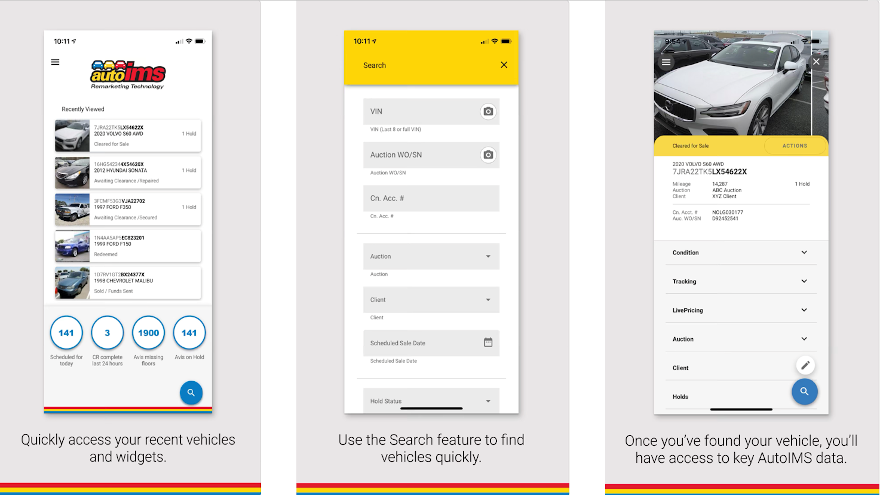
On Wednesday, Auto Auction Services Corp. (AutoIMS) announced a new mobile application for its members. The company highlighted the AutoIMS app was designed to offer users the most vital data and features of its inventory management system in the palms of their hands.
Provided to users at no additional cost, the app is designed to be an intuitive window into AutoIMS and can allow users to:
• Search for vehicles (a VIN scanner is included)
• View and edit the most important vehicle data
• Review and add notes
• Enter or adjust floor prices
• Review and approve repairs on the CR
• Seamlessly transition from desktop work to mobile-enabled work
• Login using biometrics for security and convenience
“Our journey from strategy, to concept, to design, testing, and rollout was intense. Creating a good mobile experience requires extensive input, expertise, and trial and error,” AutoIMS chief technology officer Robert Williams said.
“Our team, together with a partner called DevelopmentNow, rose to the occasion on everything from developing new data pathways to debating color schemes,” Williams continued.
AutoIMS mentioned that released the app to all consignor and auction users gradually during the last few months, and already reports hundreds of logins per day.
The company also noted a group of beta testers that gave input on functionality and design beginning more than a year ago were the first official users. As of Monday, all users have access and were notified of their ability to download the app from either the Apple or Google app stores.
“This investment in our clients’ productivity tested our comfort zone. Yet it is already proving to be a meaningful value-add to AutoIMS users, despite the limited mobility imposed by the pandemic,” AutoIMS vice president of client experience Joe Miller said.
“We are grateful to our clients and shareholders who contributed their time, constructive input, and support to ensure we would deliver a great tool to the industry,” Miller went on to say
Interested users can search “AutoIMS” on their Apple or Android phone’s app store and login with their usual AutoIMS credentials. User-specific privileges and access levels on the app mirror the same on autoims.com.
Perhaps the most well-known auto auction group in the Pacific Northwest is going to the Southwest with its latest expansion.
The McConkey Auction Group, headquartered in Spokane, Wash., announced Tuesday that it has added Dealers Auto Auction of Las Vegas to its group.
DAA Las Vegas joins existing MAG auctions DAA Northwest and DAA Seattle.
The deal to purchase the Nevada auction was completed last Wednesday, MAG president and chief executive officer Bob McConkey said via email.
Dan Thomas and Russ Norrish of DAA Las Vegas will remain with the auction as vice president/partner and managing partner, respectively.
“Russ and I started our careers in the auction industry 46 years ago,” Thomas said in a news release. “We were working for my father, who founded Golden Gate Auto Auction. Shortly afterward, we met Bob and have been personal friends and business associates ever since. It’s hard to believe that the three of us have 132 years of collective auction experience!”
Norrish said of working with the McConkey group: “After all these years in the business, we now have the chance to work together. I’m looking forward to this next chapter in my career — this is going to be fun!”
In an email, McConkey said Vegas is a “strategic location for our customer base,” and that this move was an opportunity for a larger independent to have a footprint in such a major market as Vegas and complement the existing Manheim and ADESA presence there.
Noting that the group’s influence is on the West Coast, McConkey called the DAA Las Vegas addition a “natural progress for us” and a “great launch point for expansion of our virtual presence in the West” through the digital partnership with EBlock that facilitates online dealer-to-dealer sales for the group.
The DAA Las Vegas purchase also marks a return of the group to the Southwest. The McConkey Auction Group sold its EPI El Paso auction in Texas to the XLerate Group in 2016.
In a related move, but in the Midwest, the McConkey Auction Group sold its KCI Kansas City auction to America’s Auto Auction last fall.