According to a news release distributed on Tuesday, Sagent Lending Technologies announced its 2018 Auction of the Year award winner.
At the start of each year, Sagent analyzes the prior year’s performance metrics for all of its auction partners, awarding the top performer with the designation of Auction of the Year. And receiving the latest accolade was ADESA Cincinnati/Dayton.
To qualify for the award, an auction must be a member of the National Auto Auction Association, reside within Sagent’s preferred auction network and outperform its peers within the designated calendar year.
As determined by its accumulation of points within Sagent’s National Quality Control Program (NQCP), the company’s 2018 Auction of the Year award winner is ADESA Cincinnati/Dayton located in Franklin, Ohio.
The company said runners-up included Manheim Louisville located in Clarksville, Ind., and Manheim Dallas.
ADESA Cincinnati/Dayton auction provides registered dealers, brokers, automobile manufacturers, rental agencies, as well as corporate and government fleets with a complete vehicle marketing solution in Ohio.
When speaking of the honor, ADESA president John Hammer said, “ADESA Cincinnati/Dayton and all ADESA auctions are committed to quality and focused on creating a seamless, efficient customer experience. Recognition of our efforts from a remarketer like Sagent Lending Technologies is an indication that we’re doing something right.”
ADESA Cincinnati/Dayton was presented with the award at an appreciation dinner held by Sagent Lending Technologies on Monday.
“Sagent expects the highest quality and standards from their vendor partners. ADESA Cincinnati/Dayton is one such partner that goes above and beyond expectations and deserves the 2018 recognition as Auction of the Year,” Sagent Lending Technologies chief product officer Charles Sutherland said.
Copart’s addition of 18 acres to its location near Austin, Texas, is a move that the company says addresses its “substantial growth” in business for that area.
The property — at 8725 N Interstate 35 in New Braunfels, Texas — is historically significant for the global online vehicle auction company. Copart purchased it in 1999. In the company's early years, the property served most of south Texas, including San Antonio, Waco and Corpus Christi. Since then, Copart has seen major growth in the region.
“This is an important achievement for Copart, given the increased demands from our buyers and sellers in Texas,” Copart chief executive officer Jay Adair said in a news release.
Adair added, “We are thrilled to grow with our customers and the economy in the state of Texas, also home for our global headquarters.”
Copart, founded in 1982, operates in more than 200 locations in 11 countries.
Auctions at the Austin location take place every Thursday at noon central time. Eligible buyers can use Copart’s proprietary online auction platform, VB3, to bid on current inventory. Or they can use the location’s kiosks during normal business hours.
“The additional 18 acres will be instrumental in helping us provide the highest level of service to our clients,” Copart Austin general manager Joshua Speck said.
RumbleOn is an e-commerce company that uses technology to help dealers and customers buy, sell, trade, or finance pre-owned vehicles through one online location. Expanding its partnership with Manheim into Fontana, Calif., RumbleOn notes that its distribution network from California to Washington, Pennsylvania and down to Florida, now hits all corners of the United States.
That coverage further reduces inbound freight costs without capital expenditures, according to RumbleOn.
The addition of Manheim Southern California gives RumbleOn regional partnerships in 17 markets across the country, including nine Manheim locations. Those markets include:
—Cincinnati
—Nashville, Tenn.
—Dallas
—Orlando, Fla.
—Daytona Beach, Fla.
—San Diego
—Fontana, Calif.
—San Francisco
—Greensboro, N.C.
—Statesville, N.C.
—Spokane, Wash.
—Indianapolis
—Kansas City, Kan.
—West Palm Beach, Fla.
—Madison, Wisc.
—Windsor, Conn.
—Manheim, Pa.
“By adding Fontana to our capital-light distribution network, RumbleOn further taps into one of the largest pre-owned vehicle markets in the country,” RumbleOn founder, chairman and chief executive officer Marshall Chesrown said in a news release.
“As we expand our automotive presence, Manheim’s reputation for being one of the leading reconditioning and end-to-end remarketing companies makes them a great partner for RumbleOn’s growth strategy," Chesrown continued.
Manheim senior vice president of marketplace Patrick Brennan added, “With its strong brand, RumbleOn is an incredibly valuable partner for Manheim, both as a wholesale buyer and a seller.
"Bringing their attractive inventory, 30-day guarantee, and transportation assistance into southern California is a great win for Manheim buyers in an important market for used vehicles," Brennan went on to say.
The spring market is starting to bloom at the auction.
This week’s edition of Black Book Market Insights report included slowdowns in vehicle value decreases as well as rising sales percentages, especially if trucks and SUVs were included in the lane.
“The first sign of the spring market showed up last week with mid-size cars experiencing an increase in value. In comparison to last year, the used auto market shows a lag in seasonal lift,” Black Book executive vice president of operations Anil Goyal said in the report.
Volume-weighted, editors indicated that overall car segment values decreased by just 0.19 percent last week. In comparison, Black Book pointed out that the market values for cars had decreased by 0.43 percent on average during the previous four-week period.
Among cars, editors noticed the values of midsize cars actually increased by 0.33 percent or $26.
Again volume-weighted, Black Book said overall truck segment values (including pickups, SUVs and vans) softened by 0.39 percent last week. That’s slightly less than the previous four-week average, which was 0.41 percent.
In truck space, editors determined full-size vans experienced the biggest drop, sliding by 0.85 percent or $117.
Turning next to what Black Book representatives stationed at nearly 60 sales nationwide noticed, the leading anecdotes focused on sales performances. Here is the rundown:
— From Pennsylvania: “The sales percentage was close to 70 percent today, which made for a really good sale. Trucks and SUVs both sold well.”
— From Texas: “We had a good day with one of the lanes selling 70 of the 85 vehicles offered. It was probably not a coincidence that most of the vehicles in that lane carried a (condition report) of 4.0 or higher.”
— From Tennessee: “SUVs were in demand which resulted in a lot fewer no-sales since there were a lot of them in the sale.”
— From South Carolina: “Attendance was the highest it has been since last spring. The auction GM said that the independent dealers are reporting really good activity on their lots.”
Along with announcing that it would be leveraging a tool from Dealertrack, Westlake Financial Services named its 2018 Auction of the Year winner as well as gave accolades to auctions in four other regions.
The top accolade as Westlake’s 2018 Auction of the Year went to America’s Auto Auction Harrisburg.
“We are happy to congratulate our 2018 Auction of the Year winner America’s Auto Auction Harrisburg. They are a great partner and together, we look forward to continuing our growth,” Westlake Financial Services vice president of remarketing William Walters.
Westlake also highlighted that its 2018 top regional auction performers included:
— Northeast Region Winner: America’s Auto Auction Harrisburg
— Midwest Region Winner: Manheim Nashville
— Pacific Region Winner: ADESA Sacramento Brashers
— Southeast Region Winner: Manheim North Carolina
— West Region Winner: Manheim Phoenix
Each year. Westlake grades auctions based on sales and service levels including sales of Westlake remarketed units with the highest MMR percentage. Westlake recognizes top performing auctions in each region with the highest graded auction receiving the Auction of the Year award.
“We are proud to be working with all our auctions and I want to congratulate the top five,” Westlake chief financial officer Paul Kerwin. “We hope to continue our success alongside each of these groups.”
Westlake partners with auctions nationwide to sell thousands of used vehicles each month. Many units are sold with Westlake’s Buy with Confidence Guarantee, which is geared to give dealers peace of mind they are purchasing quality units.
Additionally, Westlake offers a Dealer Loyalty Program in which retailers can receive discounts when Westlake units are purchased at auctions and financed through Westlake.
Operators interested in learning more can contact the remarketing department and check upcoming sales by going to www.westlakefinancial.com/Remarketing.
Westlake picks Dealertrack title tool
In other company news, Westlake Financial Services has chosen Dealertrack Accelerated Title in an attempt to provide dealers with a quicker and more efficient way to handle the payoff and title release process for trade-ins.
With 30 years of experience in the auto finance industry, Westlake Financial Services is a full-spectrum lender that helps dealerships finance customers in all credit categories, including first-time, prime and sub-prime buyers. Using Dealertrack’s Accelerated Title solution will enable Westlake to streamline its transactions and reduce processing costs by delivering a faster title turnaround service.
Dealertrack said the process of obtaining a payoff quote, manually writing checks to pay off a traded-in vehicle and obtaining the title from the finance company can often take anywhere from 12 to 18 days or more. With Dealertrack’s Accelerated Title solution, Westlake Financial Services can now deliver substantial cost savings by facilitating faster electronic payments to finance companies and completing title release for dealerships in just four to six days. That process can speed the standard payoff and release process by 70 percent.
As dealerships continue to face the challenges of margin compression, Dealertrack insisted implementing innovative solutions to optimize efficiency and reduce overhead costs is essential. On average, dealerships pay a holding cost of $32 per day for each vehicle that sits idle on their lot.
In addition, Dealertrack added that recent research demonstrates that vehicles holding a title are nearly twice as likely to sell on the first pass through auction than those without a title.
“At Westlake, we are committed to offering the most seamless financing solutions for dealers and consumers,” said Mark Vazquez, senior vice president for sales and marketing at Westlake Financial Holdings. “Using Dealertrack Accelerated Title enables us to process title releases more swiftly, allowing dealerships to turn their inventory more quickly and reduce their holding costs.
“In today’s margin-compressed environment, finding ways to save time and money for our dealer partners is the key to success, as we all strive to enhance the customer experience by streamlining the financing of their purchase for all parties involved,” Vazquez went on to say.
Dealertrack offers advanced finance company solutions and Accelerated Title is a powerful tool delivering increased speed, accuracy and consistency to vehicle payoffs. Dealertrack holds more than 53 million titles and processes more than 28,000 transactions per day to help finance companies originate installment contracts.
Accelerated Title can provide dealers with title visibility to ensure validity of the trade before the deal is finalized. The service empowers dealers with 24/7 title tracking, reporting and statements so they know exactly what's happening with every transaction. This solution can give dealers more control over their transactions, as the fully electronic process provides them with a reliable and accurate back-office operation.
“We are pleased to see Westlake Financial Services adopt Dealertrack Accelerated Title,” said Kaitlin Gavin, vice president and general manager of Dealertrack Registration and Title Solutions. “Our goal is to continue to increase efficiency and expedite the financing and titling process for dealers by working with lending partners who share our commitment to optimizing efficiency and profitability.”
After three years of holding its annual convention in partnership with Cherokee Media Group’s National Remarketing Conference during Used Car Week, the National Auto Auction Association will return to having its own standalone event this fall.
NAAA is hosting its event Sept. 30 to Oct. 3 at the JW Marriott in Indianapolis.
The association said in a news release that its executive committee made the decision “in response to requests from its membership.”
NAAA president Chad Bailey said in the news release: “Resuming our autonomous annual meeting will allow us to concentrate on NAAA’s priorities with more targeted content on issues relevant to the auto-auction business and the work NAAA conducts all year long in such areas as standards, safety, advocacy and the future of wholesale auto auctions.”
He later added in the release: “We appreciate the dedication and hard work Cherokee Media Group has devoted to professionally producing our shared meeting in the past three years. On behalf of NAAA, I want to thank them for their partnership and encourage our members to continue supporting and attending their events. As part of that effort, NAAA has pledged to continue as a sponsor and industry partner with the National Remarketing Conference, joining with the International Automotive Remarketers Alliance, National Independent Automobile Dealers Association, National Auto Finance Association and the American Recovery Association in support of Used Car Week.”
Used Car Week is scheduled for Nov. 11-15 at the Red Rock Casino, Resort & Spa in Las Vegas.
Bill Zadeits, who is president of Cherokee Media Group, said: “We will continue to strongly support the NAAA and its meetings to accomplish the important work of the industry and for the good of the entire auto remarketing community.
“As we celebrate the 20th anniversary of the National Remarketing Conference this year, we look forward to having NAAA continue as one of our industry partners as we gather the auto remarketing and used-car industries together again during Used Car Week.”
Ron Smith decided to roll the dice in 2001.
It wasn’t long after 9/11, and the aftermath of the attacks was having a big impact on the business travel industry.
Hotels were facing cancellations, and many companies were averse to business travel at that point, Smith said.
So, Smith, the founder of Auto Remarketing and its parent company, S&A Cherokee, talked it over with his lieutenant, Bill Zadeits.
They decided to take a chance and bring the company’s then upstart event, now known as the National Remarketing Conference, to the Bellagio in Las Vegas later that upcoming winter.
Smith and Zadeits booked a keynote speaker, Jeff Heichel, who led used-car activities at General Motors, and began planning for a conference in February 2002, which was just six months away.
Having personally guaranteed the finances, it was a gamble, for sure, but one that ultimately paid off, Smith said.
“We would be losing money and lose our houses and everything if only 50 people showed up,” he said. “We ended up with over 400. And that changed the whole paradigm of the NRC … it changed it a lot, and we never looked back from there.”
The event is now celebrating its 20th anniversary with the 2019 installment of the conference, which is part of Used Car Week, being held Nov. 11-15 at Red Rock Casino, Resort & Spa in Las Vegas.
Smith, who is retired but remains part of the company’s management team, has passed the NRC reigns to Zadeits, president of Cherokee Media Group (CMG) and group publisher of Auto Remarketing, and Marilu McQuilkin, CMG’s senior director of events and marketing.
Zadeits was at the first installment of what is now NRC, which took place in 1999 at a resort on Camelback Mountain in Scottsdale, Ariz. At that time, the term “certification” was a major theme and new buzzword in the used-car industry.
Of course, many knew the term from the retail standpoint, referring to the certified pre-owned car programs that had emerged and gained steam in the 1990s.
“But there was a lot of interest on certification and standards in the wholesale marketplace,” Zadeits said. “And so that group in Scottsdale back in 1999 was really focused on (answering), ‘What kind of certification standards do we need in the wholesale market? How does that translate to retail? What are those standards? How do we measure them? Is there an independent source that creates these certification standards? Is it done by company, within the auction lanes?’”
There were roughly 100 people at the inaugural event, Zadeits estimates.
He said it was a “great start” that “really set the tone for what we would be able to build on as we moved forward.”
To put it in football parlance often used by Zadeits, it was a team scoring a touchdown on an opening drive. Of a four-quarter game. In a season that keeps going and going.
Digitalization changes industry, NRC
And if Zadeits is the coach of that team, then McQuilkin is the tenured quarterback, having led event-planning at the company a dozen years.
Both she and Zadeits have seen the wholesale used-car industry go increasingly digital in recent years, and that impacts the topics that are discussed at NRC.
McQuilkin recalls a recent interview on the Golic & Wingo radio show with the founder of the Alliance of American Football, which just began play, that touched on how the new league and the NFL can complement each other, rather than competing.
“And to me, throughout that interview I heard a lot of similarities and a lot of parallels to the digital and physical auction (markets) and that transformation that they’re experiencing right now,” she said.
The radio interview looked at how the two leagues can utilize resources, “so that the two can work off of each other as opposed to compete with each other,” McQuilkin said.
“And that’s the nice thing, I think, about the live events is that at an event like the NRC, we have all of that content in one place, from both sides. So that those two different groups, those two different families, can meet; they can interact with each other; they can sit and talk about ways that they can work through the evolution, revolution … of this digital transformation,” she said.
“At the end of the day, a car itself is a physical piece of inventory. A car is never going to be sent up into a cloud and then sent to a person. It needs a place to live. It needs a place to stay, to be transported from point A to point B regardless of how the sale is done,” McQuilkin said. “A lot of the physical auctions are also looking at different ways that they can evolve with it and how they can restructure themselves so that they are still part of that whole process, because they need to be. that’s the goal that they bring to the table.”
That overall digital transformation in auto, be it finance, retail or wholesale, is coming fast, Zadeits said. And that has impacted the NRC, too.
“It’s almost exponential in terms of how quickly it’s changing,” Zadeits said. “And so our job, I think in many ways, is to be sure that our audiences from the remarketing side, from the auto finance side, from the retail side, are getting great information from us, great content from us in whatever platform they need. Content that prepares them, that helps them learn more, that opens their eyes, that gives them insight into how they grow their companies, and how they prepare their companies to not just survive, but to excel, in this new environment.”
Speaking of transformations, the NRC has certainly had its own over the past 20 years.
The linking with CMG’s auto retail and finance events to form Used Car Week earlier this decade. The combined event with the National Auto Association’s annual convention from 2016 through 2018.
And an early one: moving the conference to the fall instead of the spring, where many other auto industry events take place.
Moving NRC to November several years ago, “gave us a window to say, ‘Let’s look ahead into this next year,’” Zadeits said.
“And by positioning it that way, it really has generated a lot of content that has really been, in many ways, clarifying of what’s happened in the year leading up to it,” he said, “and also in many ways, visionary as to what will or what could happen — or what we might expect as an industry — as we move into the new year.”
Over the years, another change has been that content and that conversation at NRC.
Pierre Pons, chief executive officer ServNet Auctions and president of TPC Management Company, is a longtime NRC attendee and has been a panelist at the event, as well.
Asked how the conference has changed over the years, Pons said via email: “It’s really gone from concentration on a single platform/channel for wholesale remarketing — and by that, I mean brick-and-mortar traditional auto auctions — to multiple platforms/channels.
“Years ago, all the tactical discussions were about how best to utilize and develop the brick-and-mortar — sell over the auction block — channel,” he said. “Today remarketers have to evaluate what the ‘best’ channel is for their portfolio — upstream, mid-stream, downstream, direct-to-consumer, direct-to-dealer — and evaluate many different channel/platforms and how to mix and match what is the best strategy for their particular portfolio.”
Added Peter Kelly, who is president of KAR Auction Services: “It’s been interesting to see how the conversation has evolved over the past 20 years, but one thing has remained a constant: the impact of technology on our industry and its ability to improve outcomes for our customers. More than 20 years ago, I attended NRC as the founder of OPENLANE, an early digital disruptor. It was events like NRC that helped us to learn and grow as a company.
“Becoming part of the KAR family in 2011 increased my understanding of the broader industry, and our ability to lead innovation in remarketing. It’s a privilege to contribute to the conversation about the digital future of the industry and how technology can continue to transform it. Now, I often find myself looking at younger NRC attendees and wonder who among them will drive the most change in our industry going forward.”
NRC relies on longtime allies
McQuilkin, Smith and Zadeits aren’t the only familiar faces walking the conference halls. Another is Steve Kapusta, who heads up Ally’s SmartAuction, NRC’s longtime lead sponsor.
The CMG team and NRC, he said, has taken an “open perspective” to conversations about the remarketing industry, something that aligns with the values of his company.
“When I take a look at that and I take a look at the cultures of both of our teams, we’re there to create, and add and deliver value,” Kapusta said.
It’s about looking at “what’s the issue at hand in the industry?” he said. “How do we help people in this industry succeed and open up the door to potential relationships, opportunities and (other) things that will help each other succeed?
“That just aligns extremely well with us,” Kapusta said.
He said he enjoys the fact that NRC is not about any one particular approach to wholesale or any one particular product or viewpoint. It’s an open dialogue about industry trends.
This approach, Kapusta said, has “kept it in a perspective that allows the audience and allows the attendees to make their own informed decisions and/or dig in and get more information.”
Kapusta also pointed out the value of relationship-building that has come out of attending NRC.
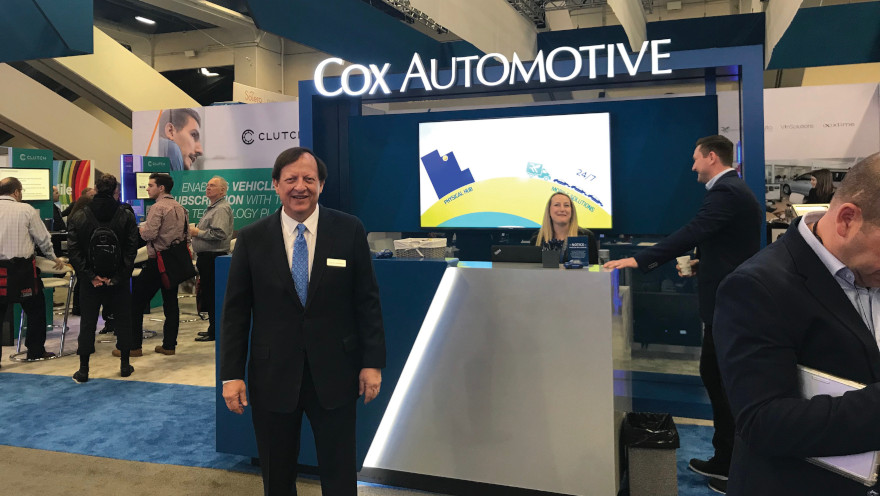
Another familiar face around the conference is Nick Peluso of Cox Automotive, who has attended since the early days of NRC.
“Here’s how I would sum it up. In the late 90s or in the early years, it was a conference that was nice to be at,” said Peluso. “Today, it’s a ‘must-be-at.’”
Peluso, who is the president of Manheim Digital Marketplace and RMS Automotive at Cox, said one thing that he, his team and peers have found valuable about NRC is that served as a chance, given the timing, to develop plans for the year and talk strategy.
Additionally, the networking and relationship building is a plus. “I do think what the conference has done just well over the years is the way that you’ve allowed us to network.”
Beyond the presentations and sessions, the conference has included “networking knowledge collisions,” Peluso said.
“You guys have really spent time thinking through that and how you allow people to congregate and bump into people by accident, although you guys actually have choreographed it. I think it is something that makes your guys’ conference really special.”
That networking, which Peluso described as planned yet not forced — organic, if you will — is something that has stood out to Smith, the event’s founder.
He recalls a conversation with former Manheim leader Dean Eisner at the event years ago.
Eisner had approached him, saying how much he had enjoyed the conference. But Smith replied had not seen him in any of the sessions.
“’Well I came to one,’” Smith remembered him replying. “He said, ‘But this was a place where I could meet with a lot of different people.’ And I think I knew that, but also it reinforced the fact that there were three pillars that I wanted to have in a conference: a place that people like to go to, information sharing from experts and also ample time for networking.”
Asked what makes the event valuable from his perspective, Pons, the ServNet and TPC executive and longtime NRC supporter, said: “That’s simple: The participation and attendance from such a large array of participants in the remarketing process. It’s not ‘just’ an auto auction meeting. It brings out attendees from every facet of the process:
• Auctions
• Remarketers, from all segments
• Transporters
• Preconditioners
• Financiers
• Private equity and other institutional parties
• Insurance
• Security
“It’s this multi-faceted attendee pool that make NRC unique and a worthwhile investment — actually a must investment — in time and money,” Pons said. “And expanding the program to a full Used Car Week and only enhanced the crossover of participants, which is good for everyone.”
Over at KAR, Kelly said: “I attend NRC for the content and the people – primarily the people. Anytime I can be in the same room as others in our industry, I find it valuable. Events like the NRC are an opportunity to meet with our customers, industry partners, and our competitors. Through the back-and-forth of our discussions at NRC, we have developed solutions to industry challenges and continue to create opportunities for continued success. It’s a win-win for all involved.”
This story, plus a full photo spread of NRC through the years, can be found in the March 15 Auto Remarketing.
The events keep rolling along for Cherokee Media Group. The annual Auto Remarketing Canada Conference runs Tuesday and Wednesday at the Westin Harbour Castle in Toronto. That is followed up on Thursday with the Women & Automotive Canadian Leadership Forum, also at the Westin Harbour Castle.
As Auto Remarketing continues to report on the wholesale remarketing strategy of commercial consignors, the story would be incomplete without the inclusion of credit unions. CU Direct said member auto-loan originations by the 1,100 credit unions using the CUDL auto lending platform, as an aggregate, have led the auto lending industry.
(Author Disclaimer: I provide media consulting services to CU Direct; they did not participate in this story other than providing the above data, and a data point below).
The wholesale credit union market is driven by repossessions. The leading consignor for the nation’s credit unions is Element Fleet Management. It also remarkets vehicles under its fleet contracts, including RVs and other vehicles. Paul Seger, executive vice president, asset remarketing said Element consigns 70,000 vehicles a year, of which 90 percent originate as vehicles repossessed by credit unions.
This figure is somewhat remarkable, given the average credit union auto loan customer presents with a 700 or higher credit score, according to CU Direct and AutoCount. In other words, credit union-member car buyers typically don’t fall into the subprime category; one would assume these consumers would have a lower default rate than the average for the auto finance industry.
Some news outlets, reporting recently on the Federal Reserve Bank of New York’s consumer delinquency trends, were anything but encouraging: “More Americans than ever are struggling to pay their car loans as overall debt rises in the U.S.,” noted USA Today in its headline.
Yet as reported by a Cherokee Media Group publication afterwards, this news, seen in the right perspective isn’t grim.
“At first blush, it might look inflammatory that the New York Fed data fueled by Equifax showed that more than 7 million people had an auto finance contract at least 90 days delinquent by the time 2018 finished,” reported Auto Remarketing’s sister publication SubPrime Auto Finance News. “However, the data set also pointed out that more than 89 million people have some form of auto financing — a lease or retail installment contract. That’s the highest figure ever recorded, according to the Fed data from Equifax that goes back to 1999.
“All told, auto financing surged by $53 billion year-over-year to close 2018 at $1.27 trillion; again, the highest figure ever recorded.” The report went on to mention that auto financing is just part of what’s pushing overall debt to new highs.
Element relies on a multi-channel remarketing strategy. However, its primary channel is its Element Mega Sales live event it conducts routinely in 45 to 50 markets nationwide and runs these through the mainline auction houses.
“We make a decision based on the market strength of that particular facility,” Seger said.
“We have seen over the last two years a huge movement toward the online course, so I anticipate this channel is going to evolve to bring efficiencies to the overall remarketing process,” Seger said.
Just like cream and sugar cuts the bite of strong coffee, KAR Auction Services chief economist Tom Kontos noticed wholesale price movements of cars versus trucks unfolded similarly in February to produce the overall reading.
And the movements happened in part to what’s occurring “upstream” versus “downstream.”
According to ADESA Analytical Services’ monthly analysis of wholesale used-vehicle prices by vehicle model class, wholesale used-vehicle prices in February averaged $10,775. The reading represented an uptick of 0.1 percent compared to January and 0.6 percent relative to February of last year.
On average, Kontos explained that car segment prices were down both month-over-month and year-over-year, while the opposite was true for trucks.
Average wholesale prices were relatively flat in February, as opposing forces largely canceled each other out,” he said in his latest installment of the Kontos Kommentary.
“To be more specific, overall car price declines were more than offset by truck price gains, and off-lease price strength was largely offset by softer prices elsewhere,” Kontos continued. “Within the off-lease segment, the ‘take-rate’ of midsize cars purchased upstream may be higher than that of midsize SUV/crossovers, which is leaving fewer late-model midsize cars in the lanes and an abundance of midsize SUV/crossovers.”
To illustrate his assertions further, Kontos went back to a main part of his monthly updates — examining fleet/lease sales of 3-year-old midsize sedans and midsize SUV/crossovers with less than 45,000 miles.
“When holding constant for sale type, model-year age, mileage, and model class segment — using criteria that characterize off-lease units — prices were up significantly on a year-over-year basis for midsize cars but down significantly for midsize SUV/CUVs,” Kontos said.
Prices for those specific cars jumped $411 to $11,967 while prices for those particular utilities slid by $471 to $20,102.
“A possible explanation for the strength of off-lease midsize car prices is that more off-lease cars are being bought ‘upstream,’ that is, in online-only sales from dealer lots and marshalling yards,” Kontos said. “So, auctions may be seeing a relative scarcity of late-model midsize cars.
“On the other hand, there may be an abundance of midsize trucks at auction as more of these vehicles are making it ‘downstream’ to physical auction lots,” he continued.
Kontos went on to mention average wholesale prices for used vehicles remarketed by manufacturers in February rose 1.7 percent month-over-month but dropped 1.8 percent year-over-year.
He noted prices for fleet/lease consignors ticked 0.4 percent lower sequentially but jumped 4.6 percent year-over-year.
Furthermore, Kontos said average prices for dealer consignors in February edged 0.4 percent versus January and 0.3 percent relative to February of last year.
Kontos closed his analysis by looking at used-vehicle deliveries based on National Automobile Dealers Association data. Retail used-vehicle sales by franchised dealers, and independent dealers each increased 4.0 percent year-over-year in February.
ADESA Wholesale Used-Vehicle Price Trends
| |
Average |
Price |
($/Unit) |
Latest |
Month Versus |
| |
Febuary 2019 |
January 2019 |
February 2018 |
Prior Month |
Prior Year |
| |
|
|
|
|
|
| Total All Vehicles |
$10,775 |
$10,761 |
$10,707 |
0.1% |
0.6% |
| |
|
|
|
|
|
| Total Cars |
$8,339 |
$8,374 |
$8,609 |
–0.4% |
-3.1% |
| Compact Car |
$6,484 |
$6,495 |
$6,563 |
-0.2% |
-1.2% |
| Midsize Car |
$7,352 |
$7,394 |
$7,702 |
-0.6% |
-4.6% |
| Full-size Car |
$7,780 |
$7,729 |
$7,554 |
0.7% |
3.0% |
| Luxury Car |
$12,663 |
$12,771 |
$13,132 |
-1.1% |
-3.8% |
| Sporty Car |
$13,412 |
$13,044 |
$14,079 |
2.8% |
-4.7% |
| |
|
|
|
|
|
| Total Trucks |
$12,820 |
$12,793 |
$12,647 |
0.2% |
1.4% |
| Minivan |
$8,367 |
$8,496 |
$8,714 |
-1.5% |
-4.0% |
| Full-size Van |
$12,287 |
$12,585 |
$13,032 |
-2.4% |
-5.7% |
| Compact SUV/CUV |
$11,095 |
$10,962 |
$10,638 |
1.2% |
4.3% |
| Midsize SUV/CUV |
$11,234 |
$11,192 |
$11,083 |
0.4% |
1.4% |
| Full-size SUV/CUV |
$13,628 |
$13,957 |
$13,411 |
-2.4% |
1.6% |
| Luxury SUV/CUV |
$17,788 |
$17,613 |
$18,101 |
1.0% |
-1.7% |
| Compact Pickup |
$9,692 |
$9,734 |
$8,977 |
-0.4% |
8.0% |
| Full-size Pickup |
$15,662 |
$15,552 |
$15,635 |
0.7% |
0.2% |
Source: ADESA Analytical Services.
Helping to build the Cox Automotive portfolio by nurturing organic growth at Autotrader and Manheim is just one of Cox Automotive president Sandy Schwartz’s accomplishments over his three-decade career with the company.
Schwartz has been a key member of the leadership team at Cox Media Group and Cox Automotive, helping to grow the company to $20 billion revenue and 60,000 employees.
Recognizing that and other achievements, the Northwood University board of trustees has named Schwartz a 2019 Outstanding Business Leader honoree.
Northwood University said in a news release that it selects honorees based on personal achievement and that each winner personifies the philosophy of Northwood University.
“Since first vested in 1981, the (Outstanding Business Leader) Award has gone to some of the most extraordinary leaders in enterprise in whose company and association we believe you belong,” Northwood University president and chief executive officer Keith Pretty wrote in a statement congratulating Schwartz on the honor.
In selecting the honorees, Northwood University uses criteria such as contribution to the philosophy of private enterprise, support of the integration of business and the arts, contribution to education, economic innovation, creative marketing ideas, community involvement, religious leadership, philanthropic contributions and business success.
In helping build the Cox Automotive portfolio Schwartz integrated software start-ups such as vAuto and Xtime and helped lead the $4 billion acquisition of Dealertrack and Dealer.com.
Cox Automotive added in a news release that Schwartz has also fostered a family-first ethic and an “open, honest and direct culture” at the company.
Schwartz has also led community service initiatives for entities such as the A.C. Green Youth Foundation and the American Red Cross of Metropolitan Atlanta. The Northwood website section promoting the event describes Schwartz “as a self-described ‘car guy’ whose garage houses an EV and an American muscle classic. He’s right at home with the breadth of Cox Automotive’s reach in the auto industry—from in-lane auctions to online vehicle listings to open platform dealership software.”
Northwood will honor Schwartz and six other leaders at its Outstanding Business Leader awards event on Saturday. More than 200 people, including past honorees, board members, Northwood students and family members and friends of Northwood are expected to attend.
Arthur E. Turner, co-founder of Northwood University conceived the award program, which recognizes leaders in the American free-enterprise system.