Columbus Fair Auto Auction (CFAA) notes that dealers can take up to seven days to prepare vehicles purchased at auction for placement on their front line. A new CFAA service aims to save time by offering mechanic, reconditioning, body shop, and transportation services for a single flat rate.
Under CFAA’s Frontline Ready service initiative, which will be available in the first quarter of this year, units will be made “frontline ready” in 48 hours, which CFAA says will save buyers resources and accelerate time-to-market.
The FLR service is available to any dealership, not just those who make purchases at the auction.
Greg Levi, president of Columbus Fair Auto Auction — a family-owned auction founded in 1959 — said in a news release that the auction created the new service under the coordination of its shop managers to help its buyers and local dealerships.
“By utilizing this service, dealers will be able to move their units from our campus directly to their lots prepared for immediate sale,” Levi said.
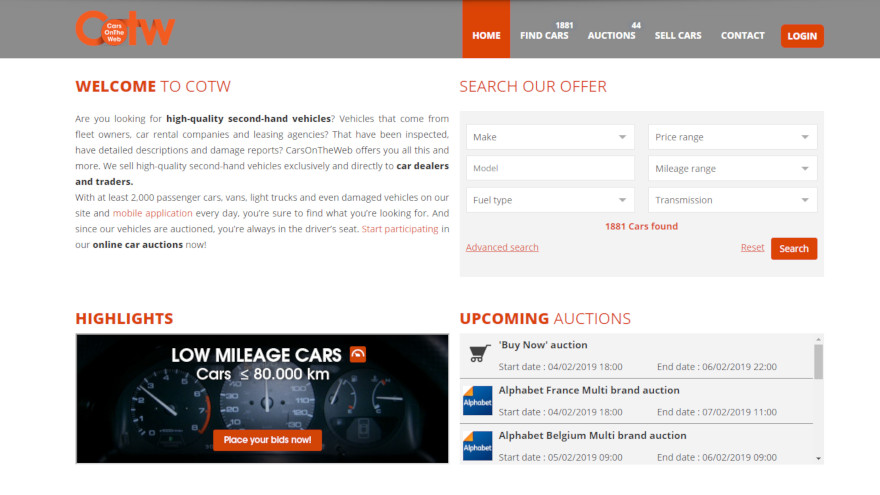
KAR Auction Services said last week that it has completed its purchase of CarsOnTheWeb, a digital wholesale auction platform out of Belgium.
The agreement to purchase COTW was first announced Nov. 28.
The purchase was for roughly 91 million euros in cash, plus as much as 65 million euros more (over time) based on certain terms and conditions as well as performance by COTW, KAR said.
“Now part of the KAR family, CarsOnTheWeb will help fuel our continued international growth with the power to deliver innovative, digitally connected services to our global customers,” said Benjamin Skuy, KAR’s executive vice president for international markets and strategic initiatives, in a news release.
“CarsOnTheWeb is already the leading cross-border automotive remarketing platform in Continental Europe,” Skuy said. “And together with KAR’s technology, data, ancillary service capabilities and strong industry relationships, we will lead and accelerate the evolution of the European marketplace.”
The COTW online auction marketplace is designed to connected automakers, fleet owners, wholesalers and dealers in 50-plus countries, KAR said. It has sales operations in Belgium, France, Germany, Italy, the Netherlands and Spain.
COTW provides various auction, transport and related services to sellers in those six nations and buyers throughout Europe.
There are parts of KAR’s existing business that it can “layer on” to this digital wholesale auction platform, KAR chief executive Jim Hallett said shortly after the deal was first announced.
“Our strategy has been to focus on being asset light,” Hallett said of how KAR has expanded internationally. “With the online model or digital model, it’s very easy to expand and to grow into the future. With that said, you take the existing platform that CarsOnTheWeb is operating off of now, we feel that we have assets that we can layer on.”
The CarsArrive transportation and logistics services first come to mind, Hallett said, but the possibilities elsewhere in KAR’s business are deep, too.
“You think about the company we acquired a few years back, DRIVIN, and the data and analytics that we’re doing here in North America. CarsOnTheWeb has their own data and analytics, but now we can add even more horsepower (to) that data and analytics and actually cast a wider net,” Hallett said.
“And then you think about some of the technologies that we have here in North America that may enhance the technology at CarsOnTheWeb, whether that be anything from what we’re doing within OPENLANE to what we’re doing within TradeRev to what we’re doing within ADESA.com — all those things have the opportunity to enhance the overall service offerings that currently are being offered by CarsOnTheWeb,” he said.
COTW will retain its key operating locations, employees and key leadership/management. It will be a wholly owned subsidiary of KAR.
At KAR Auction Services, the widespread and varying investments it has made to adapt to the digital transformation in wholesale are multi-faceted.
They have included the purchases of companies in the digital space (TradeRev), data and analytics (DRIVIN), international (CarsOnTheWeb) and mobility (STRATIM).
And then integrating those systems.
Through all of it, they’ve strived for “fast, fair and easy,” said KAR chief executive Jim Hallett.
“Dealers want to do it faster. They want it to be easy — no brain damage. And they want it to be fair,” Hallett told Auto Remarketing at the recent NADA Show 2019 here. “They want to buy it in 45 minutes on TradeRev. They want us to take care of shipping, as quick as we can — within two days. They want to know if there’s a problem that we’re going to take care of it, (that) we’re going to take care of the arbitration. And they want to know that we’re going to be fair.
“It’s what the world wants … you do that through technology, through data and analytics, through the things that we’ve invested in,” Hallett said.
But it’s also important to note the major physical auto auction purchases KAR has made as recently as 2016, including Flint Auto Auction, Sanford Auto Dealers Exchange and the Brasher’s group of auctions.The company also opened ADESA Chicago in 2017.
“Would we still buy a brick-and-mortar auction? I would say it’s not entirely out of the question. They have to be very selective and very strategic. But brick-and-mortar auctions do more than just buy and sell a car,” Hallett said. “They offer you the real estate, the marshaling, the logistics. As we think about the ancillary services, we’ll still need those. As we think about mobility now coming, we’re going to need real estate.
“So, I don’t think brick-and-mortar auctions are done. The average age of a vehicle on the road is 11-and-a-half years old,” he said. “I think a young car, primarily off-lease cars — 2-, 3-, 4-, 5-year-old car — sells well online because you can get good condition reports and you can get good images. You start getting into a 9-, 10-, 11-year-old car, it gets harder to sell that car online.
“So, I think there’s still a play for physical auctions, but I think that the world is going more and more digital and more and more online.”
Likewise, Grace Huang, who is president of the Cox Automotive Inventory Solutions group that includes the Manheim auctions, said she sees a lot of opportunity for auto auctions when it comes to servicing new partners like mobility fleets.
“I believe the auction industry is well positioned in the fleet world. As we think about the needs of the future fleets, it’s the same things that we’ve been doing since the beginning of Manheim: reconditioning the vehicle, cleaning it, storing it, changing out tires, doing mechanical work,” she said. “These are all things that we’ve done and increasingly, we’re seeing more and more clients ask for those services that are not attached to the buy and sell.”
Manheim sees a future where there are a “longtail of dealers that still want to come to the auction — which would be great,” Huang said. “But we believe more and more space will be used to help new emerging companies in this fleet space manage their vehicles.”
Similarly, a digital wholesale environment still has use for brick-and-mortar auction locations. In fact, it was a “huge January” for Manheim with cars coming into the auctions, Huang said.
“Even in the future, if a lot of the cars are being sold digitally, those services still need to be had,” Huang said. “The challenge for the entire auction industry is that we’ve got to adopt and move faster to find ways to continue to transform our business into what clients need. Current clients and future clients. And for us, some of these future clients are fleet customers that will never buy and sell through the lane. And that’s OK.”
Last month, the Cox Automotive Mobility Group launched a new brand called Pivet that will provide a network of end-to-end mobility fleet services.
That network will include both physical locations and mobile vehicle management solutions, and the initial flagship hub location is Manheim Metro Atlanta, which was previously an auto auction.
The company said in a news release that Manheim Metro Atlanta now provides traditional fleet services to such clients as Lyft, Flex Fleet Rental, Hertz and Clutch. The fleet hub team there will also help develop advanced senor and electric vehicle technologies through innovation labs launching in 2019. The hub at Manheim Metro Atlanta will also provide a “consumer mobility lounge” where Lyft and Uber drivers can have their vehicles cleaned and serviced.
There is also a partnership with Southern Company: Georgia Power, where they are working with Lyft and Electrify America in a project providing EV charging stations for ridesharing. In addition to more growth planned for the Manheim Metro Atlanta hub, the physical hub model is expected to launch at other Manheim locations and other properties this year.
Huang also sees a future where auctions could run both daily sales and offer the services of what Manheim Metro Atlanta does, for example. It’s not “an either or” situation.
At auction locations where Manheim has the necessary space and it makes geographic sense, “we will be combining all the services,” she said. “Because in our minds, it’s just different ways of servicing that vehicle, whether it’s a fleet vehicle, a retail vehicle or a wholesale vehicle.”
Part I of the story can be found here.
There wasn’t any “grand announcement” from Cox Automotive when Sandy Schwartz took the floor at an NADA Show 2019 press conference here late last month.
Rather, Cox Automotive was touting a range of projects in the hopper designed to “make a difference in the future of dealers,” said Schwartz, the company’s president.
“One is digital wholesaling,” he said. “We’re a big, big player in the wholesale market. That business is going digital.
“We’ve been working and doing this for many years, but we’ve really reached a point today where I think you’re going to see the future change dramatically.”
The present changes in the wholesale car market are dramatic, as is.
Though he acknowledges some may find this stance puzzling given Manheim’s physical auction presence, Schwartz said that, “we believe we should run no cars through the lane. We think there is amazing technology out there today that allows you to move the car less, to get great history on the car. Not everyone subscribes to that. Some of our customers do.”
Many do, apparently. Within Cox Automotive’s Manheim business, 43 percent of sales in 2018 — and over 2 million transactions — involved a digital buyer, the company said.
“And we have seen that accelerate in recent years,” said Derek Hansen, Manheim’s vice president of off-site solutions, during the press conference.
Similarly, at rival KAR Auction Services, which owns the ADESA auction chain, the breakdown in the wholesale mix is about 50-50 online/digital versus physical auction, chief executive Jim Hallett told Auto Remarketing at NADA.
“As I said on ‘Mad Money,’ every business is in transformation,” Hallett said, referring to the CNBC television show on which he was recently a guest. “And we’re seeing transformation in our business. We’re seeing a big focus on digital right now. Online and digital.
“We’re now about 50-50. About 50 percent of our vehicles sell either in an online or digital format. And then 50 percent at a physical auction. So, we’ve seen this transformation taking place,” he said. “We’ve made some big bets on digital and online, going back to OPENLANE and obviously TradeRev, but other technology companies that we’ve bought along the way” as well, Hallett said
Grace Huang, president of the Cox Automotive Inventory Solutions group that includes Manheim, said it’s not just that the digital’s share at the auction chain is growing, but that the rate of growth is increasing, as well.
“And we’re pretty confident by the end of this year it will be in the 50-percent range,” Huang said in a forthcoming podcast with Auto Remarketing that was recorded at NADA.
“And this is going to be the year of the tipping point,” she said. “Obviously, we’ve been talking about it for 20 years, but believe it or not, it’s here.”
It has been a steady and evolving movement, for sure. Online wholesale platforms have been around for more than a decade. So, it’s not a new concept, but is likely one poised to pick up more steam.
“I have to tell you, when I took over Manheim eight years ago, I was convinced in a year or two we’d be at 50 percent (digital sales) … we’re not at 50 percent today, but we absolutely believe this is the way of the future,” Schwartz said.
“And that’s the technology with Manheim Express, with RMS, that we’re investing in, because that will be better for the dealer, it will be better for the wholesaler, it will better for the end consumer when it gets to them,” he said.
New players emerge
Tech investments are what some of the relatively new entrants to the space are betting on, as well.
ACV Auctions, for example, is a dealer-to-dealer online wholesale marketplace that is not just securing funds (raising $93 million in a Series D round of funding in December), but also putting a big emphasis on tech development.
ACV debuted a new feature at NADA Show called ACV AMP designed to let dealers hear the recording of engines of cars listed online through the wholesale platform.
The ACV AMP feature is part of the company’s condition reports and is slated to be rolled out later this month.
“Our team continues to develop game-changing technologies in the digital auction space,” ACV chief executive CEO George Chamoun said in a news release. “ACV AMP is another example of our commitment to listening to what our dealers want to see and hear when buying wholesale vehicles, and delivering the next-generation auction experience.”
Canadian online auto auction EBlock is also betting on this market. The company announced last month it officially set up shop in the U.S., as well.
EBlock’s U.S. operations are headed up in Burlington, Vt., and led by former Dealer.com executive Mike DeCecco. (Dealer.com is also headquartered in Burlington).
EBlock will begin its U.S. expansion in the Northeast, and leading the company’s North American growth is president and chief operating officer Jason McClenahan.
There is an “aggressive hiring plan” on tap this year, including for sales and operations positions, the company said. EBlock exhibited at NADA Show 2019, as well.
“Our dealers see the hammer drop on over 200 units per hour and they are incredibly pleased with the results they are experiencing using our technology,” EBlock chief executive officer Ryan O’Connor said in a news release. “Launching in the U.S. around the NADA convention makes perfect sense for us.”
In that news release, DeCecco, who is vice president of sales and operations for EBlock in the U.S., said: “Most wholesale vehicles in the U.S. sell in 60 seconds; why change this formula? We’ve seen what EBlock has done in a short amount of time in Canada and we are confident that the product will thrive in the U.S. market.”
Independents get in on action, too
In a late summer interview with Auto Remarketing, ServNet CEO Pierre Pons said he believes independent auction technologies such as Auction Edge, and the independents’ embrace of technologies from their corporate chian competitors, show that the traditional auction companies can be strong competitors with the technology “disrupters.”
“We are every bit as disruptive in our own industry, and that’s what keeps it going,” Pons said. “The independents and ServNet are at the cutting edge of everything that is technology-related.”
ServNet continues to keep an eye on the disrupters, ServNet president Eric Autenrieth wrote in an update last year. But ServNet is not looking avoid those channels. Instead, it wants to use those tools to strengthen its online capabilities.
“We can sell (a vehicle) in lane, we can sell it online before the sale, we can sell it online after the sale, and we can … sell the vehicles while they’re sitting on the dealer’s lots. So we’re looking at it as an opportunity to expand our coverage of what services we do offer,” Autenrieth said in a phone interview this summer. “We’re trying to stay on the front cutting line of what’s happening in the industry.”
Correspondent Daryl Lubinsky contributed to this story.
Part II of the story can be found here.
Global online vehicle auction company Copart has opened its newest South Carolina location.
The new, 53-acre facility at 120 Commerce Ave. in Harleyville, S.C., is located close to Charleston. The opening follows what Copart chief executive officer Jay Adair described as the success of Copart’s Spartanburg location.
Copart North Charleston general manager DaNeisha Mack said in a news release, “It was great for me to see the facility being built from the ground up and witness the excitement of our buyers and sellers for the location.”
Eligible buyers can join auctions and bid on inventory through the Copart website. They can also use the Copart Mobile App for iOS and Android devices.
During normal business hours, bidding kiosks are also available for use at the new location.
Founded in 1982, Copart now fields operations in more than 200 locations in 11 countries, including the United States, Canada, the United Kingdom, the Republic of Ireland, Brazil, Germany, the United Arab Emirates, Oman and Bahrain.
RVI Group examined the wholesale market in both the United States and Canada for the latest installment of the RVI Risk Outlook, spotting similar trends in both countries and comparable forecasts looking ahead toward 2020.
Beginning first in the U.S., report indicated December real used vehicle prices — seasonally adjusted for 2- to 5-year-old units — increased on a year-over-year basis. Analysts calculated that real used-vehicle prices (after adjusting for MSRP) increased by 3.5 percent in December 2018 when compared to December 2017.
On a month-over-month basis, RVI determined real used-vehicle prices decreased by 1.8 percent.
“Prices for used vehicles continue to be stronger as the economy continues to fuel consumer confidence with low unemployment and rising wages,” analysts said.
“The increasing supply of used vehicles and steady growth of incentive activity will continue to put downward pressure on used vehicle prices,” they continued. “We expect lease penetration to decline from record highs over the next three years. Thus, this supply of off-leased vehicles (record highs) will enter the market, and drive further declines in used vehicle prices.
RVI projected that used-vehicle prices are expected to decline by 3.4 percent from current levels by 2020.
“Key economic indicators signal a stable U.S. economy,” analysts said while pointing out that in the third quarter of 2018, GDP grew at an annual rate of 3.5 percent, down from 4.2 percent in the second quarter of 2018.
“The deceleration of the economy was caused by a decrease in personal consumption and exports,” analysts continued in the report.
Turning next to Canada, analysts found that real used vehicle prices in Canada also increased in December on a year-over-year basis.
RVI calculated the exchange rate decreased from November to December. The firm also noted Canadian GDP slowed in the third quarter of 2018, coming in at an annual rate of 2.0 percent, down from the 2.9 percent achieved in the second quarter of 2018.
RVI went on to mention new-vehicle sales increased slightly, with 2.1 million units (SAAR) sold in September 2018. On a year-over-year basis, real used vehicle prices increased by 8.0 percent in September.
“Looking ahead, we expect that a growing supply of off-lease vehicles in North America will put downward pressure on used vehicle prices, which are expected to decline by 6.1 percent from current levels by 2020,” analysts said.
Dealer-to-dealer digital auction platform TradeRev continues its work to help accelerate the dealer buying and selling experience, or in the company’s words, help dealers “move metal” faster and easier.
With its MOVE METAL services, the company says users will see shorter auctions, flat fee transportation and streamlined registration.
TradeRev announced that beginning on Feb. 5 it will unveil various platform enhancements such as shortening its auction timer to speed up dealer transactions on the MOVE METAL platform. The new transaction times will be a 45-minute auction and 15-minute closing period for buyers and sellers to finalize sale details, which is a time reduction from the previous one-hour auction plus one-hour closing period.
TradeRev also announced its 2019 flat-fee transportation rates for all U.S.-based dealers. The company says it will offer heavily discounted rates well below retail transports. That along with the ability to move vehicles from coast to coast means dealers have virtual access to what TradeRev describes as a “highly active national marketplace” with thousands of other dealers.
The flat-fee transportation program is facilitated in partnership with CarsArrive Network, a TradeRev sister company under TradeRev parent, KAR Auction Services. TradeRev’s streamlined registration process will also help new dealers become TradeRev partners, and transactions can start in minutes rather than days or weeks, according to the company.
“TradeRev was built by dealers for dealers, and we’re constantly working with our dealer partners to make our marketplace as fast, fair and easy as possible,” said Becca Polak, TradeRev president and chief legal officer for KAR Auction Services, in a news release. “Time is a dealer’s most valuable commodity, and we know every auction minute saved is a minute dealers can spend fostering leads and closing retail sales. By reducing the TradeRev auction experience to a single hour, buyers will have more certainty on cars they’ve won, and sellers can move inventory off the lot faster than ever.”
The company also unveiled an accelerated registration process that allows new dealers to register and begin transacting in as little as 10 minutes.
Dealers were able to demo TradeRev and sign up through TradeRev’s accelerated registration at the recent NADA Show. Once registered, dealers were able to buy and sell live in the booth and experience TradeRev’s condition report imaging technology powered by H.
Black Book is seeing a stable start to auction activity this month.
The newest Market Insights Report showed prices for both cars and trucks softened at the same rate last week as Black Book lane watchers shared observations that aligned with the data editors compiled.
Black Book reported that overall car segment values on a volume-weighted basis decreased by 0.44 percent last week. In comparison, the market values for these vehicles had decreased by 0.66 percent on average during the prior four-week period.
Among cars, editors noticed the sub-compact car and compact car segments experienced the smallest drops, ticking down by just $18 and $24, respectively.
Again volume-weighted, Black Book determined overall truck segment values (including pickups, SUVs and vans) also dropped by 0.44 percent last week. During the previous four-week span, the average decline for trucks came in at 0.59 percent.
In the truck space, editors found that sub-compact luxury crossovers sustained the biggest price drop, sliding by 1.5 percent or $250.
“Weekly depreciation dropped to the lowest level in nine weeks. The car segments and light truck segments registered similar depreciation rates last week,” said Anil Goyal, executive vice president of operations for Black Book.
Turning next to Black Book’s representatives stationed at nearly 60 sales nationwide, the anecdotes reflected a mix of lane intensity. Here is the rundown:
— From Pennsylvania: “The market here could best be characterized as steady. The really nice merchandise is bringing very good money.”
— From Georgia: “Passenger cars sold well, but the same could not be said for the SUVs.”
— From California: “There was active bidding in most of the lanes today. Cars, trucks and SUVs all sold well. For example, a 2016 pickup truck with 81,000 miles brought very strong money.”
— From Indiana: “Anything nice will sell. Consignment was down, and we had many more buyers than sellers.”
— From Nevada: “The high-line lanes were soft as two of the biggest consignors weren’t willing to lower floors to meet the bids.”
As the wholesale price experts from KAR Auction Services and J.D. Power Valuation Services saw December metrics move in similar different directions to close 2018, they also agree that prices are likely to dip somewhat as this year continues.
According to ADESA Analytical Services’ monthly analysis of wholesale used-vehicle prices by vehicle model class, prices in December averaged $10,620 — up a modest 0.2 percent compared to November and down 1.7 percent relative to December of 2017.
KAR Auction Services chief economist Tom Kontos explained that on average, truck prices softened more than car prices, which were up significantly versus November, though down year-over-year.
“Average wholesale prices in December fell on a year-over-year basis for the second month in a row and for the seventh time in 2018, supporting our expectation of general price softening due to supply growth,” he continued in his latest edition of the Kontos Kommentary.
“Supply growth is increasingly concentrated in the truck segments, which consequently saw greater price softening in December than did cars,” Kontos continued. “On a month-over-month basis, rising car prices more than offset declining truck prices, allowing a modest increase in overall wholesale prices.
“Auction prices for off-lease units were another major bright spot, as upstream remarketing continues to be effective in distributing supply across multiple channels,” he went on to say, while elaborating more in a video that’s available here.
Kontos also dissected wholesale price movements of midsize cars and midsize SUV/CUVs that are 3 years old with less than 45,000 miles. Typically characterized as off-lease units, he pointed out that prices were up significantly on a year-over-year basis for both categories when holding constant for sale type, model-year age, mileage and model class segment.
Prices for those particular cars rose $596 or 5.7 percent to $10,985, while prices for those specific utilities climbed $1,488 or 8.6 percent to $18,855 in December as compared to a year earlier.
Kontos wrapped up his last analysis of 2018 data by noting average wholesale prices for used vehicles remarketed by manufacturers declined 4.5 percent month-over-month and 4.0 percent year-over-year.
He determined December prices for fleet/lease consignors edged 0.4 percent lower sequentially but ticked up 6.2 percent annually.
Furthermore, Kontos added that average prices for dealer consignors in December were down 0.4 percent versus November and down 2.2 percent relative to the same month in 2017.
Analysis from J.D. Power Valuation Services
Meanwhile the team at J.D. Power Valuation Services shared their December wholesale price data, too, noting a decline for the fourth consecutive month to close 2018, what analysts described as a “typical” result.
Contained in the most recent edition of Guidelines, the J.D. Power Valuation Services’ Seasonally Adjusted Used Vehicle Price Index declined by 0.4 points in December on a sequential basis to land at 119.6. Despite the downward streak to close the year, analysts pointed out the index reading finished at the highest point since 2016.
All told in 2018, J.D. Power Valuation Services calculated wholesale prices rose 2.9 percent compared to 2017 information; a “healthy” gain driven by what analysts noted as the mainstream portion of the market.
Analysts determined prices for compact cars finished 2018 about 9 percent higher than the prior year while prices for midsize cars climbed by 7 percent.
An increase in supply kept prices for utilities from climbing at the same rates, but J.D. Power Valuation Services found they still rose year-over-year. Prices for compact SUVs finished 2018 with a 2-percent increase, and midsize utility prices rose nearly 5 percent, according to information shared via Guidelines.
On the premium side of the market, analysts noticed widespread price declines with the midsize car segment sustaining price declines that stretch all the way to 2012. That segment saw a downward price move of 7 percent in 2018.
So what’s ahead in 2019?
J.D. Valuation Services projected that wholesale prices are expected to “cool off” this year with an annual decline predicted to come in at about 1.1 percent.
“There should be increased in used supply once again this year along with more volatile credit conditions, which are expected to apply downward pressure on the used side of the market,” analysts said in their report.
“Gasoline prices and labor conditions are expected to have neutral impacts, while overall demand and consumers’ appetite for used cars, which is supported by increases in equipment as well as more advanced safety and technology features, will help to balance out but not outweigh the anticipated negatives for the year,” analysts went on to say.
ADESA Wholesale Used-Vehicle Price Trends
| |
Average |
Price |
($/Unit) |
Latest |
Month Versus |
| |
December 2018 |
November 2018 |
December 2017 |
Prior Month |
Prior Year |
| |
|
|
|
|
|
| Total All Vehicles |
$10,620 |
$10,599 |
$10,804 |
0.2% |
-1.7% |
| |
|
|
|
|
|
| Total Cars |
$8,337 |
$8,197 |
$8,502 |
1.7% |
-1.9% |
| Compact Car |
$6,398 |
$6,315 |
$6,452 |
1.3% |
-0.8% |
| Midsize Car |
$7,252 |
$7,149 |
$7,651 |
1.4% |
-5.2% |
| Full-size Car |
$8,071 |
$7,822 |
$7,551 |
3.2% |
6.9% |
| Luxury Car |
$12,786 |
$12,516 |
$12,959 |
2.2% |
-1.3% |
| Sporty Car |
$13,034 |
$13,143 |
$13,846 |
-0.8% |
-5.9% |
| |
|
|
|
|
|
| Total Trucks |
$12,595 |
$12,635 |
$12,966 |
-0.3% |
-2.9% |
| Minivan |
$8,306 |
$8,141 |
$8,891 |
2.0% |
-6.6% |
| Full-size Van |
$11,122 |
$11,583 |
$12,619 |
-4.0% |
-11.9% |
| Compact SUV/CUV |
$10,991 |
$10,890 |
$10,508 |
0.9% |
4.6% |
| Midsize SUV/CUV |
$10,980 |
$10,982 |
$11,148 |
0.0% |
-1.5% |
| Full-size SUV/CUV |
$13,306 |
$14,070 |
$14,856 |
-5.4% |
-10.4% |
| Luxury SUV/CUV |
$17,686 |
$17,463 |
$18,711 |
1.3% |
-5.5% |
| Compact Pickup |
$9,464 |
$9,600 |
$9,209 |
-1.4% |
2.8% |
| Full-size Pickup |
$15,351 |
$15,540 |
$16,189 |
-1.2% |
-5.2% |
Source: ADESA Analytical Services.
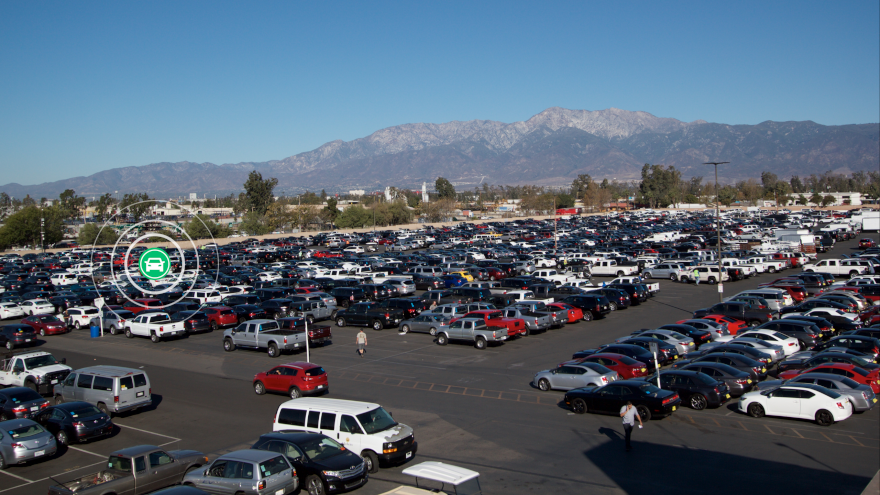
Manheim’s physical sites span more than 6,500 acres. That makes it a challenge to find some units quickly. On average, each vehicle is moved five to six times as it passes through service areas such as reconditioning, inspections and sale-day staging. The company moved vehicles 40 million times in 2018 alone.
To ease that challenge, Manheim is releasing a new product that reports a vehicle’s whereabouts within 10 feet on a Manheim lot.
Lot Vision is a GPS-based wireless device placed in a vehicle’s on-board diagnostics port that Manheim says reduces the typical search time from hours to minutes. The company says the Lot Vision tracking technology makes locating nearly 8 million vehicles registered annually at its physical auctions much easier.
To use Lot Vision, dealers and transporters input a work order number and activate “Location Services” on a smart phone or tablet to see their exact vehicle location and a directional path to it. For vehicles without an on-board diagnostic port, trackers attach to the steering wheel. Manheim says Lot Vision also speeds up vehicle processing.
Dealer clients and transporters can access tracking data, via the Lot Vision website at mymanheim.com/lotvision. The data is currently available at no charge. The company says account representatives can use the tool’s automated lot scanning process to more easily monitor inventory.
Manheim projects that the technology can boost auction work flow by roughly 75 percent by providing team members with enhanced vehicle data and streamlining scanning activities. Later this year, Manheim plans to examine other Lot Vision capabilities, including offering real-time vehicle diagnostic information and assessing remaining battery life and fluid levels.
Extensive testing took place last year, and now Lot Vision is in place at Manheim Toronto, Manheim West Palm Beach and Manheim Fort Lauderdale. By the end of the first quarter, Lot Vision will be available at four additional sites, including Manheim Orlando, which is one of the company’s largest locations. Lot Vision will expand to other Manheim sites nationwide this year.
The company created Lot Vision partially in response todealer clients who stated they looked forward to having more confidence in their ability to locate vehicles, saving time and experiencing less hassles.
“Our team members and partners will now be able to identify — with pinpoint accuracy — each vehicle’s location and journey within various areas of the facility, such as reconditioning,” Grace Huang, president of Cox Automotive Inventory Solutions, said in a news release. Cox Automotive is the parent company of Manheim.
Cox2M, Cox Communications’ new connected asset services business line, collaborated with Manheim to develop the GPS tracking hardware that powers Lot Vision. Manheim is Cox2M’s first customer to use this new technology.
As Lot Vision’s technology extends beyond Manheim lots, dealer clients such as Sonic Automotive and U.S. Auto Sales are now piloting the product at a few dealerships.
NADA Show 2019 convention attendees can view a Lot Vision demo at Manheim booth #1709S.
“Lot Vision revolutionizes vehicle management at Manheim and strengthens our capability to take vehicle tracking to the next level,” Huang said in a news release.