Wholesale vehicles with dents, dings, squeaky wheels and other mechanical hiccups near the Alamo now can be buffed and repaired by Manheim more efficiently.
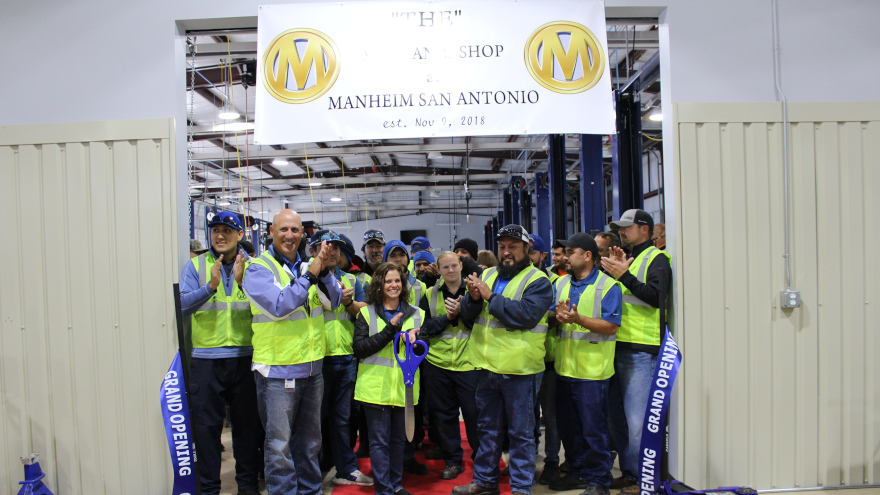
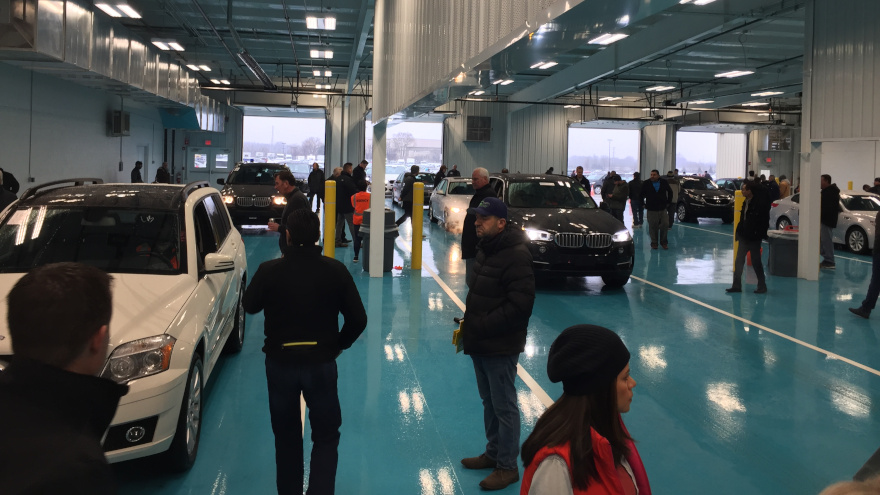
To deliver a better way for clients to do business and prepare for their growing needs, Manheim recently invested $1.8 million in a new 11,000 square-foot mechanic shop for Manheim San Antonio. The expanded and upgraded facility is designed to offer enhanced service to dealers, commercial consignors and vehicle mobility providers.
“This new facility strengthens our ability to deliver outstanding reconditioning services and end-to-end solutions to our clients,” said Mike Browning, general manager of Manheim San Antonio.
“With a larger operation, advanced equipment and skilled mechanics, we can repair more wholesale and retail vehicles and meet marketplace needs,” Browning continued.
To celebrate the grand opening of the new facility on Nov. 9, the leadership team at Manheim San Antonio held a ribbon-cutting ceremony for employees and local business leaders.
The Manheim San Antonio mechanic shop now supports a staff of 26, including 22 mechanics who can work even more efficiently thanks to:
• 14 lifts and two drive-up alignment racks
• Separate tire work shop with balancers, tire machines and a brake lathe
• Large parts room plus work areas for team member training
“Manheim continues to invest in facilities, equipment and training as we focus on the services most needed by our clients — today and tomorrow — including those in the mobility and fleet sectors,” said Nick Boris, regional vice president for Manheim.
This is just one of Manheim’s many facility investments announced this year. For example, funding of the Manheim San Antonio mechanic shop comes on the heels of:
• Completion of its $400 million auction and process transformation
• $7 million investment at Manheim Phoenix for facility enhancements, a new 26-acre lot that can handle about 4,000 more vehicles and expansion of a nearby road to ease inbound and outbound traffic
• $6 million investment in sustainability and security enhancements for Manheim Texas Hobby
• $2.7 million move to enhanced, combined offices in Phoenix for Ready Logistics and Central Dispatch
“Strong support from leadership coupled with our amazing team members enabled Manheim San Antonio be named among the Auto Remarketing Best Auto Auctions to Work For in 2018,” Browning added.
In addition, Manheim San Antonio team members volunteer for the American GI Forum National Veterans Outreach Program which addresses housing, employment and training needs of homeless, disabled and elderly veterans. And, over the last four years, they also donated their time and thousands of pounds of food to the San Antonio Food Bank.
The International Automotive Remarketers Alliance had a golf outing planned for its 2018 IARA Summer Roundtable in August, and decided to use the event to honor Ken Osborn, the late general manager of ADESA Dallas who passed away early this year, and dedicate the net proceeds in his memory.
Less than two months later, that gesture took a step forward at Used Car Week in Scottsdale, Ariz.
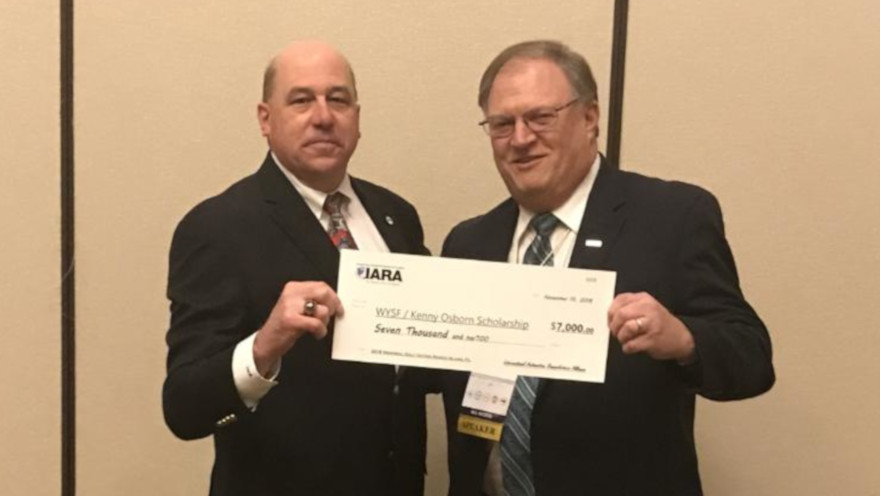
During the NAAA board of directors meeting, IARA presented a $7,000 check to the auction association’s Ken Osborn Auction Education Scholarship that was named in his honor.
IARA said most of the proceeds from the alliance’s charity fund came from funds raised at the golf tournament.
“Enjoying a beautiful day of golf with many of Kenny’s friends was a great way to honor Kenny’s memory and to contribute to a cause that was dear to Kenny and his family,” IARA executive director Tony Long said.
“The IARA and its members will always remember the friendship and support that Kenny gave to those of us in the industry,” Long said.
AutoTec has added a new provider to its AuctionACCESS floor plan platform.
The company announced earlier this month that XL Funding has been integrated into the platform, which gives XL Funding the ability to automatically send updated credit availability and flooring request messages to auctions that subscribe to AuctionACCESS.
“With this integration, AuctionACCESS is now integrated with over 10 lenders,” AutoTec vice president Charlie Adams said in a news release. “We are pleased to add XL Funding to this platform that provides a centralized and efficient way for auctions and lenders to communicate credit availability and floor plan transactions.”
XL Funding president Curt Phillips added: “We are excited to partner with AuctionACCESS. This integration will make it easier for our partner auctions and dealers to transact business with XL Funding.”
Amid the NAAA Convention during Used Car Week in Scottsdale, Ariz., DealShield announced its purchase protection solution will now be available for dealers and buyers at Lake Charles Auto Auction.
The Lake Charles, La., facility marks DealShield’s 40th independent auction. DealShield’s DS360 Guarantee, which helps dealers protect their purchases and return vehicles for any reason, will be available at the auction location this month, bringing the total number of auctions for the DealShield network to 115.
“We are excited to be able to offer DealShield to our clients as we know so many of our clients will take advantage of this incredible service,” said Matt Pedersen, owner of Lake Charles Auto Auction. “At LCAA we strive to provide unmatched customer service along with keeping up to date on the latest and greatest auto auction products, so teaming up with DealShield is just another avenue for us to enable our clients to ‘discover the difference.’”
So, how does it work, and what does it mean for dealers buying at Lake Charles Auto Auction? According to DealShield, with the DS360 Guarantee, dealers can purchase a vehicle at a participating operating location in-lane or online via Simulcast or OVE. And if it doesn’t suit their needs or meet their expectatinos, they can return it to any location in the DealShield network for a full refund of the vehicle purchase price and buy fee. There is no arbitration required.
Dealers can opt in for a 21-day guarantee, or upgrade to the 30-day program. The company explained DS360 subscribers can also extend their protection window further when they transport their purchases with Ready Logistics through a partnership solution called “Ready. Set. Pause.” This allows dealers to “stop the clock” on their days of coverage while a vehicle is in transit.
In the more than six years since it launched, over 1.4 million vehicles with $20 billion in vehicle value have been guaranteed by DealShield.
“Since 2012, dealers have told us countless times how DealShield has helped them grow their businesses by giving them more confidence in their wholesale purchases,” said Stu Dressler, associate vice president of assurance at Cox Automotive. “We’re excited to broaden our network of independent auction partners and further our mission to cover transactions anywhere dealers buy.”
In other recent news from the company, in late October, DealShield announced it integrated with the EDGE AuctionOS platform from remarketing technology provider Auction Edge.
This means that more than 100 independent auction partners of Auction Edge can now tap into the services of DealShield.
ServNet chief executive Pierre Pons is tired of hearing online auction companies referred to as “disrupters.”
He believes independent auction technologies such as Auction Edge, and the independents’ embrace of technologies such as OPENLANE and DealShield, show that the traditional auction companies can be strong competitors with the technology “disrupters.”
“We are every bit as disruptive in our own industry, and that’s what keeps it going,” Pons said. “The independents and ServNet are at the cutting edge of everything that is technology-related.”
ServNet continues to keep an eye on the disrupters, writes ServNet president Eric Autenrieth in the network’s Mid-Year Report. But ServNet is not looking avoid those channels. Instead, it wants to use those tools to strengthen its online capabilities.
“We can sell (a vehicle) in lane, we can sell it online before the sale, we can sell it online after the sale, and we can … sell the vehicles while they’re sitting on the dealer’s lots. So we’re looking at it as an opportunity to expand our coverage of what services we do offer,” Autenrieth said in a phone interview. “We’re trying to stay on the front cutting line of what’s happening in the industry.”
Autenrieth writes in the Mid-Year Report that he is proud of what ServNet owners do to ensure their voices are heard and “to battle the disruptors in our business to make sure that the lane presence remains strong in the remarketing industry.”
Autenrieth and Pons expanded on some of the report’s key points, and they along with Independent Auction Group (IAG) executive director Lynn Weaver discussed additional current and future challenges and opportunities for independents.
Disrupters and ‘physicality’
Pons agrees with Autenrieth on the importance of the physical auction, touting activities such as Bel Air Auto Auction opening a 185-acre site in Bel Air, Md., last year.
“I think this is conducive to the rest of the independent auction community, to stay up to date on the ‘physicalness’ that we need, because at the end of the day, it’s a 3,000-pound piece of metal that requires about a 6- to-8-foot by 20-foot parking space,” Pons said. “Vehicles have to be moved, they have to be shined up pretty, they have to be marketed and displayed, and you have to park them somewhere.”
Dealers, rental car companies, leasing companies and banks still need vehicle transport, he added.
“There is a physicality to this,” Pons said. “There is a requirement to have boots on the ground, to have drivers in vehicles moving them around, and nobody has embraced that better. We haven’t lost track of upstream and technology, but … you need dirt, and our independents and our ServNet owners are good at that.”
The Internet players are looking to partner with the independents, because the independents have land. The vehicle still must be picked up and checked in, with pictures taken somewhere. “It doesn’t all happen in cyberspace,” Pons said.
Technology is a top-of-mind issue for Weaver. He also mentioned the disrupters and noted that if they are not currently affecting the independent auctions, everyone is hearing about and thinking about them. Those disrupters probably have more impact on the larger auctions.
The smaller auctions can probably ride out the trend because of their strong personal relationships with dealers, Weaver said, but the “whole technology feel” is a top issue for the industry. He said industry members are asking, “Where do we go, what do we do next, and how do we pay for it? Is the market shrinking; is the market going to grow if I invest in technology?”
Weaver describes compliance as “another huge area” that has grown to where it can dictate whether or not an auction gets business in some cases. Auctions must be computer compliance-literate and Consumer Financial Protection Bureau (CFPB)–compliant if they are doing any commercial business. That can include following regulations on tasks such as paper shredding and document storage.
“Every client that comes in may have a little twist on that, so if you’re an auction doing that kind of business, you almost have to have a compliance officer, or the GM and owner have to be pretty CFPB-savvy to play in that arena,” Weaver said.
Future looks bright
But conversations with Weaver, Autenrieth and Pons reveal that they see a strong future ahead for their industry. The ServNet Mid-Year Report reflects that, starting with its title, “Mid-Year Report Reveals Strong Market and Thriving Sales Environment at ServNet Auctions.” Autenrieth notes in the report that tax time “took hold early and never stopped, with the dip we generally expect to see following the refund checks not really materializing this year.”
Competition is challenging for capturing dealer business, but Pons said ServNet auctions have done well in that area. Events Pons described as “gargantuan promotion sales” have generated strong interest. He mentioned DAA Northwest’s Rock & Roll sale in July, which the Mid-Year Report also highlighted. Pons noted the sale’s “record-setting performance” of running 5,500 vehicles over two days, and he also mentioned the Guitars & Cars sale in Kansas City this past August, which he said achieved a record-setting performance as well.
“We try to offset within the ServNet group — some of this lull in the marketplace, lower lease returns and stagnant dealer trades — by big promotion sales that bring people our way, and that’s something that differentiates us, not only from the two big chains, but from the other independents,” Pons said.
He added that as ServNet prepares for one of its two yearly meetings this coming October, he sees confidence among other industry members and optimism “around the capabilities and services we’re able to provide our dealer and our commercial accounts.” Weaver shares the optimism, noting that he expected some downturns, but the market has remained strong during tax season, spring, summer, and now heading into fall. “It’s still rolling right along,” he said. “That’s still very good and positive stuff for us.”
Big auction chains Manheim and ADESA are seeing their traditional business models upended and are working to address dealers’ changing wholesale vehicle buy-sell needs.
Challenging auctions is the quickening drive to all things digital. As digital auction sources proliferate, dealers can buy and sell remotely, never having to set foot in a physical lane.
This evolution is like what’s happening in auto finance and insurance, with fintech disruptors appealing directly to consumers, offering online credit applications, financing and the sale of service contracts, GAP and prepaid maintenance.
Dealers once dominated the sale of those products, but these new channels siphon off that revenue — and relationship with the dealership.
Similarly, digital auction disruptors — whether independent startups or the mainline firms’ digital channels — deliver faster and more convenient options for conducting commerce.
Manheim, a Cox Automotive brand, noted for the first half of 2018 that 43 percent of all vehicles were sold to a digital buyer using one of its digital platforms. Digital offsite sales, transactions happening outside a physical auction location, grew 39 percent over 2017, the company said.
Manheim started its digital channels nearly 20 years ago now, with the 2002 introduction of its Simulcast online bidding tool, and continues today with its recent launch of Manheim Express, a mobile listing and selling tool. This summer, Manheim announced the multi-year completion of a $400 million technology and process initiative to give dealers more digital options for buying and selling cars more efficiently through Manheim channels.
“Adoption of online auctions has been a little slower than what we predicted in 2002 when we launched Simulcast, but we see a steady increase in our OVE online platform,” said Matt Trapp, Manheim’s regional vice president for the Northeast. “As supplies are lower than demand, dealers are looking at other channels and other opportunities to purchase vehicles, but this is not accelerating beyond our expectation.
“We’re hearing from clients they have to look farther afield to find the inventory they need. As auction chains, we help dealers by providing broader search opportunities to fit their needs,” Trapp said.
KAR Auction Services, the parent company of ADESA, is also meeting changing auction need challenges through technology investment. The company recently reported an 11-percent revenue increase for the second quarter of 2018 over the same period of 2017. Chair and chief executive officer Jim Hallett said in a news release that growth is evidence of the firm’s ability to execute on the fundamentals “while making meaningful investments in our future. We continue to advance our strategic priorities, develop new capabilities and pursue opportunities for growth.”
ADESA president John Hammer said that while physical in-lane volume is “experiencing a modest decline,” total auction volume is up. “Collectively, we are bigger than we were last year.”
KAR bought data-analytics company DRIVIN in 2017 to leverage KAR’s expansive data assets to help customers make better-informed buying and selling decisions. Earlier this year it acquired STRATIM, a programmatic fleet management company for KAR’s play in the mobility market.
These companies’ technology investments aside, it seems “market collusion” as much as anything has knocked loose physical auctions’ glory days. Combining to deliver this punch have been flat new-car sales, which drive used-car volumes (eventually); increased dealer preference to retail lease returns and other vehicles they once sent to auction; and, the tightening supply of the type and quality of used-cars dealers want to buy.
Glen Mercer in his 2017 report, Auction of Tomorrow: 2027, produced for the National Auto Auction Association, agreed: “Certainly it is hard to imagine new-car dealers will be sending more of their used-car units to auction in the future. The debate over upstream marketing … is more nuanced: How much further will this go, how much will it hurt auction profits, and how likely is to slow or even reverse when we (inevitably) move into a down market?
“From the growth of virtual auctions to the rise of mobility services such as Uber and Lyft, toward the impending launch of autonomous vehicles, many dramatic changes have already altered the industry landscape or loom just ahead on the horizon,” Mercer wrote.
Auction Management Solutions president Tom Stewart, on the other hand, sees this all as the auction industry “balancing itself.”
“Digital disruption in this space is nothing new,” Stewart said. “SmartAuction, which has been around since 2004, is an example. Everybody freaked out at the time. I remember a senior executive with ATC-Onlane [now OPENLANE] saying years ago that the physical auction would be dead in 10 years, yet here we are 10 years later, and the world is still spinning.”
The mainline auction chains agree.
“People have been saying for years the physical auction is dead,” Trapp said. “Yes, the traditional auction model with cars running down the lane is changing, and auction companies are finding new ways with digital buying and selling tools to service their dealer clients, but there still is a vast need for physical auctions.
“When it comes to models aged five to 10 years, dealers tend to want to touch those cars, and they find it comfortable to do that at the physical auction, with bidders in the lane validating activity on that vehicle. Our data bears that out — cars sell for the highest money at a physical auction,” the Manheim executive said.
He reported that vehicles coming to auction are selling at greater efficiency — roughly 57 percent compared to a historic 50-percent rate. “Of the cars registered at auction, we’re selling more of what is being offered, which tells us there’s strong demand for vehicles out there,” Trapp said.
ADESA has acquired 12 physical auction properties in the last few years. “If we saw a drop in the effectiveness of physical auctions we wouldn’t have done that,” Hammer said.
“When we talk about opportunities and challenges in this industry, these changes make it a lot of fun,” he added, “because it isn’t business as usual, and we must find new ways to service our customers. We play in most of the different auction channels, from upstream to online to mobile trucks that take the auction to dealer locations.
“Dealers go where they can find inventory,” Hammer said. “They’ll try one platform, and if that doesn’t deliver for them, they’ll try another.”
Mercer concluded, “While we understand the argument that in an online world there will be less need for large physical auctions…it seems to us that any shift to auction relocation will be very slow” due to time to dismantle.”
“The industry is balancing itself,” Stewart said. “The physical auctions have one thing digital auctions do not, and that is cars need somewhere to sit. If physical auctions were dying, why would men and women continue to show up at the lanes when they have these digital options?”
Chad Bailey, president and majority owner of Akron Auto Auction, believes that the National Auto Auction Association has a lot to offer its members — from helping them learn to become more effective leaders to figuring out ways to address the industry-wide service technician shortage and so much more in between.
In fact, Bailey has benefited so much from the programs and information offered by NAAA that as its president-elect, he plans to share with auction owners and general managers how getting involved in the association is an investment in the futures of their businesses.
Bailey, 44, is to be installed as president of NAAA at the group’s annual convention this week in Scottsdale, Ariz. The NAAA Convention is held in partnership with the National Remarketing Conference as part of Cherokee Media Group’s Used Car Week .
“An independent guy like me from Akron — I don’t have a research and development staff, so it’s on me to stay up on what’s going on and stay ahead of the curve and continue to change with the times,” said Bailey, who earned a B.S. in mass communications at Miami University in Oxford, Ohio and an MBA at the University of West Florida, in Pensacola, Fla.
“In my opinion, that’s why you need to be involved with NAAA — so you know what’s going on in your industry. Well, here I am. I care, and I got involved.”
Bailey is to take over the NAAA presidency from Warren Clauss, who works on strategic initiatives at ADESA, a business unit of KAR Auction Services. Clauss is the former general manager of ADESA Buffalo. Clauss will become the association’s chairman.
‘Get better, lead better’
Bailey points to becoming involved in an NAAA-sponsored leadership program created in 2011.
The program was created in conjunction with the Disney Institute, which helps advise and train companies in a variety of industries “based on business insights and best practices of Walt Disney Parks and Resort,” according to the institute’s website.
The training focused on team building and how team members work together by recognizing and drawing on one another’s strengths, Bailey said.
“That excited me,” he said. “I’ve always wanted to get better and to lead better.”
NAAA also keeps members apprised of industry challenges and performs the costly, time consuming legwork to find solutions for members, Bailey said.
Take the industry-wide shortage of service technicians.
The problem is that many older technicians have either retired or are getting ready to retire, and many younger people, shunning the “grease monkey” image, are opting to pursue other careers, Bailey said.
This labor shortage is happening at a time when the U.S. Bureau of Labor of Statistics data predicts that more than 237,000 jobs in service and repair will open by 2024, said a June 2018 NAAA press release announcing that the association had commissioned a study about the problem and was seeking solutions.
Inspections and condition reports
Financial institutions that must liquidate vehicles they repossess and independent dealers who don’t have their own service departments are among the auction customers that often depend on auctions for pre- and post-sale mechanical inspections, said Bailey.
Condition reports that accompany vehicles offered for sale by auctions online are based on inspections and diagnosis conducted by service technicians, he added.
“Back in the day, your only auction customer was the guy in the lane,” he said. “What he saw was what he was getting.
“Now they’re sitting at their computers and need to know everything, other than just the picture. They rely heavily on auctions to be their eyes and ears.”
One approach is for auctions to partner with local technical schools to mentor students or offer apprenticeships, with the notion of hiring some of the students after they graduate, Bailey said.
Another solution could be that auctions make deals with local repair shops to allow shop technicians to work at the auction diagnosing vehicle problems.
In exchange, the auction might agree to send mechanical work to the local repair shop.
Bailey said auctions typically don’t pay technicians as much as franchise dealerships.
That’s because dealership service departments are profit centers, whereas many auctions perform inspections, diagnose mechanical problems and create condition reports for nominal fees. The cost of additional mechanical work is negotiated between the auction and the consignor, Bailey said.
Though the level of training and expertise for auction technicians is the same as for dealership technicians, auction techs, in general, don’t work a lot of weekends, excluding holidays and extreme weather events, he said.
Lower salaries vs. flexible schedules
That might be attractive to millennials and others who don’t mind trading off lower salaries for more flexible work schedules, he added.
But either way, finding competent service technicians is “a vital part of our industry, and we’re going to have to pay whatever we have to pay,” he said.
About 70 percent of the vehicles Bailey sells at his six-lane auction are owned by dealers, about 20 percent are repossessions and 10 percent are fleet-lease sales.
The vehicles are typically about six to seven years old and sell for about $6,000 to $8,000.
Bailey, during high school and college, worked off and on at Akron Auto Auction, started by his grandfather, and joined full-time as a consultant in 2000. He worked his way through the auction management ranks and acquired majority ownership in the company from his uncle in 2011.
Bailey has “always liked sports,” and helps coach football and basketball at his alma mater, Jackson High School, in Massillon, Ohio.
He and wife, Tracie, have two sons: Cole, 16, and Caden, 12.
It’s back to normal for the wholesale used-car market.
Following a summer where both the value retention in used cars and weather were hot, Black Book is starting to see “normal patterns” for this season, as fall marches on.
“Used-car depreciation rates are now showing normal patterns for this time of the year after strong retention in summer,” Black Book executive vice president of operations Anil Goyal said in this week’s Black Book Market Insights report.
After softening an average of 0.47 percent during the previous four weeks, there was 0.60-percent depreciation in car segments last week, according to Black Book.
Truck segment depreciation also grew steeper.
Their values were down 0.48 percent last week after 0.35-percent average depreciation in the four weeks leading up to that.
Anecdotal evidence of the new season can be found in the commentary Black Book’s field team gathered in their usual weekly observations of the auction lanes.
For example, this comment from Florida: “A more typical fall market as prices have dropped and retail is slower. The demand is for vehicles with good miles and a clean history report.”
Likewise, an auction owner in Missouri said this, according to Black Book’s staff: “The fall market is here. Vehicles are in short supply and the demand has slowed.”
Copart is moving into Germany as fast as drivers accelerate through segments of the Autobahn.
Following location openings near Hannover, Leipzig and Mannheim in Germany, Copart announced this week that it will begin auctioning vehicles every other Friday from its new facility located at Furth, near Nurnberg, the second largest city of the German federal state of Bavaria.
This facility is Copart’s fourth location in Germany.
“With our national and international buyers asking for more locations from which they can buy used and salvage vehicles in Germany, we are proud to open this facility near Nurnberg,” said Alain Van Munster, managing director of Copart Germany. “We are proud to offer a vehicle auction platform that guarantees buyers access to salvage vehicles in Germany.”
The new location will begin its biweekly vehicle auctions 12 p.m. Central European Time (6 a.m. Central Daylight Time) on Friday. Eligible buyers can join auctions and bid on inventory on Copart.de or through the Copart Mobile App for iOS and Android devices.
“We are committed to transforming the experience in Germany for salvage vehicle buyers and policy-holders alike,” said Nigel Paget, Copart chief executive officer for Europe and the Middle East.
Copart chief executive officer Jay Adair added, “These additional locations give us the network we need to deliver a superior experience across Germany through our people, processes and technology.”
To learn more about Copart Germany, visit www.copart.de.
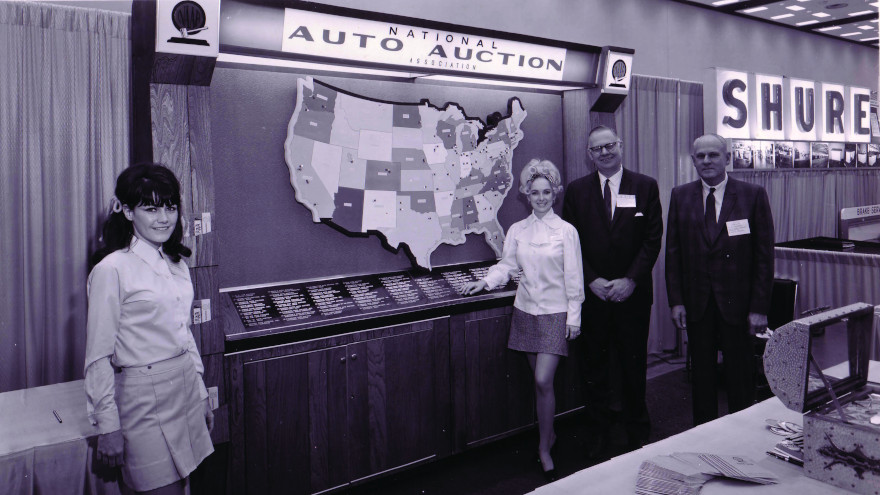
Advocacy, whether it’s addressing their needs in legislative halls or responding to the operational challenges of running an auto auction, is nothing new to NAAA.
But as the National Auto Auction Association turns 70 this year and celebrates with its annual convention in Scottsdale, Ariz., that advocacy has certainly evolved and grown throughout the past seven decades.
For example, in a timeline of milestones posted on its website, NAAA touted its work in helping to push such legislative measures as The Anti Car Theft Act of 1992 and The Truth in Mileage Act (1986).
However, the association has really ramped up its legislative efforts in more recent years, forming a political action committee in 2012 and making legislative issues a major focal point.
And as detailed below, working on behalf of auto auctions is something NAAA has at its heart, whether it’s making the 50-mile trip from its Frederick, Md., headquarters to Capitol Hill or traversing the country to meet with individual auction location leaders.
Building relationships in D.C.
NAAA has “recognized that we have to be leaders in Washington, D.C.,” says its chief executive officer, Frank Hackett.
The trade group has worked with the National Automobile Dealers Association, National Independent Auto Dealers Association and state-level independent dealer groups on Capitol Hill, as well.
“A lot of times, it can be topics that we’re working on in an individual state that may be the hot topic of the time. But in Washington, it’s really spending time with members of Congress who are the decision-makers and telling our story, that we’ve been around 70 years, and we sold 10 million cars last year and generated over $102 billion in combined sales,” Hackett said in a phone interview, referring to the auto auction industry.
“You start talking about employees or you talk about the relationship with NIADA and NADA and collectively how big we are to the economy of the country, I think that’s a story that they want to hear, and the fact that we can support them,” he said. “To me, it’s making friends in Washington before you absolutely need them. And that’s the point of the political action committee. It’s really there to establish friendships in advance of needing somebody to help you in a time when you really need their help.”
Ideas: ‘If it’s a good one, let’s all share it’
That advocacy, though, goes far beyond the halls of Congress or state legislative houses. NAAA’s history is dotted with measures creating standards designed to address the day-to-day or operational challenges that could come up at any of the NAAA-member auctions, where slightly more than 10 million cars were sold last year.
For instance, NAAA created a Water/Flood Damage Policy in 2002 and a Vehicle Condition Grading Scale and Arbitration Policy in 2006. Lately, many of its industry-wide efforts have centered on auction safety.
Hackett emphasized the importance that a trade association would “bring people together” for the common good of an industry.
“And when I say people, I’m talking about how we can be very competitive amongst the auctions, but yet we can do things like set standards with arbitration (or) safety, where people can wrap their arms around Safe T. Sam, which was created by KAR Auction Services, (and) just recognize that it could be somebody’s else’s idea, but if it’s a good one, let’s all share it,” Hackett said.
Regarding the safety measure to which he was referring, the Safe T. Sam full- and part-time auction employee safety certification program has been a major point of emphasis for NAAA. So, too, has been the Coach Caution auctioneer safety training program.
Hackett said over 36,000 auction employees have been Safe T. Sam certified, and with Manheim pushing to certify its entire employee headcount before the end of 2018, that number could jump by about 15,000, he said.
And with its Coach Caution program, NAAA is teaming up with the National Auctioneers Association for this training that aims “to provide useful information to each independently contracted auctioneer, to ensure the safety of the auto auction experience for everyone involved,” NAAA said on its website.
Outside partnerships
And sometimes, NAAA’s advocacy efforts takes them outside of their own organization and into partnerships. Like, the aforementioned work on Capitol Hill with dealer associations. NIADA and NAAA share a lobbyist, Hackett said.
And beyond politics, NAAA’s official magazine is published within NIADA’s magazine.
NAAA also partnered with what was then known as NADA Used Car Guide (which is now J.D. Power Valuation Services) 27 years ago to create the AuctionNet wholesale vehicle data service.
NAAA also has media partnerships, having merged its Spring Business Meeting with Bobit Business Media’s Conference of Auto Remarketing in 2009 and merging its annual Convention with Cherokee Media Group’s National Remarketing Convention in 2016.
“It’s not often that non-profits merge with for-profits and are successful at it,” Hackett said.
Speaking of the latter event, Hackett is looking forward to what’s in store for this year’s NAAA Convention, held in conjunction with the NRC during Used Car Week, which is being held Nov. 12-16 in Scottsdale, Ariz.
That includes the NAAA Welcome Luncheon featuring a keynote presentation from former Ford CEO Alan Mulally, followed by a moderated Q&A session that also features Cox Automotive president Sandy Schwartz; KAR Auction Services chairman and CEO Jim Hallett; and BSC America chairman and CEO Ray Nichols.
Plus, there will be a pedal car auction sponsored by Black Book during the NAAA President’s Gala that will raise funds for the new NAAA Disaster Relief Fund designed to help its member auctions following natural disasters.
Talk about advocating for your members.