Leaders from Black Book and General Motors Financial recently used the adjectives “steady” and “stable” when describing how the wholesale market is behaving.
The latest Black Book Market Insights report indicated used vehicles across most segments are depreciating at a “steady” rate. Editors determined only two vehicle segments — compact vans and sub-compact luxury crossovers — maintained or increased their value.
“Used-vehicle prices and sale conversion rates at the auctions hold firm. Post-hurricane sales activity continues but is slowing down in the Houston region,” said Anil Goyal, Black Book’s senior vice president of automotive valuation and analytics.
GM Financial president and chief executive officer Dan Berce touched on the used-vehicle space when the captive conducted its conference call to discuss its third-quarter performance.
“And a few more comments on the state of the used-car market. Our disposition proceeds on returned leased vehicles compared to estimates at origination in the September 2017 quarter were generally stable both year-over-year and sequentially,” Berce said.
“And based on recent used-car pricing trends that have remained more favorable than previously expected and the temporary impact from Hurricanes Harvey and Irma, we now expect used-car prices to decline less than 7 percent during 2017 compared to 2016, which was our previous guidance. But we do continue to expect the increased supply of used-car vehicles to pressure used vehicles into 2018,” Berce went on to say.
Getting back to Black Book’s latest analysis, editors noticed that based on volume-weighted information, overall car segment values decreased by 0.37 percent last week, similar to the average weekly decrease of 0.41 percent in values they spotted during the previous four weeks.
Black Book pointed out that the sub-compact car and compact car segments were the best performers last week.
Again looking at volume-weighted data, editors noted that overall truck segment values (including pickups, SUVs and vans) softened by 0.21 percent last week, nearly mimicking the similar the average weekly dip of 0.24 percent in values recorded during the previous four weeks.
While minivans declined the most, Black Book mentioned there was renewed demand for compact vans.
Turning next to what Black Book’s representatives shared from the lanes, the rundown began the same as it has since early September with an update on what’s happening in Texas.
“Post-hurricane sales activity continues in the Houston area. Several new buyers from just outside the Houston metro are showing up to purchase inventory at the auctions,” Black Book’s lane watcher in the Lone Star State said.
Where storms also hit, the story is slightly different.
“Older cars seem to be the focus for many dealers in our market. Buyers are being more selective in recent weeks.” Black Book’s representative stationed in Florida said.
Black Book also gathered two other anecdotes from the Southeast.
— From Tennessee: “Nice, clean vehicles with a little age on them continue to thrive. This is especially the situation with the pickup truck market.”
— From Georgia: “A good sale for this time of year, and the prices were consistently solid.”
Two other reports from the lanes originated in locations where the weather already has turned much cooler.
— From Pennsylvania: “Sales conversions and prices continue to hold firm.”
— From Indiana: “Retail remains pretty good here, but prices have slipped a little as has the consignment.”
Barrett-Jackson recently raised $1 million for Las Vegas first responders during its 10th annual Las Vegas Auction at the Mandalay Bay Resort and Casino.
The five charity vehicles featured in the sale included a rare 2007 Ford Shelby GT500 Super Snake owned by Barrett-Jackson president Steve Davis, which sold for $1 million, according to Barrett-Jackson.
“As a former police officer, I understand the incredible heroism that was shown by Las Vegas’ first responders during the recent tragedy,” Davis said in a news release. “This Shelby is an incredibly special car to me, and I’m grateful to be part of the Barrett-Jackson family and show that we are all Vegas Strong. We are all America Strong.”
The 1 million will benefit Las Vegas first responders through the Injured Police Officers Fund.
The organization’s mission is to help lessen the financial burden suffered by first responders, trauma personnel, nurses, police officers and their families in the event of a line of duty injury or death.
“Our hearts go out to the hundreds of families and friends who were victims in October 1st Las Vegas mass shooting,” said Minddie Lloyd, executive director of the Injured Police Officers Fund. “These were our fellow Nevadans, our friends. Like the rest of the world, we mourn with you. In the face of this tragedy, there was so much courage: From first responders charging into the middle of the chaos to everyday citizens who helped remove and get the wounded to emergency care.
“We may never fully understand in this life why we face tragedies of sorrow, pain and suffering; at least over 500 people injured, and 58 innocent lives lost. But it is important to know that we trust in our community and Steve Davis and Barrett-Jackson. From The Injured Police Officers Fund please know we will be by your side. Nevada will not fail you,” she went on to say.
The winning bidder of the 2007 Ford Shelby GT500 Super Snake is Paulette Carpoff, chief operating officer of DC Solar.
“DC Solar is proud to be a part of the Las Vegas community. We want the first responders to know, especially in the wake of the recent tragedy, that we stand with you and we are proud to help however we can,” Carpoff said.
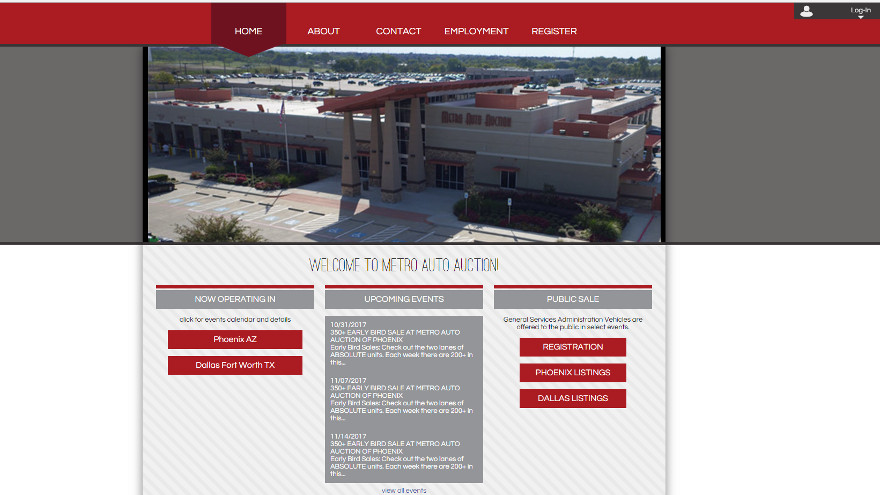
The ServNet Auction Group has added another member: Metro Auto Auction Phoenix.
The auction, which opened in 2007, is led by managing partner Tom McDermott and is part of the Berkshire-Hathaway Automotive Group.
ServNet last added an auction in November 2016, when Houston Auto Auction joined the group. In October of last year, ServNet added Louisiana’s 1st Choice Auto Auction as a member.
There are now 21 member auctions of ServNet, based on a membership list on the ServNet website.
“We are very pleased to report that Metro Auto Auction of Phoenix will carry the ServNet banner,” ServNet president Eric Autenrieth said in a news release. “Tom McDermott leads a facility that is a leader in its region, with a long-established and vibrant influence in the Southwest.
“ServNet continues to seek the strongest independent auctions in key markets across the country, and the addition of Metro Auto Auction Phoenix helps to extend the reach of our service from coast to coast, and from Florida to Alaska,” he said.
Metro Auto Auction Phoenix holds its weekly sale each Tuesday, typically offering more than 1,600 units. Its consignors include more than 70 franchised dealers, large independent dealers, Kia and U-Haul. The auction also sells cars for financial institutions, credit units, rental car companies, leasing firms and has a monthly sale for the General Services Administration.
“ServNet has made an indelible mark on the remarketing industry by clarifying the strengths of the independent auction, setting benchmarks in the scope of services that are vital to the auction customer,” McDermott said.
“I have great respect for the bright and experienced business leaders who own the ServNet auctions, and I look forward to collaborating with them to bring the benefits of the ServNet brand to institutional customers as well as the dealer body in our market area,” he said.
Metro Auto Auction also has a sister auction in Dallas, but this specific move just includes the Phoenix auction.
Auction Edge announced Friday it has attained over 115 customers running its EDGE Simulcast platform powered by Velocicast and brought aboard new senior vice president Julie Warpool to oversee the augmentation of all the company's auction systems.
“In partnership with the developers behind Velocicast we committed to crafting an unparalleled user experience for auction user, buyer and seller. The volume of vehicles running through the system coupled with tens of thousands of buyers channeled through Edge Pipeline create a truly immersive experience for all parties,” Auction Edge chief executive officer Dan Diedrich said in a news release.
Auction Edge began offering its multi-lane, multi-auction bidding platform fitted with a modern and intuitive interface design earlier this year, according to the company.
“Since changing simulcast providers to EDGE Simulcast powered by Velocicast nearly three months ago, we have experienced nothing but good things,” said Shawn Glatz, general manager at Morton Auto Auction. “We are hearing great feedback from our online buyers as well as commercial consignors who utilize the online rep capabilities. The ease in which they both can conduct their business is what it is all about. We couldn’t be any happier with the product and the service we are receiving.”
Warpool has been in automotive remarketing for over 25 years, according to Auction Edge. She spent the last 17 years with Manheim/Cox Automotive, where she served in positions as senior director of vehicle solutions, operational excellence, product strategy and technology.
“Julie has a proven history of innovation, but as importantly, execution in our industry. Julie’s skillset, mindset and experience align perfectly with our mission to modernize and deliver the solutions our customers need,” added Diedrich. “Moreover, Julie will assist us in the evolution of all Edge products to help keep auctions relevant, resilient and on the leading edge for years to come.”
Additionally, Warpool is recognized as an architect of enterprise-wide technological and operational solutions.
She has several patents for live-bid event online auction platforms, vehicle inspection/damage estimation and digital imaging systems, according to Auction Edge.
“It’s so exciting to become part of Auction Edge and help carry out the vision of evolving the universe for independent auctions,” Warpool said.
“There are a few things that attracted me to Edge. The first is the opportunity to give back to an industry that I’ve grown up in and unleash a common vision that the Edge team’s share. Second, is the culture and the people. The folks I’ve met are excited to come to work every day and there is a buzz about what can be accomplished. It’s wonderful to see inspirational teams who give their all and think beyond the possible,” she went on to say.
Warpool began her auction career in 1992 at ADT Automotive, which was acquired by Manheim in 2000.
An accomplished musician beyond his analytical chops, KAR Auction Services chief economist Tom Kontos has previously seen a storm-themed song play its familiar tune in the wholesale market.
The company’s latest data showed the melody showed up again in September.
According to ADESA Analytical Services’ monthly analysis of wholesale used vehicle prices by vehicle model class, wholesale used vehicle prices in September averaged $11,046, representing a lift of 0.9 percent compared to August and 2.9 percent relative to September of last year.
“Average wholesale prices in September were up month-over-month and year-over-year, bolstered by dealer demand in the hurricane-stricken regions,” Kontos said. “This impact may be waning and prices are likely to resume the softening pattern seen prior to these catastrophic events.
“In short, Harvey and Irma seem to have resulted in an impact to wholesale prices like that seen in the aftermath of Sandy: A lift of limited duration, geographic scope, and magnitude, but a lift nonetheless,” he continued in his latest Kontos Kommentary that also includes a video available here or via the window at the top of this page.
“Another underlying factor is the stop-sale of manufacturer units involved in recalls, which is keeping some of the supply growth, and the inevitable downward pressure on prices, at bay,” Kontos went on to say. “This, too, should resolve itself with time, resulting in a return to the softening price trend seen previously.”
Though truck segments outperformed car segments, Kontos explained prices moved higher for both groups, unlike in previous months when car prices often softened while truck prices climbed.
“This could be indicative of greater balance in the supply of both groups of vehicles, whereas previously trucks were in relatively short supply,” Kontos said.
Looking again at a specific wholesale segment that’s become a staple of his monthly updates, Kontos pointed out that fleet and lease sales of two particular kinds of vehicles with 36,000 to 45,000 miles produced price climbs on a year-over-year basis in September.
Prices for midsize cars in this space rose by $304 or 2.7 percent to $11,641 while prices for midsize SUVs and CUVS jumped by $710 or 3.7 percent $19,767.
“Last month, when midsize SUV/CUV prices were down in this table, we suggested that prices might turn up in the aftermath of Harvey and strong truck demand in Texas. This appears to have been the case,” Kontos said.
That Texas truck demand also might have surfaced in the latest data from RVI Group, which saw both is real and nominal Used Vehicle Price Index climb on a sequential basis in September.
RVI Group indicated its September real index reading for full-size trucks climbed 2.7 percent month-over-month and 3.6 percent year-over-year.
Analysts found the RVI Used Vehicle Price Index (Real) increased from August to September by 1.8 percent. However, when compared to September of last year, prices were down by 0.4 percent.
Their Used Vehicle Price Index (Nominal) also moved 1.8 percent higher in September when compared to August. When compared to September of last year the index increased by 1.4 percent.
Turning back to ADESA’s September information, Kontos mentioned average wholesale prices for used vehicles remarketed by manufacturers were down 0.7 percent month-over-month and up 4.1 percent year-over-year.
Prices for fleet/lease consignors rose 0.2 percent sequentially and 3.6 percent annually.
Average prices for dealer consignors ticked up 0.5 percent versus August and 5.7 percent relative to September of last year.
ADESA Wholesale Used-Vehicle Price Trends
| |
Average |
Price |
($/Unit) |
Latest |
Month Versus |
| |
September 2017 |
August 2017 |
September 2016 |
Prior Month |
Prior Year |
| |
|
|
|
|
|
| Total All Vehicles |
$11,046 |
$10,947 |
$10,731 |
0.9% |
2.9% |
| |
|
|
|
|
|
| Total Cars |
$8,777 |
$8,732 |
$8,663 |
0.5% |
1.3% |
| Compact Car |
$6,682 |
$6,624 |
$6,495 |
0.9% |
2.9% |
| Midsize Car |
$7,785 |
$7,639 |
$7,518 |
1.9% |
3.6% |
| Full-size Car |
$7,243 |
$7,063 |
$7,608 |
2.5% |
-4.8% |
| Luxury Car |
$14,007 |
$14,003 |
$13,769 |
0.0% |
1.7% |
| Sporty Car |
$13,930 |
$13,903 |
$13,353 |
0.2% |
4.3% |
| |
|
|
|
|
|
| Total Trucks |
$13,182 |
$13,036 |
$12,735 |
1.1% |
3.5% |
| Minivan |
$9,059 |
$8,777 |
$8,383 |
3.2% |
8.1% |
| Full-size Van |
$13,005 |
$13,009 |
$13,457 |
0.0% |
-3.4% |
| Compact SUV/CUV |
$10,673 |
$10,468 |
$10,525 |
2.0% |
1.4% |
| Midsize SUV/CUV |
$11,430 |
$11,407 |
$11,655 |
0.2% |
-1.9% |
| Full-size SUV/CUV |
$13,740 |
$13,353 |
$13,255 |
2.9% |
3.7% |
| Luxury SUV/CUV |
$19,205 |
$18,947 |
$18,591 |
1.4% |
3.3% |
| Compact Pickup |
$9,591 |
$9,599 |
$8,608 |
-0.1% |
11.4% |
| Full-size Pickup |
$16,964 |
$16,989 |
$15,878 |
-0.2% |
6.8% |
Source: ADESA Analytical Services.
The National Alliance of Buy-Here, Pay-Here Dealers, Manheim and the National Independent Automobile Dealers Association are all rallying during the East Coast BHPH Conference that begins on Monday to help operators still impacted by hurricane damage.
Officials from NABD and Manheim confirmed with Auto Remarketing on Friday that a golf cart will be auctioned off by the staff from Manheim Orlando during the conference with the proceeds benefitting NIADA Foundation’s Hurricane Harvey relief campaign.
Officials said the item will be at Manheim’s conference booth, and the sale will take place during Tuesday evening’s networking session.
NABD also highlighted that operators who can’t get away from their stores for all three days of the conference can attend for at least a day. Dealers can gain important training, industry updates and networking opportunities for just $150 on Monday, $250 on Tuesday or $100 on Wednesday. To learn more, call (832) 767-4759.
And in the process, attendees can help NIADA’s philanthropic efforts.
The Disaster Relief Fund was established by the NIADA Foundation to provide a venue for members of the National Independent Automobile Dealers Association and its industry partners to assist fellow dealers and others in the automotive community affected by the recent storms.
The NIADA Foundation is a non-profit 501(c)(3) charitable organization that serves as the focal point of NIADA’s charitable efforts and coordinates the association’s charitable giving.
Perhaps the bidding for this golf cart will generate at least a portion what conference exhibitor gave recently as Spireon contributed $100,000 to NIADA’s charity arm.
The NIADA Foundation will continue to fund hurricane relief efforts in the coming months.
It is not too late to donate. For more information or to contribute, visit www.niadafoundation.org.
TradeRev announced three executive changes Thursday, including sales team promotions and additions following KAR Auction Services recent acquisition of remaining interest in the company earlier this month.
In 2014, KAR purchased a 50-percent stake in TradeRev and over the next four years, acquired the remaining interest for $50 million in cash and an additional $75 million.
The company said the new role changes are aimed at both boosting TradeRev’s market expansion and integrating KAR’s capabilities into its buying and selling experience.
TradeRev’s leadership changes include sales and operations executive vice president Keith Crerar, who will take on the additional responsibilities of leading commercial accounts sales and account management for the company's U.S. and Canada markets.
Prior to his current role, Crerar served as vice president of dealer services for ADESA, a business unit of KAR.
Crerar has more than 15 years of automotive industry experience and has been recognized through Nissan’s Club Excellence as one of the top three Sales Managers in the country for five consecutive years, according to TradeRev.
Will Farmer, who most recently served as southeast regional director, managing the southeast sales team and account management for major auto group operations, has been promoted to executive director of dealer sales for the U.S. markets, and will report to Crerar.
In his new role, he will focus on national sales growth and management of TradeRev’s five regional sales teams, according to the company.
Farmer has more than 14 years of experience as a licensed auctioneer, including being president and owner of Farmer Auctions in Virginia. Before heading Farmer Auctions, Farmer worked at ADESA East Tennessee.
Additionally, TradeRev has brought on Vince McNeal to serve as executive director of commercial sales for its U.S. and Canada markets, and he will also be reporting to Crerar.
Since 2013, McNeal has served as executive sales director at ADESA and will continue to oversee a number of KAR commercial clients while serving in his new role, according to TradeRev.
He joined ADESA in 2005 as a dealer sales representative and later transitioned to management and leadership positions, including fleet lease manager and assistant general manager at ADESA Lexington.
Last year, McNeal earned a spot on the Remarketing & Used-Car Industry’s 40 Under 40 list, and Farmer made the list this year.
When announcing the acquisition of TradeRev’s remaining interest this month, KAR officials highlighted that TradeRev brings mobile and digital technology to KAR’s portfolio of 250 whole car and salvage auctions and floorplan financing solutions.
Hurricanes Harvey and Irma took a chunk out of auction volumes for late-model vehicles.
According to the latest Guidelines report from J.D. Power Valuation Services, late-model auction volume was down 18.1 percent month-over-month in September. It dropped 9.3 percent year-over-year.
More specifically, auction volume for this age group (vehicles 3 years old or less) was at 213,950 units for the month. That puts year-to-date late-model auction volume at 2.16 million, according to J.D. Power.
On an overall basis (late-model and otherwise) experts were predicting earlier this year that the auto auction industry would set a new sales record of more than 10 million vehicles this year, compared to 9.8 million last year.
Ira Silver, National Auto Auction Association chief economist, said this summer he believes 10 million sales for the industry is on target. Tom Kontos, KAR Auction Services chief economist, said he also believes the industry is tracking to sell “more than 10 million” units this year.
In October, Kontos confirmed that he still believes it will be north of 10 million, indicating that volume might be distributed to the hard-hit areas from places like the Northeast, which have strong off-lease numbers.
However, he doesn’t anticipate the supply itself will be less.
Likewise, in October, Silver confirmed his projection of 10 million auction sales for 2017, saying that October and November would likely make up for the disruptions that happened the prior two months.
Correspondent Arlena Sawyers contributed to this report.
Following the company purchasing the remaining interest in TradeRev, KAR Auction Services ironed out a few leadership updates on Wednesday.
Becca Polak, who had been KAR’s executive vice president, general counsel and corporate secretary the past decade, is now the president of TradeRev.
She also earned a promotion to the role of chief legal officer and secretary for KAR. In that role, Polak will remain the head of KAR’s enterprise legal and corporate communications functions.
“I am thrilled to see Becca Polak at the helm of TradeRev — one of our most technologically advanced and fastest growing business units,” KAR chairman and chief executive officer Jim Hallett said in a news release. “I am confident she will accelerate the evolution of TradeRev and help lead the digital transformation of our company and our industry.”
Meanwhile, KAR has promoted Chuck Coleman from assistant general counsel to general counsel; Coleman will retain his posts as vice president and assistant secretary. He has been with the company since 2015.
Additionally, KAR senior vice president of corporate communications Tobin Richer is also taking on responsibilities as TradeRev’s chief marketing officer. He will report to Polak in both roles, and has been with the company since 2016.
“KAR is well positioned for growth, and has the leadership bench strength to make sure we capture the many opportunities ahead,” said Polak, “Chuck and Tobin quickly established themselves as leaders in protecting and promoting KAR’s brands and supporting our diverse businesses units. It is great to see internal talent continue to grow at KAR, and I am very pleased to see them take on additional responsibilities.”
The first thing you might have noticed at Manheim Atlanta earlier this year was a countdown and buttons worn by employees that notified sale attendees that “a change is coming.”
That change they were specifically referring to was Manheim’s investment in a widespread technology update and redesign of some of its auction processes, a change the company called its largest ever.
But that “change” could also describe the broader approach by the auto auction industry as a whole to become more efficient and technologically swifter at its brick-and-mortar locations.
That’s evident everywhere from Atlanta to Chicago, North Carolina to Arizona and all points in between, as changing ways of buying and selling wholesale vehicles are met by an evolving industry striving to adapt.
That includes a Manheim mobile auction in Wilmington, N.C., transitioning to a permanent, two-lane location and a new Bel Air Auto Auction site that Ray Nichols, chief executive of parent company BSC America, says “will be able to accommodate continued growth in the marketplace and allow us to serve better our customers’ needs with ease and efficiency in a state of the art auction facility.”
East and west, corporate and independent — change is here in the auction business.
More efficient, leaner ops at Manheim
As of late September, more than half of Manheim’s auctions (including Manheim Atlanta) had been upgraded with the aforementioned enhancements, which include, for instance, centralized technology that would allow the administrative office at this Atlanta-area auction to complete title work for the Orlando location.
What you might notice is missing from Manheim Atlanta on sale days, by the way, are the long lines, says assistant general manager Chris Hill.
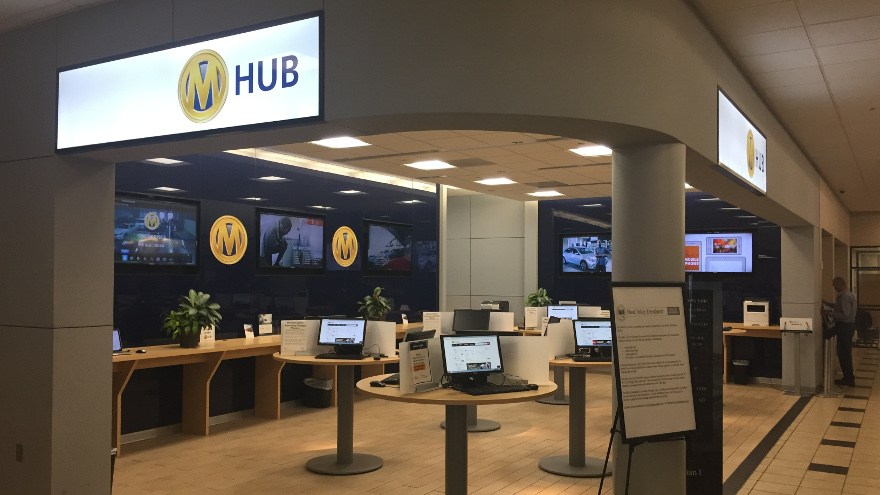
When you walk in the door at the auction, to the front left is a bank of computers known as a “Hub.”
A “hotbed” on sale day, Hill said these computer stations allow dealers to complete tasks they would have otherwise had to stand in line at the front desk to complete.
Things like making payments, printing gate passes or ordering ancillary services post-sale inspection — dealers can take care of these tasks on their own at the bank of computers.
“They can immediately come in here, and do what they need to do and get out of here,” Hill said in a late-September interview at the College Park, Ga., auction.
With the auction being what’s known as an “enhanced location,” the line at the administrative desk is reduced, because so many more clients are doing some of the admin type tasks on their own.
“They never had this conduit into our system by which to get information out. They always depended on us via phone call, via standing in an arduous line,” Hill said. “We don’t want you to leave here, but we know you’ve got a business to run or a family to see or both.”
Another piece of efficiency you might notice at Manheim Atlanta is what’s known as Lean Daily Management. It’s a concept founded by Toyota as a manufacturing improvement, but adopted by other business sectors, including the likes of the New England Patriots.
And starting last year, Manheim began rolling it out to its locations.
“As we were looking at new technologies for driving efficiencies for our clients throughout the auction locations, we also, at the same time, realized it’s not just the technology,” said Grace Huang, president of Cox Automotive Inventory Solutions, in an interview at Manheim Atlanta.
“Technology in and of itself is great, but you have to have the processes and the foundational pieces to underpin it, to really maximize technology and technology investments to really bring it to life for our clients.”
Manheim had a team look into how the LDM concept could be incorporated into auctions, “and we followed the same tenets about measurement and metrics, and looking at each of the processes, working together collaboratively across departments to identify potential road blocks,” Huang said.
In a conference room at the auction, there is a whiteboard — known as a “measurement board” — that shows each individual department displayed horizontally, with various metrics (including safety, quality, delivery, cost and engagement) displayed vertically.
Each square has a score, highlighted in green for metric goals that were reached and red for those that were not reached.
Each department has a 10-minute standup meeting for to discuss their own metric and the auction as a whole has a “set the standards meeting” where all departments meet to discuss roadblocks and pitch project that can solve the “rocks” that might be hindering the system.
“It has brought all the departments together in a much more collaborative fashion,” Huang said.
And it has fostered an approach to thinking of the auction as one system, rather than silos.
Opening day in Chicago: ADESA builds on safety & tech
In March, I had the chance to check out the new digs of ADESA Chicago during its grand opening event
On the left side of the arena (from the entrance) were doors to the outside that can be opened and closed as necessary.
Exhaust fans were there to keep the air fresh even if the doors were shut. These doors fed into the auction lanes.
At the opposite end were gateways to a space that were still under the roof of the facility, but fed out to the back of the facility.
From entry-to-exit, the vehicle essentially would travel in a backward J route. This is designed to avoid the “wind-tunnel effect,” said Kurt Madvig, ADESA’s vice president of auction operations, during the on-site interview in March.
In the lanes themselves, near the blocks were digital displays with lights, announcements and other bits of information. The point, Madvig said, was to make sure that the dealer in the lane — whether he or she is tech-savvy or not — has the same easy access to information to the person bidding online, simply by looking at the screens.
“It helps transition from the old paper days to digital,” Madvig said.
Yellow pylons line the lanes, designed for safety. These steel tubes were filled with concrete, with plastic outer covers and went four feet into the ground, Madvig said.
Should a car go off course, this helps to keep it contained within the lane.
Another unique part of the facilities: the cafeteria and Internet center were smack dab in the middle of the arena, allowing the dealer to “feel like this is the only place they need to be” during the sale, Madvig said.
The bright teal floors consisted of an epoxy surface with grit, which were designed to make them anti-slip with all the weather Chicagoland can get, be it rain, snow or ice.
Speaking of weather, the exterior is prepared for weather: besides the area out front, the entire facility utilizes rolled concrete instead of asphalt.
ADESA Chicago employees were equipped with mobile printers, vehicle stickers with bar codes and folks using mobile phone apps to conduct business. All of this with the intention of making the customer’s day quicker and more efficient at the auction.
The future?
So what does the design of an auction look like years from now? Perhaps Bob Wolfsen’s Auto Auction In The Round concept — which has earned a patent from the United States government — gives us a hint.
Walk into most auto auctions today and the arena where the sales happen has a familiar appearance: rectangular with long lanes that extend from one side to the other.
Wolfsen’s design shakes that up, making the arena — as the name would imply — round.
Each selling arena in Wolfsen’s design is a circular pod that includes anywhere from eight to 12 lanes, he said in an interview with Auto Remarketing earlier this year.
The vehicles enter and exit behind each auction block. They come into the pod and go around to the front of the block, going 180 degrees before exiting out behind the block.
To get to the pods, attendees can walk from the office down a “tube” hallway and then select one of the pods to enter, he explained.
The patent was approved on March 23, Auto Auction In The Round is now operational, and the official patent number is 9,691,100.
Wolfsen, whose company is based Chandler, Ariz., is the transportation manager at Metro Auto Auction in Phoenix.
Asked what prompted the idea, he said: “It started when I helped put another auction together here in Phoenix — Dealers (Auto Auction of the Southwest),” he said.
Wolfsen and the team there shaped the auction blocks into a V-shape, he said, “so that the dealers could see all the cars at all the blocks from any position.
“I wish I could take credit for that but I can’t,” he said. “But it started me thinking about, ‘How do I close the V to make a circular pattern?’”
But closing the V would result in bunched-up traffic, he said: “It would be six lanes feeding into a three-lane area. So that’s when I started thinking about the circle, and coming in from the outside of the circle, around the front of the blocks, and then back out behind the block.
“And I actually laid it out over there — this was, gosh, almost 14 years ago now — in paper and drawing it out on the floor. It was an empty building. It made sense. So that started the thought process”
The design was based on what dealers had told him over the years.
“And it boils down to, ‘I missed some opportunities. I wish I had the ability to be in that other lane at a point because I really needed that car,’” Wolfsen said. “I hear this more and more. I hear it every week here. On the seller’s side, (they’re) never happy with the lanes. ‘Oh it’s too far away from the door. It’s too close to the end of the building.’
“There’s always a reason. And the third item is that, ‘I’m not happy with my numbers. I want to run in prime time and I want to run in the meat of the sale, and I want to run in 30 to 60,’ or whatever that might be,” he continued. “This addresses all those issues, where the buyer will be in a position where he can bid on any car that comes through the building.
“That’s unheard of in this industry. Where the seller can (choose to) not be concerned about lane preference, because it doesn’t matter anymore. Every car has the same exposure, availability.”
Just one of many ways auction folks are thinking differently.